Building Bridges Down the Bourbon Trail
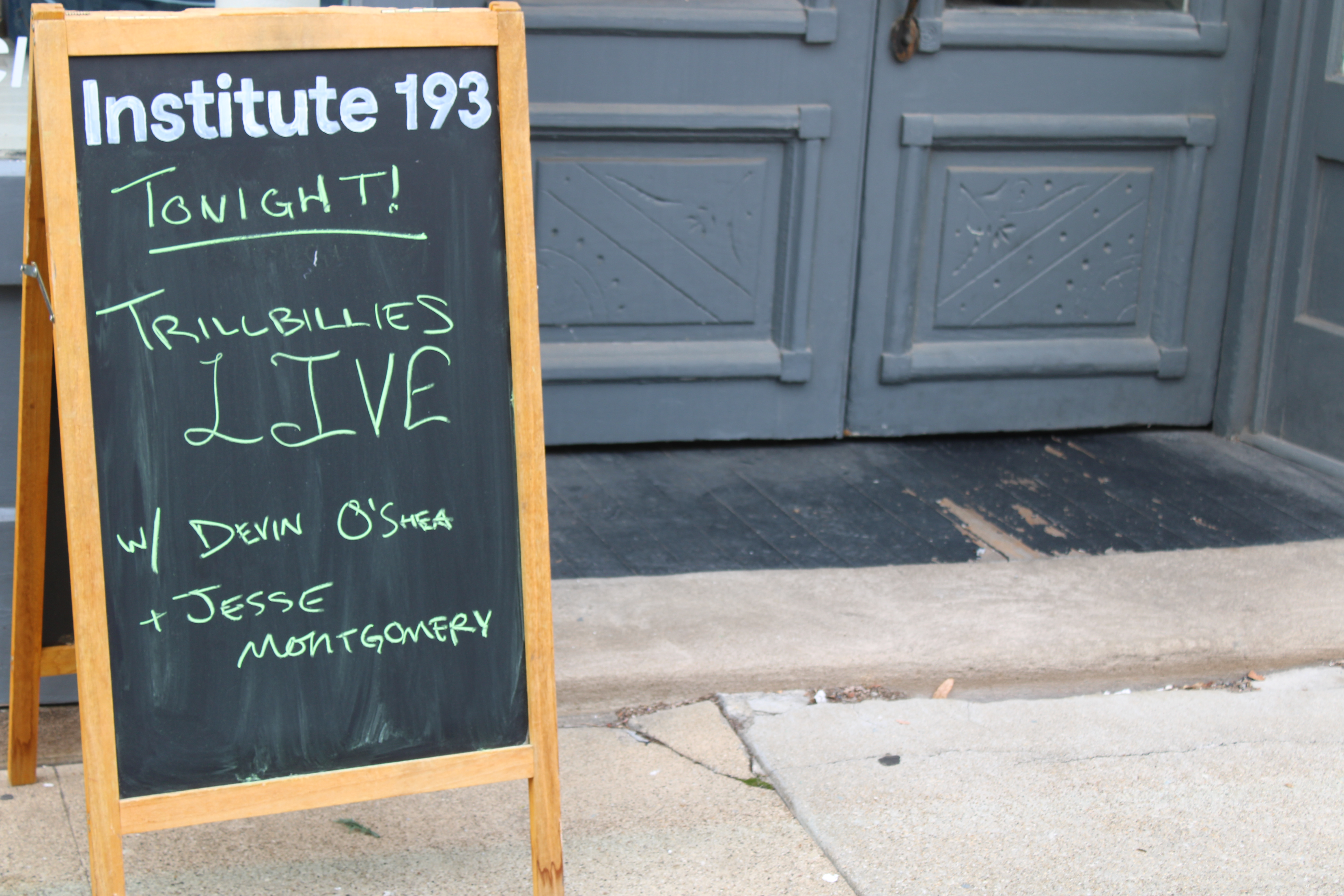
On a hot and humid mid-August day, a friend and I got in my car for the near seven hundred mile round trip down Interstate 64 from St. Louis to Lexington and back, which we completed in around 36 hours. After arriving in the city, we still had time to get dinner at a popular BBQ restaurant and walk around a neighborhood of Lexington’s downtown, admiring the proliferation of public art, including numerous murals, adorning the street corners. We were not simply seeking sights, however. Institute 193 was hosting an event that evening in their shotgun storefront turned art gallery, and this was the ultimate purpose of the trip. The sold out performance was seated comfortably with rows of folding chairs divided by a center walkway. The show was graced with the appearance, in the audience, of a noted “violence gang” member, the Queeber himself, Bryan Quinby.
The attendees came out to see The Trillbillies Workers Party’s first live show in many years. Terrence Ray and Tom Sexton, stars of the almost decade-old podcast, were joined by two guests to speak about their recent books: Jesse Montgomery and St. Louis’s own Devin Thomas O Shea.
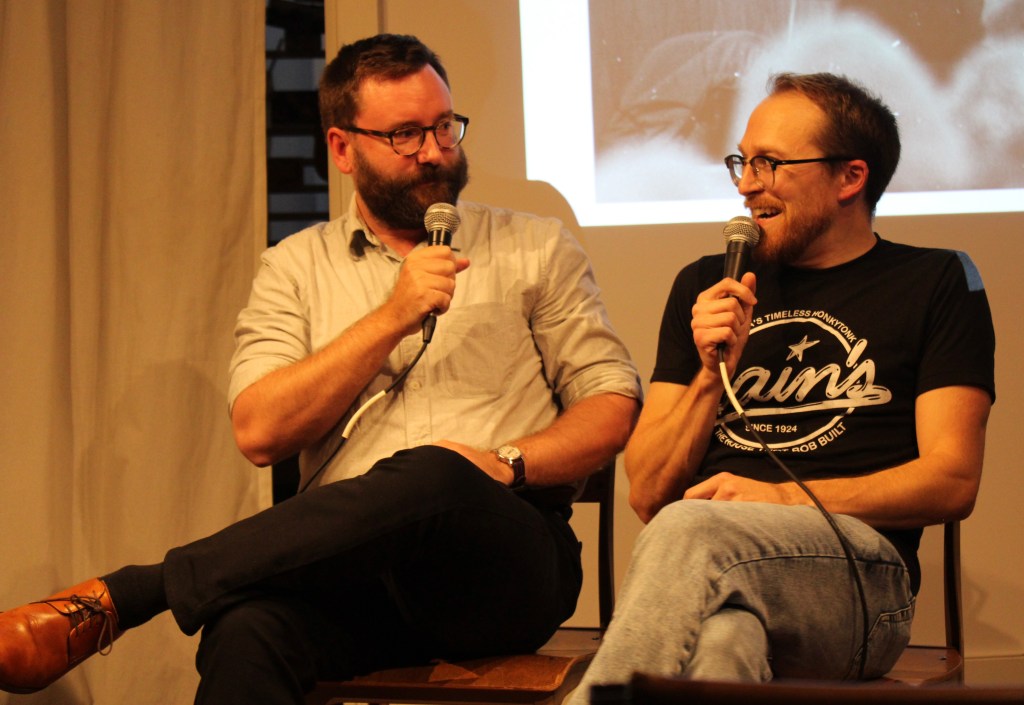
They began the night with ‘Speak Your Piece’, a regular segment on their podcast, wherein the hosts read aloud the opinions from the namesake article of The Mountain Eagle, a long-running newspaper from Kentucky. Tom read from the print as Terrence provided a musical accompaniment. They then shifted to a more serious subject, noting the amount of time elapsed since their last live performance, and began to go over active shooter protocols for the evening. While admitting that the chances of an active shooter being present or entering the space was highly unlikely, they chose to err on the side of caution and outline the roles that we each may choose to play in such a terrible scenario.
Tom volunteered first, raising his hand and declaring, “I’m on Team Opossum!”, alluding to the fact that if someone started shooting, he would freeze up and play dead. Next, there would need to be Human Shields. A surprising number of people were all too eager for this position, which is fortunate, because that will be the role most people take, regardless of their desires. Finally, there would need to be the Hero, and one brave soul quickly said that they would do it. One must imagine this individual then hoped this thought exercise might play out in real life for the rest of the night.
Moving on, the boys lamented the removal of a mural in Lexington of musical artist Jelly Roll. After admitting that murals are usually made for martyrs, they came up with some ideas on how to replace it. The options were between Turning Point USA’s Charlie Kirk, former United Health CEO Brian Thompson, and the Ocean Gate Five, who died when their submersible craft imploded while attempting to explore the sunken remains of the Titanic. In what may as well be a bellwether for modern American society as a whole, the crowd voted overwhelmingly for Brian Thompson. Luigi isn’t dead yet.
The first guest of the evening was Jesse Montgomery, who came out to discuss his book, It Is Not Enough to Survive: The Young Patriots Party, published by The University of North Carolina Press on May 26th of this year. The YPP was a white radical group consisting of disillusioned workers who moved to Chicago from the Appalachian and Southern states, drawn by industrial jobs. They were founding members of the Rainbow Coalition, formed by Fred Hampton, Chairman of the Illinois Black Panther Party in 1969. The discussion covered insights from the book, including how the group would go about organizing in country music bars, along with how they attempted to, but later abandoned, wearing Confederate flag patches on their vests beside ones that read, “Free Huey”.
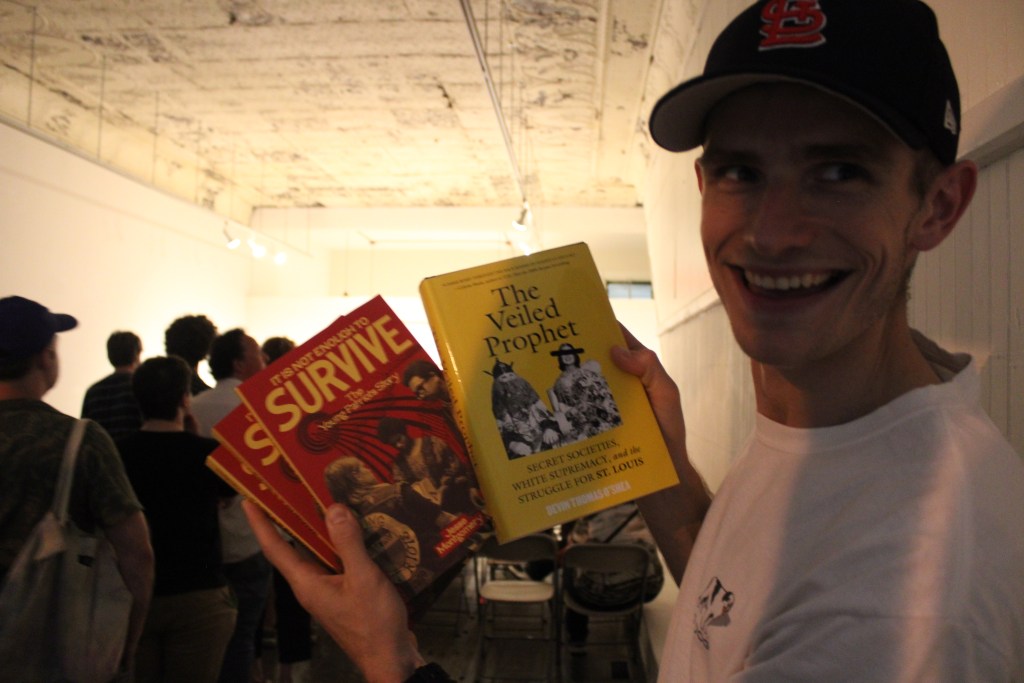
Devin Thomas O’Shea was introduced next to speak about his newest book, The Veiled Prophet: Secret Societies, White Supremacy, and the Struggle for Saint Louis, released by Haymarket Books on June 23rd. Most St. Louisans have some conception of what the Veiled Prophet is; be it from attending the VP Fair, or more recently, the revelation that The Office star, Ellie Kemper, was once crowned as the Queen of Love and Beauty at the annual debutante ball for the elite secret society. O’Shea’s book intricately details the history of this organization, from its origins as a reaction to the multi-racial coalition which resulted in the 1877 Railroad Strike and Saint Louis Commune, through local activist, Percy Green, who scaled the side of the then uncompleted Saint Louis Arch, and the work of the group ACTION, which he helped form in the 60s. In fact, ACTION had one of the most dramatic moments in The Veiled Prophet’s history, when civil rights activist Gena Scott unmasked the Prophet during the 1972 ball, revealing him to be none other than Tom K. Smith, the then President of the Monsanto Corporation.
Terrence ended the evening with an interesting and intriguing expose of a lesser god known well around Saint Louis: the Billiken, God of Things as They Ought to Be. Rather than actually being a generations-old Inuit ivory carving tradition, as was once believed, they were in fact created in 1908 by an art teacher named Miss Florence Pretz, from Kansas City, after she saw one in a dream. She sold her patent later that year for $30 to a company out of Chicago, and the Billiken became one of the very first mass-produced dolls. Much like the later crazes of Trolls and Beanie Babies, a bubble formed, popped, and the market for the product eventually disappeared.
Saint Louis University adopted the Billiken as its mascot in 1911, after a football coach was said to resemble one. Apparently, one must “tickle the toes once every ten minutes and watch it smile”. As Tom pointed out, “Muslims pray a few times a day, Christians on Christmas and Easter; But that just seems a little too involved!”
Early in the evening, the hosts asked how many people in the crowd lived in Lexington. Shockingly, the response was less than twenty people. Like myself, many people traveled long distances to listen to a discussion on multi-racial class solidarity. In a world that is so disconnected from physical human experience as ours, an event like this can remind one what it feels like to believe in things the way they ought to be.