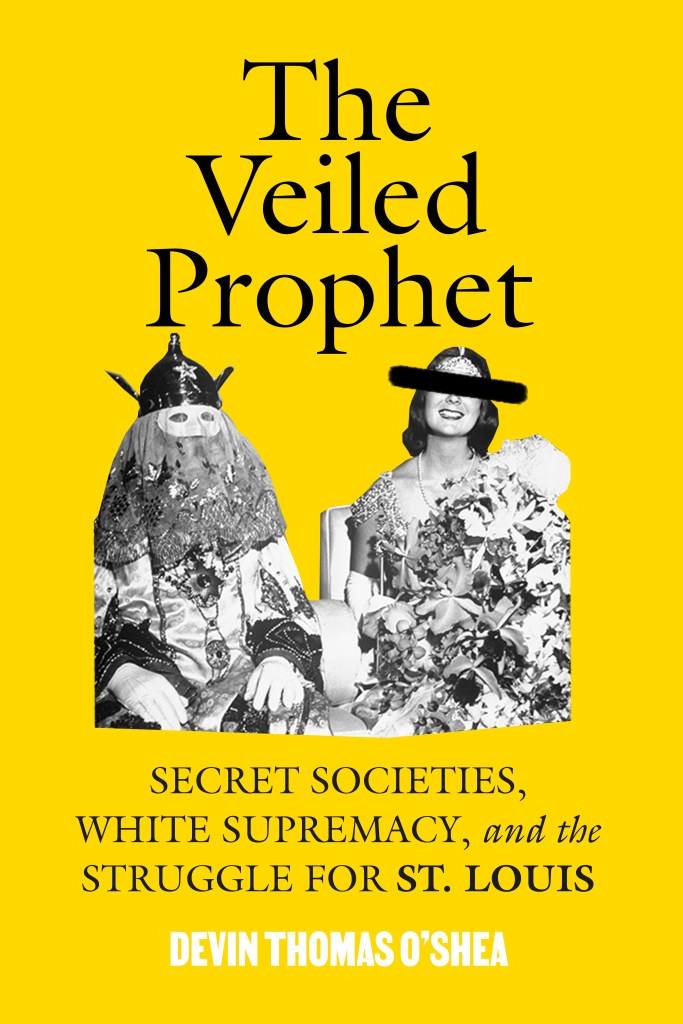
Reckoning With Open Secrets and Forgotten Ghosts: The Veiled Prophet: Secret Societies, White Supremacy and the Struggle for St. Louis
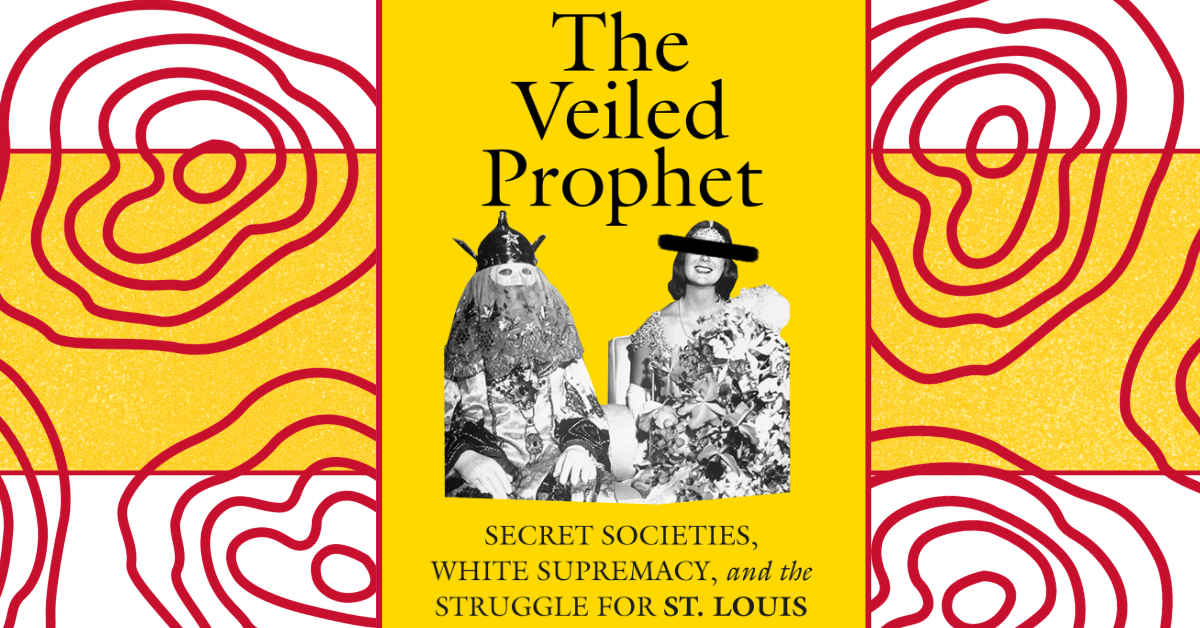
Any St. Louisan who intently reads The Veiled Prophet: Secret Societies, White Supremacy and the Struggle for St. Louis by Devin Thomas O’Shea may end up nodding their head a lot in its early pages. Shady white supremacists more interested in making their own fortunes than in the long-term impacts of their actions overtake the civic power structure of the Mound City. They create a political project that enjoins big business, high society, major universities, and the rising upper middle class in opposition to the claims of Black people and common laborers alike on the wheels of power. The police department is all too happy to aid and abet the power structure, often by turning blind eyes toward extrajudicial acts of violence against protestors. They preside over a network that rewards their hold but ultimately depletes the city of cultural vitality, diversity, and national position.
The same reader, though, may be puzzled in later pages, where members of the openly-secret Veiled Prophet Organization impact US imperialism through the development of planes, chemicals, and arms. One member even helps create the Central Intelligence Agency and serves as a member of a president’s Cabinet. The St. Louis power elite are central to assassination schemes, the Fortune 500 rankings, world wars, presidential politics, and mass propaganda concealing the workings of the US empire. This seems like a far cry from today’s St. Louis, where a hollowed-out elite are more preoccupied with ensuring their suburban hamlets are never merged and elected leaders are more worried about Facebook rumors of their data center collusion than how to manipulate the levers of US foreign policy.
O’Shea’s Veiled Prophet offers a refreshing new account of St. Louis’ infamous secret club, because the book simultaneously indicts the Veiled Prophet organization’s impact on St. Louis and the world, while reflecting on the linked decline of the organization’s clout and the fortunes of its home city. Like Walter Johnson’s The Broken Heart of America (2020), The Veiled Prophet offers a mostly-chronological and comprehensive history of its subject. The pair of books provides a compendium of must-know histories of oppression, white supremacy, and oppositional radical activism. Each offers candid views of subjects often rationalized or marginalized by prior moderate and conservative historians.
For readers who may know a bit about the Veiled Prophet history – including those who read Thomas Spencer’s excellent The St. Louis Veiled Prophet Celebration: Power on Parade, 1877-1995 (2000) – O’Shea provides fresh contextual framing. One of the recurring themes that The Veiled Prophet ponders is the relationship between the origins of the order and white supremacy as a project of American imperialism. O’Shea attends closely to the text of Thomas Moore’s Lalla Rookh (1817), in which the mythical land of Khorassan and the figure of the Veiled Prophet originate. The pro-Confederacy racist brothers Alonzo and Charles Slayback appropriated Moore’s tale first in New Orleans circles that included Ku Klux Klansman. In 1878, they brought their dream of an elitist secret society to St. Louis, right when the elites were terrified of the organized capture of the city that the Marxist Workingmen’s Party and the Knights of Labor had accomplished during the 1877 general strike.
Moore’s text provided an orientalist fantasy of a Middle East where natives are unruly and superstitious, and noble outsiders must seize in order to preserve the virtues of female beauty and moral order. The Veiled Prophet is a trickster, not a savior – a proxy that combined the admixture of superior social status and embrace of raw violence that St. Louis leaders would deploy to suppress popular movements for decades. The tropes of Lalla Rookh provided both the pretext for the racial othering of Black St. Louisans (and immigrant trade unionists, especially European leftists) as well as a larger myth in which Veiled Prophet members could view their Americanness. From the violent and murderous assault on striking streetcar workers carried out directly by wealthy business leaders in 1900 to Veiled Prophet members Clark Clifford and Tom Dooley’s participation in propaganda justifying the US assault on Vietnam, Lalla Rookh gives horrid acts moral cover while also allowing respectable men to play the devil himself.
O’Shea situates St. Louis in the middle of Cold War imperialism, showing that the connections made inside of the Veiled Prophet order fostered a key role for St. Louis in refining uranium to usher in the age of nuclear war, developing military aircraft, testing radioactive sprays for fallout tests (including at the Pruitt-Igoe housing development), and building up psychological operations on the American people. What grounds this possible long reach is O’Shea’s attention to the rather unimpressive stories of the elites back in the St. Louis club rooms. Investors and lawyers seized on opportunities to make money and climb into national power circles with the same bland calculus as they bought each other’s companies and used connections to each other’s families to get into elite universities. The mundanity of imperialist St. Louis comes across as beyond creepy, if true to the Veiled Prophet’s mythic role as destroyer.
Sometimes O’Shea’s drive for a comprehensive history keeps him from pausing long enough to really draw out the inner workings of the secret order, but there are some perfectly presented tales of how things worked. One is the apprenticeship of “Dr. America” Tom Dooley’s grandfather to railcar magnate William K. Bixby, in which the elder Dooley was able to use his position as an executive assistant to climb the class ladder. The Dooleys were able to gain admission to the Veiled Prophet but still were unable to enter the same country clubs as Bixby and the old money. This binding of members across class positions – while maintaining distinctions in other institutions – helped propagate support for the Veiled Prophet way rather than generate dissent.
Another intimate view of the order is the case of John Sutherland, the patent attorney who offered a cash prize for anyone who would assassinate Dr. Martin Luther King, Jr. While definitive proof of Sutherland’s funds reaching the pockets of petty criminal and white supremacist James Earl Ray remains elusive, O’Shea shows how the plausible deniability of the esteemed Sutherland allowed him to operate in lower-class, seedier white supremacist circles. Ray’s family owned the modest south side bar called The Grapevine, where openly bigoted supporters of George Wallace’s American Independent Party congregated. Sutherland was a quiet lawyer whose views were tolerated in the tony Clayton law firm where he worked, and a man who joined the highest-status St. Louis elites at the Veiled Prophet ball. O’Shea avoids outright conspiracy theories and sticks to evidence, but one can almost see the X Files’ Cigarette Smoking Man in the scenes around King’s terrible assassination.
Since this is a book about the Veiled Prophet order itself, there are few heroes in the pages. O’Shea does give us glimpses into those who wrestled with the Veiled Prophet order’s secrecy and role in local corruption: newspaper editors John Cockerill (who shot Alonzo Slayback) and Joseph Pulitzer, prosecutor Joe Folk, journalist William Marion Reedy, labor leader William Sentner, activist Percy Green, and many union and civil rights activists. O’Shea reminds us that—contrary to the continuous respectability-washing of the society by local politicians and journalists—labor leaders and Black St. Louisans understood and contested the racist symbolism and concentrated power of the organization from the start. Of course, the famous story of ACTION activist Gena Scott’s unveiling of Veiled Prophet Tom K. Smith in 1972 is presented, with the chilling observation that the St. Louis media to this day has never revealed the many photographs taken that day of Smith without his veil.
The Veiled Prophet resonates as a full account of St. Louis’ most enduring project of racial and capitalist power was able to capture a major metropolitan area’s economic, governmental, and institutional power for over a century. O’Shea ends by tying the organization’s impact to the regional fractures that compelled the 2014 Ferguson uprising. As with the 1877 general strike that starts the action, the uprisings and the maneuvers of powerbrokers are superstructural effects of economic power. That is, these are visible events and social forms emanating from the broken root relations in which too few hold too much of St. Louis’ wealth.
While the Veiled Prophet Organization may be both unmasked and deflated these days, it was always an instrument of white supremacist, anti-labor power – not the source of the power itself. While St. Louis is not the economic giant it was at the apex of the Veiled Prophet Organization’s influence, concentrated wealth and power have not gone away. O’Shea provides a powerful historic view of one project that organized domination by that wealth and power. Readers may come away being alert to the new forms at play in their city today.