
Today Wasn’t The Day
Click here for information on how to donate to relief efforts.
I wanted to write this while everything was still fresh in my mind. I promised myself I would try not to write things that would probably better serve as blog entries, but today wasn’t the day.
Woke up a bit before 6 AM, the usual time I wake up. I got a text while I was sleeping. Meet at 10, Fountain Park. Neighborhood cleanup. My first reaction was annoyance, which was quickly replaced by resignation and a sense of needing to fulfill a responsibility. The same kind of reaction I would have if I was being asked a favor by a friend or parent. My spouse and I had the normal morning conversation, where we create a sketch of how the day might play out. We rolled out of bed, and attended to the normal morning chores. Did our workouts, dressed for the work, and naively told each other that we would manage a couple of hours before we split to spend the rest of the day on ourselves. But today wasn’t the day.
We entered the tornado’s path through Forest Park, working our way from the Hampton zoo entrance to Lindell in the Central West End. North on Kingshighway. Not north on Kingshighway, the avenue is blocked. Highway patrol cars across the northbound side. Three patrolmen were standing in the street, decidedly not directing traffic under the nonfunctioning lights. We weave slowly through the crosshatch of streets, on and off Euclid, around downed trees. The destruction is striking already, but my reaction is tempered by the knowledge that well-off Central West End residents will easily survive their inconvenience.


Photos by Richard Reilly
The Delmar Divide
It’s no secret among St. Louis residents that there exists a sharp demarcation, like it was cut with a knife, where Kingshighway crosses Delmar. One side has landlords, trendy restaurants, bars, boutique shops, and art galleries. The other side has poverty and rentals, a still-extant reminder of redlining and the racism that sticks to the skin of the city and nation.
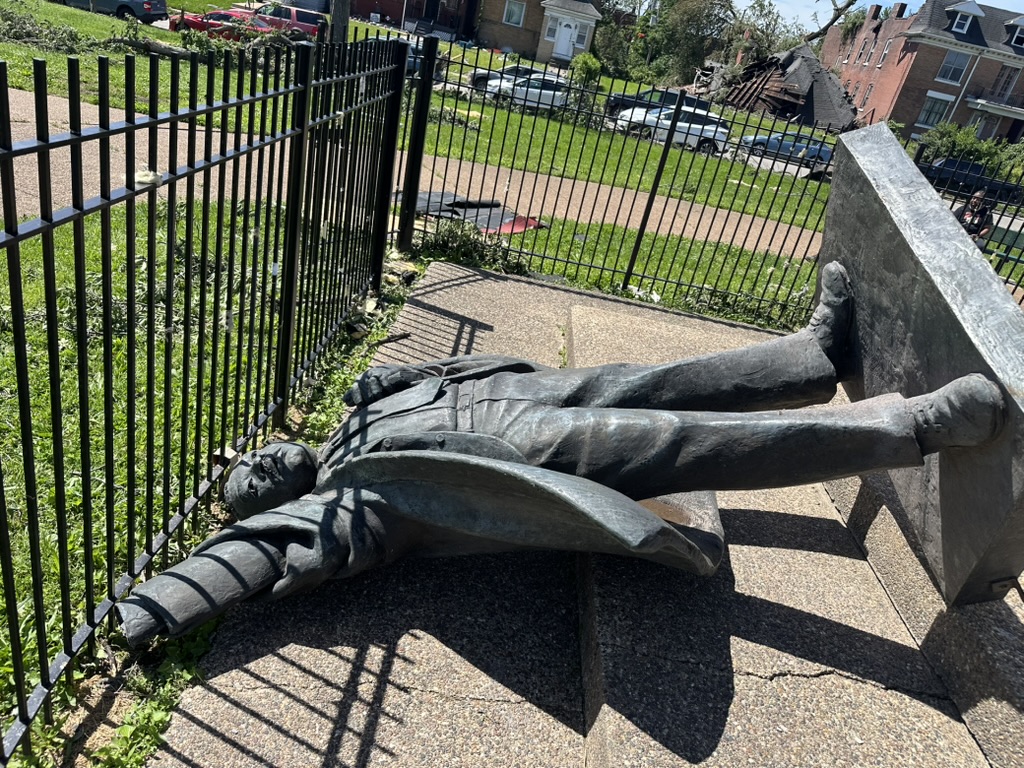
The neighborhoods are destroyed. There isn’t another way to describe it. These decades of stacking the poor on top of each other and abandoning sections of the city to the rent-seeking class have borne their fruit. The already unsound structures have shed their roofs and brick carapaces to expose their interiors. Windows have exploded out into their attendant yards. Black tar and fiberglass sheets lie everywhere.
The roads are blocked by hundred-year-old elms and oaks. We navigate our way around them and park near the makeshift pavilion where the local Party for Socialism and Liberation has erected the day’s volunteer hub. We unload the tools, shovels, and brooms we brought with us.
I should mention that not a single city employee or representative was present in the neighborhood. All day. Two flak-jacketed cops walked by while I was busy with some other Samaritans helping clean the gangways between houses, offering help to no one. If I had any courage, I’d have shouted at them to pick up a broom and get to work. But today wasn’t the day.
About three hours later, while helping some tenants put up plastic sheeting and boards over shattered windows, I saw about eight or ten Forestry Department guys avail themselves of some mutual aid food and clear a downed branch at Kingshighway and Fountain. The city workers left a massive oak blocking Cates near the tornado-defrocked Wayland AME Church.
I’ll spare you any more over-prosaic descriptions, but suffice it to say in the short six hours I was there, I saw the volunteers work small miracles for the people of the neighborhood. But still, we were all left with an empty feeling that there was just not enough to give in the presence of so much desperate need. I didn’t take enough photos because there was simply too much to be done.
If there had been no storm, there would still have been incredible, immense need. Years of neglect and desertion just festering there, as if they were waiting for a storm to come and rip off a scab and reveal the wound on the city’s human population.
Eventually, my spouse and I were exhausted by the day’s work and said our goodbyes. Leaving those people behind to drive through one of the city’s most conspicuously affluent neighborhoods was a stark experience. We wound back through the streets, and managed our way down construction-mangled Kingshighway Boulevard. As we turned right onto Interstate 44, we passed a payday loan establishment and I swear to you I have never wanted to destroy an entire predatory industry more than I wanted to at that moment. But I was exhausted, and, again, today wasn’t the day.


Photos by John Hancock, Emily Bryant, and Colleen Brennan
Note from the editor: We are seeking stories from directly impacted St. Louisans. As the long recovery continues, we invite readers to share their insights from the process. Story submissions can be sent to editorial@moundcitymessenger.com.


