
The Dwindling Popularity Of Serving On The Democratic Central Committee

Author’s Note: Author has previously served as a Democratic Committeewoman.
In August of this year, fewer Democrats ran to be on the Democratic Central Committee than in previous years. Being a Central Committee member was a sought-after role, so why does this appear to be changing? Let’s look at some factors that may affect the interest in being a city committeeperson.
A Little Background
Every four years, in the primary election directly before the gubernatorial election, Democrats* elect a committeeman and committeewoman from each ward or township to comprise the Democratic Central Committee (DCC). Committeepersons are the local arm of their political party. Members sit on the DCC and are also members of their respective legislative, senate, and congressional district committees. These other committees rarely meet; in my four years, we only met to reorganize (elect officers). The real power that these committees have is to name the Democratic candidate in the case of a vacancy. The most visible action of DCC members is usually running a ward organization – a ward-level Democratic club. If you want to know more about the Missouri Democratic Party structure, you can read about it here.
*Central Committee members are elected for the Republican, Democratic, Libertarian, and Green political parties, but this will focus on the City Democratic and Republican Central Committees.
What Does the Data Say?
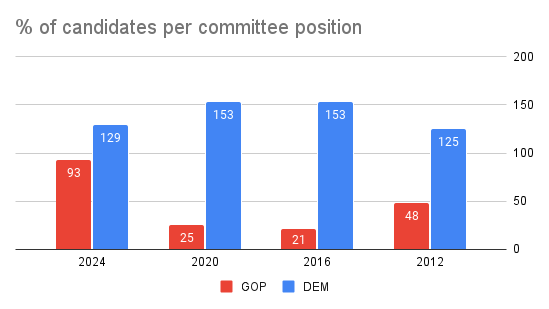
All data from the St. Louis City Board of Election Commissioners
In the chart above, I’ve compensated for ward reduction by breaking down the candidate numbers by percentages. The Republicans had many more candidates than they did in previous cycles, fielding 26 candidates for 28 positions (93% full) compared to 2012, when the GOP had 27 candidates for 56 positions (48%).
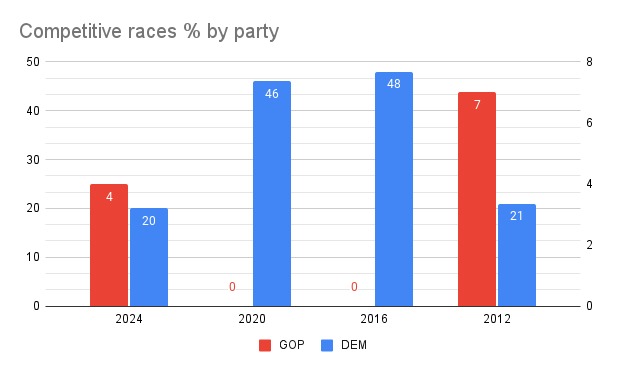
Next, let’s look at how many of these committee races were competitive (with more than one candidate per position). In 2024, we saw about half the number of competitive Democratic races. Still, it’s the opposite for the Republican committee, but looks can be deceiving as this data only represents a single competitive race compared to none in the last two cycles. The number of competitive races indicates a couple of things: the first is that more people want to be involved, and the second shows more active recruiting of candidates by those already active in the party.
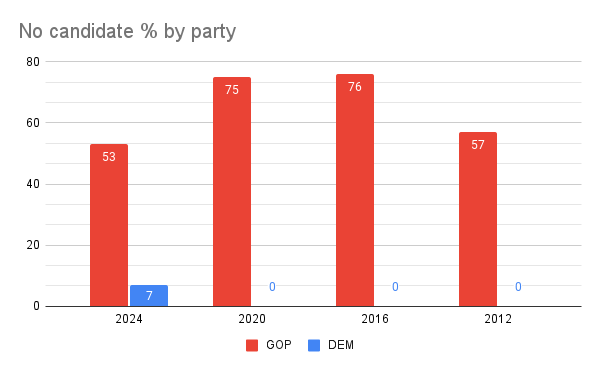
Another interesting metric to review is how many committee positions didn’t have a candidate file. In 2024, there were two Democratic committee roles (7%) without a candidate filed. Looking back, there’s been a Democratic candidate in every committee race since 2004. While these two seats were ultimately filled with write-in candidates, it indicates a potential lack of organization among the city’s Democratic Party activists.
What Is the Job of a Committeeperson?
Officially, as a committeeperson, you’re an organizer at the most local level of your political party. A state statute provides, “Each party committee shall be selected as provided in this subchapter to represent and act for the party in the interim between party conventions.” In action, it’s primarily up to the individual committeeperson, as well as the chairperson and state party leadership. For many candidates, running for committeeperson is the first political rung on the latter. Many past committeepersons have gone on to higher office either as an alderperson, in some other citywide office, or as an elected position in Jefferson City.
Unfortunately, this personal ambition interferes with the committee’s work. I agree with several committee members that the committee’s leadership was more focused on advancing their political careers than establishing a quality St. Louis City Democrats platform, helping to elect local Democrats, planning voter outreach and engagement, or even planning meetings.
Former committeeman Sisul had this to say: “there was an unexpected amount of public warnings from [the committee] leadership against committeepeople engaging in political activities outside their own wards. I had naively expected more cooperation between [committee] members. I agreed to this position, hoping to learn from many of the more experienced committeepersons and intending to broaden my understanding of City government. I sometimes found barriers to such a pursuit because of this unwritten rule. Fortunately, I did find, more often than not, people willing to collaborate. And several different ward organizations held joint events, such as debates and similar forums.”
Filling Vacancies
Before November 2020, the Central Committee had named several Democratic candidates to fill vacancies. However, the vulnerability of the Central Committee’s power started to show back in 2018 when the DCC named Paul Fehler as the Democratic Alder candidate in Ward 8. Still, then Annie Rice ran as an Independent and won despite the DCC endorsement of Fehler. In recent years, we didn’t have any vacancies for partisan races. This may be another factor in waning interest in the recent committeeperson contests.
Proposition D Changes Committee Powers
There is no doubt about it – the much more significant upheaval to the electoral process came in November 2020 when Prop D changed the election process so that some city offices would be non-partisan and be determined by approval voting. This meant that when we had several Aldermanic vacancies and a vacancy for the President of the Board in 2021, the DCC no longer had the power to name the Democratic nominee for any of those particular seats. Prop D has been a constant topic of conversation at DCC meetings since it was introduced, as there was much discussion about a formal vote to oppose it before the November 2020 election, but an endorsement vote was never taken. Prop D ultimately passed comfortably, with 68% of city voters supporting the ballot measure. After passage, it continued to monopolize committee meetings. The committee grappled with the loss of power and money – as nonpartisan elections meant the loss of filing fees traditionally given to political parties.

This loss of income translated into an increased focus on fundraising. Matt Sisul, a former committeeman from the 24th Ward, was put off by focusing on fundraising, rather than grassroots organizing. “I was surprised by the amount of time and effort spent on fundraising topics. From hiring an expensive fundraising coordinator (who didn’t really raise any money for [the committee] as far as I’m aware) to constantly discussing lost revenue (as a result of Prop D, nonpartisan primary system)…this conversation dominated nearly every general meeting,” stated Sisul. He went on to say, “I fully understand that fundraising plays a significant role in election results. But, I also believe Democrats have a good reputation for running quality grassroots campaigns. I had expected more time to be spent on debating which candidates and policies to support…rather than questioning how much money DSCC would get from them.”
A New Chapter
After the committee elections on August 6, 2024, the new, smaller, 28-member committee has been busy coordinating GOTV efforts and organizing ahead of the November election. Time will tell if a smaller committee injected with the energy of 10 new committee members will make serving on the St. Louis City Democratic Central Committee something sought after once again.


