
Charlie Gitto’s and the Garage Ramp: Keep Downtown as Weird as Possible
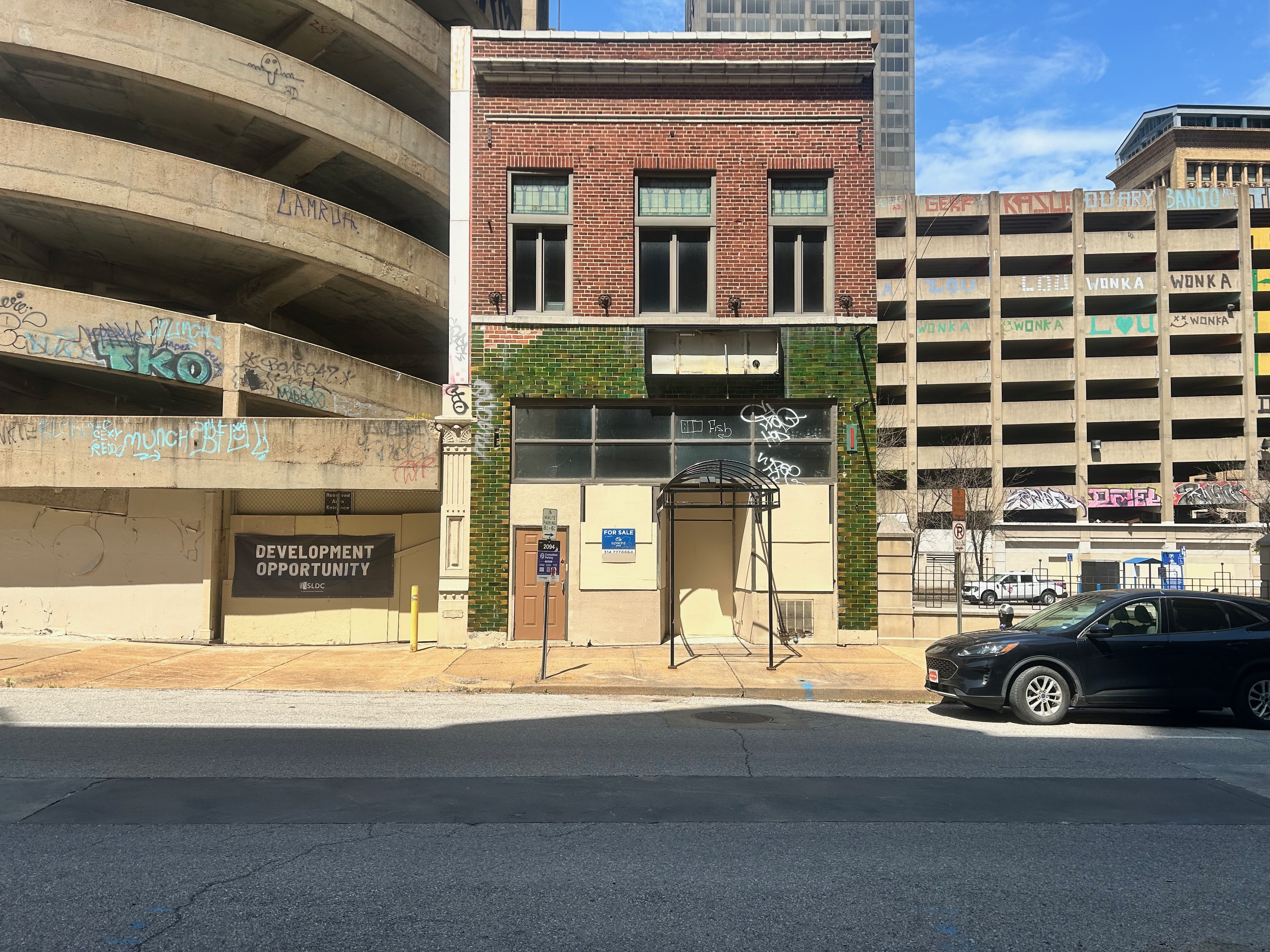
On a recent trip back to St. Louis, I headed to see the Railway Exchange Building. Tales of its wide-open expanses full of constant illicit activity, informal dwelling, and urban exploration were dashed as I saw that the building was closed up with the breathable metal panel system prevalent in Chicago and other cities but rarely seen in St. Louis. The building sat quiet on a Sunday morning, so I strolled adjacent blocks.
I absorbed the trap in which this part of downtown finds itself: a set of monolithic buildings that repeat drab colors, boring designs, and flat expanses of building along the sidewalk. There are some exceptions, but from the Kiener Plaza garages to the back side of One Metropolitan Square to parts of the old St. Louis Centre, the Railway Exchange Building is hemmed in by a built environment best traversed as quickly as possible en route to either the greenery of Kiener Plaza and the Arch grounds or the more inviting urbanism around the Old Post Office or Washington Avenue.
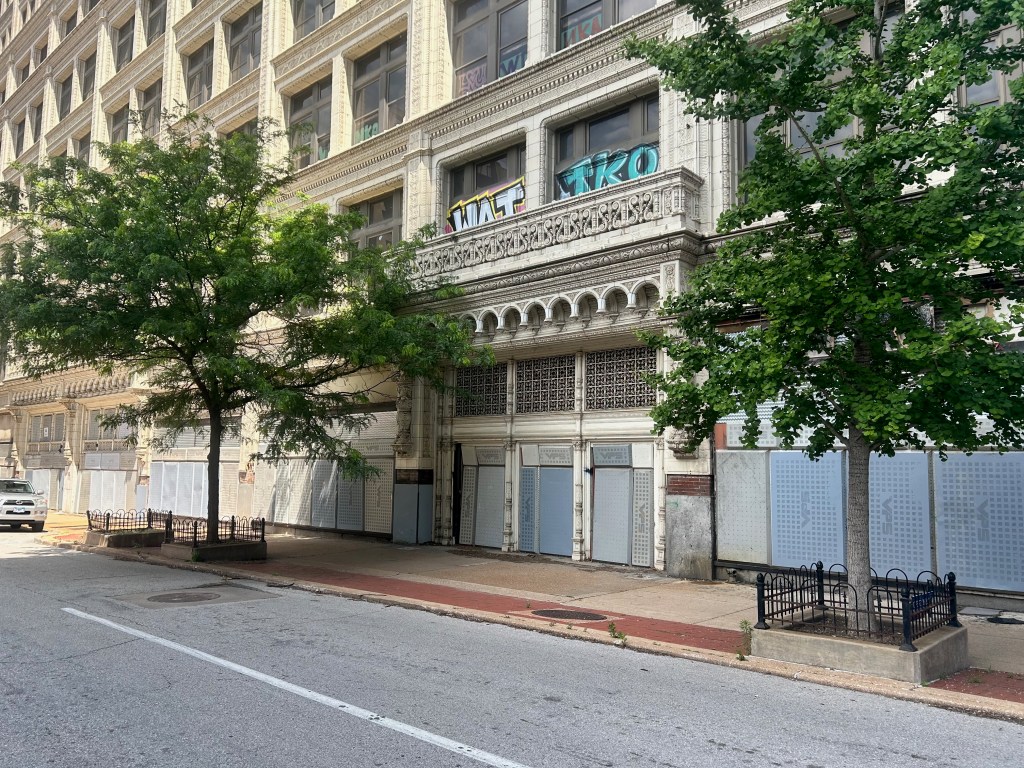
There are three exceptions, all on the block south of the Railway Exchange Building dominated by the wreck of the formerly-attached Famous-Barr (later Macy’s) parking garage. One is the diminutive Viennese Secessionist-inspired Gill Building at 7th and Olive streets, built in 1910 from a design by local architect and builder Moritz Eyssel. Another is the simple two-story brick vernacular commercial building at 207 N. 6th Street, once housing Charlie Gitto’s Restaurant, built around 1909. The final form is the raw concrete ramp of the garage itself, finished in 1962.
This preservationist will make no argument for preserving the old Famous-Barr garage in its entirety, although the historic record of downtown St. Louis after World War II is more true in its parking garages than any other type of building – so a few should be preserved long-term to represent the ideological malady of the city.
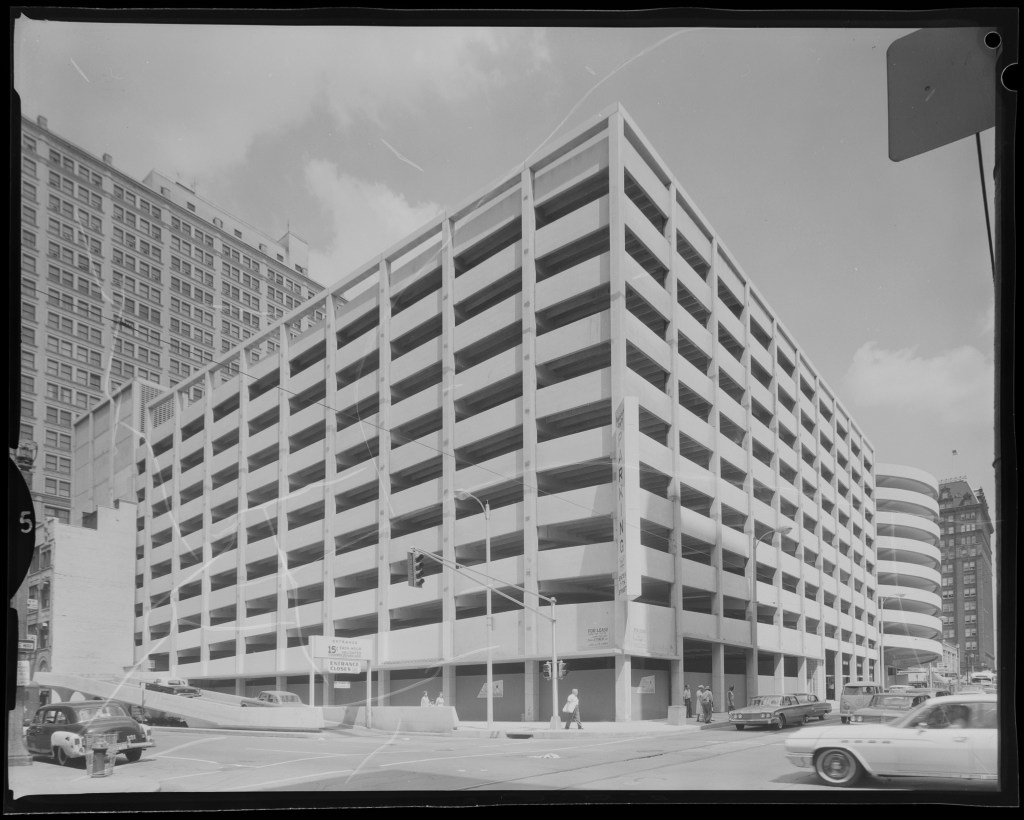
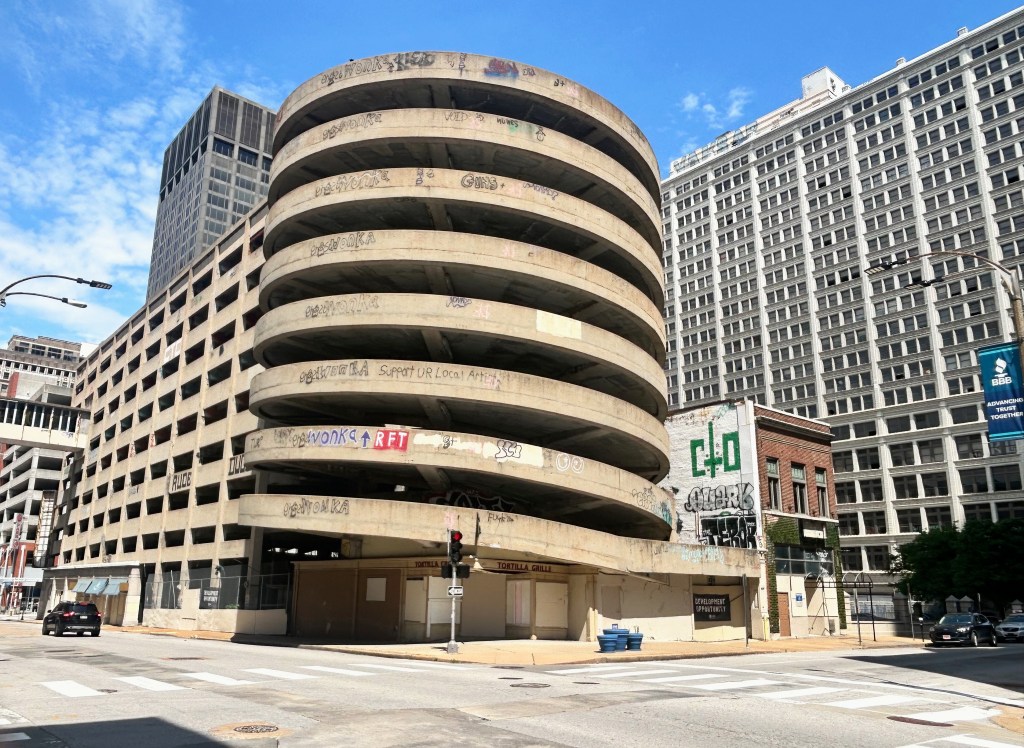
Instead, I would urge St. Louis to consider the value of the Gill Building, the former Charlie Gitto’s building, and the ramp. All three are components of what could be a lively redeveloped block.
Other buildings on this block that would have chafed at the blandification of downtown were taken down in the 1980s for a surface parking lot at 6th and Olive streets. A group of smaller commercial buildings faced in the same inimitable white terra cotta as the Railway Exchange Building joined the Gill Building in forming what was eventually listed in the National Register of Historic Places as the Olive Street Terra Cotta Historic District. Strangely, the Mead McClellan Partnership – a firm headed by Sedge Mead and Guy McClellan that had undertaken dozens of historic rehabs across Soulard and the near south side – purchased these buildings only to wreck them.
Today the vestiges of visual delight are few but now more important. The Gill Building seems unthreatened, but back in the early 2000s, Famous-Barr undertook several moves to evict its then owner-occupant, attorney and preservationist Jack Randall. The Charlie Gitto’s building was a drug store for much of its history – once Neels Drug – and its interior retains a historic wooden soda fountain bar and back bar, mosaic tile floors, and a tin ceiling. Charlie Gitto was the manager of the Pasta House Company location that opened here in 1974, and took over the restaurant under his name in 1978. The garage ramp is a sculptural oddity, and its patina of recent tagging – including a lovely rendition of the old Riverfront Times logo – only adds to its ability to call out a downtown not weighted down by balance sheets and the decisions of investors and lawyers made over lunches in Clayton who have never taken the walk around these blocks.
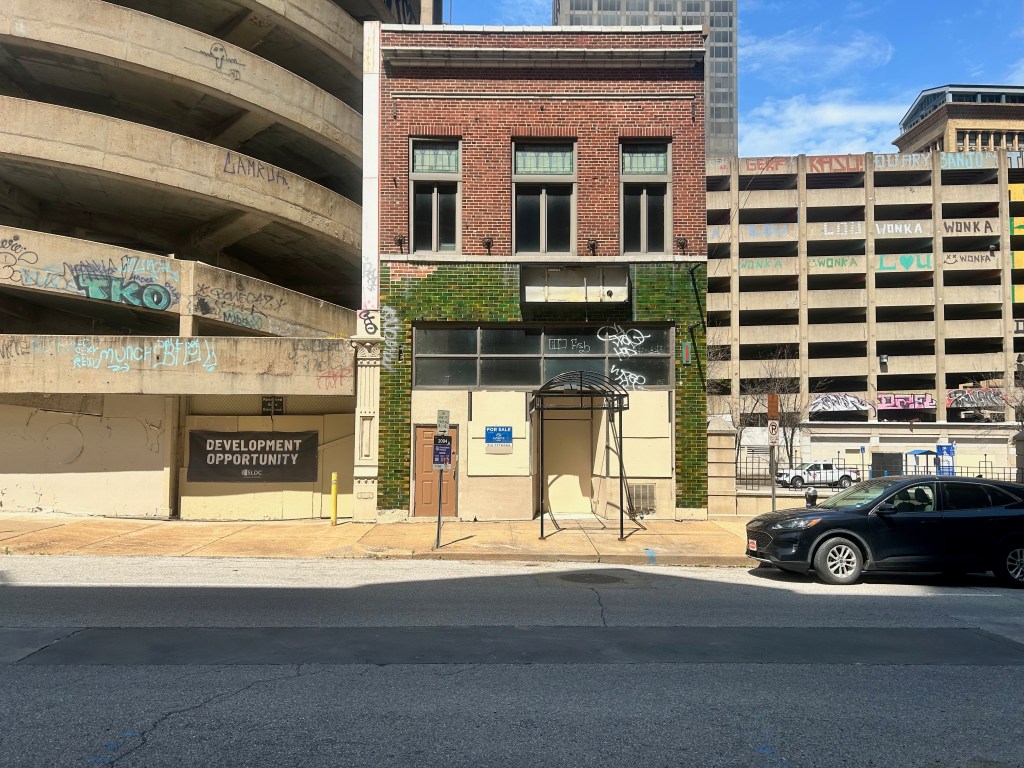
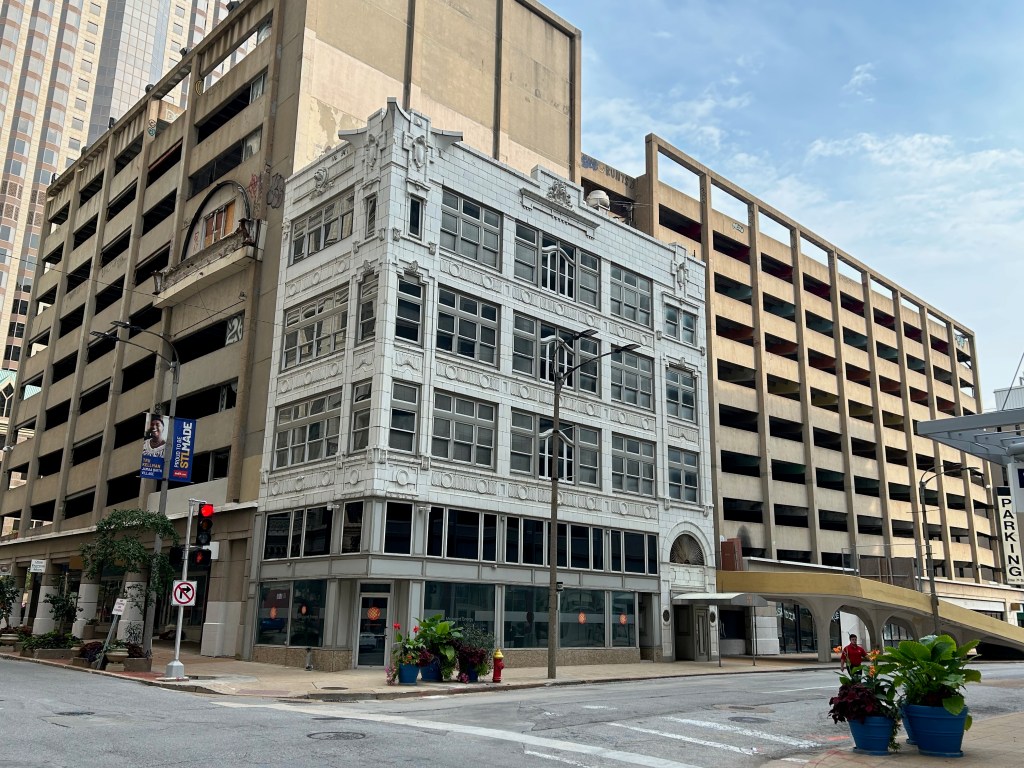
The Land Clearance for Redevelopment Agency approved demolition of the block’s structures in April, but the redevelopment plan has yet to be adopted by ordinance. That means, for now, that the city’s preservation ordinance still applies to all buildings on the block. Listed in the National Register of Historic Places, the Gill Building would still be protected by an ordinance removing generic demolition review – but the Charlie Gitto’s building would not. Neither would the garage, although it seems unlikely either the Cultural Resources Office or the Preservation Board would stand in the way of taking down a structurally-deficient middle-aged parking garage.
Yet downtown St. Louis would be richer for retaining the Gill Building, the Charlie Gitto’s building and the ramp structure. St. Louis Development Corporation Deputy Executive Director Rob Orr already has trotted out the typical demolitionist rhetoric around the Gitto’s building – that it suffered “water damage” after the restaurant closed, as if anyone would not undertake a full gut rehabilitation anyway. Civic leaders probably envision the latest five-plus-one solution for this block, but given the speed of downtown lately, it is more likely that a completely cleared block would sit empty for years à la Chicago’s Block 37.
Instead, retaining the elements of the block that make it weird, cool, and compelling would be a head start on a more imaginative redevelopment path that could chafe against the monolithic aura of the area. St. Louisans actually love commercial areas full of buildings of different colors, heights and ages – look at The Hill, Cherokee Street, downtown Maplewood and Main Street St. Charles. Downtown St. Louis used to beat every other part of the region with its architectural variety and sidewalk vitality. Now it trails. Here’s a plea from an expat to give it a chance to rebound.


