City Data Shows Limited Pedestrian and Cyclist Safety Progress

At gathering places across the city, talk of irresponsible and dangerous driving is a common topic of conversation. Unsafe driver behaviors are also a regular feature in popular local Instagram reels and other social media videos. At the same time, in an effort to encourage safer driving, the city has continued to install an increasing number of “traffic calming” strategies. From “lane diets” to “bump out” installations at intersections to the now-ubiquitous mid-block speedhumps, multiple administrations have invested significant sums in changes to city roads designed to make us safer. Is it working?
For six years, local road safety and accessibility advocacy group Trailnet has compiled the city’s collision data to create reports tracking how many pedestrians and cyclists were struck by cars in the prior year. This is done using daily accident reports published by the St. Louis Metropolitan Police Department (SLMPD). Recent years have seen the report grow to include data from St. Louis County, expanding the report’s influence beyond the city limits. As the report’s introduction states, “It has highlighted the human toll of traffic violence and underscored the urgent need for safer streets for everyone in St. Louis City and County — especially our most vulnerable road users (VRUs).” For many years, these annual releases were known simply as the Crash Report, but this year’s release brings not only more information about road safety in 2025, it also comes with a new name, The State of Our Streets.
This year’s report features a timeline of recent milestones in the city’s road safety planning work. It notes that the city adopted traffic calming guidelines in 2023, while the following year saw the city adopt a “Complete Streets” policy that requires increased public input into traffic planning activities and street design. Trailnet’s annual report drives local conversations around roadway safety, and it is often referenced by local transportation decision makers. Its regular publication has also made the report a source of data to track whether St. Louis’s road safety improvement efforts are having an impact.
Local Report Focuses on Infrastructure
The report highlights and focuses readers’ attention on infrastructure early and often. Despite the annual report’s former name and traditional focus on the number of collisions involving VRUs, Trailnet’s report sees the author devoting the first thirteen pages largely to discussions of infrastructure changes and various planning activities by the city and suburban governments. This is in keeping with the most recent Missouri Vulnerable Road User Safety Assessment, which also highlights infrastructure. As cited by Trailnet’s report, this statewide assessment by MoDOT concludes that “While human choices and mistakes can contribute to crashes, it is important to understand that those mistakes should not cost us or others their lives. Instead of demanding perfect behavior from drivers and VRUs, this approach acknowledges that mistakes are inevitable and that instead we must build redundant, self enforcing transportation systems that prevent crashes and minimize the severity of crashes that occur.”
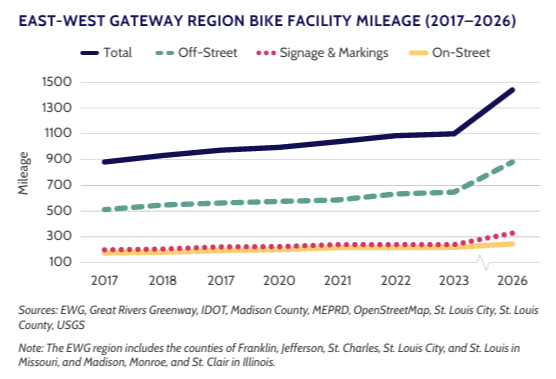
In these initial pages, Trailnet highlights how the region’s bicycle infrastructure is growing. The report shows a clear shift in 2023, likely coinciding with COVID-era federal stimulus dollars beginning to be deployed on regional infrastructure projects. It notes that the city has 277.92 miles of bicycle infrastructure, while the much larger St. Louis County has 446.77 miles of installed bike infrastructure.
St. Louis’s Most Dangerous Roads
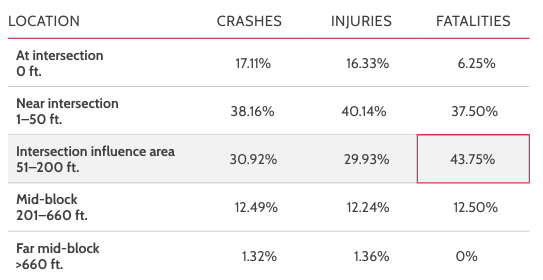
The report also calls attention to the roads in St. Louis that have seen the most crashes over the past year. The city’s deadliest road for VRUs is Gravois Ave, which saw four fatalities in 2025. This is followed by Grand Ave, Kingshighway Blvd, and Chouteau/Manchester Ave, each of which had a single fatality. Completing the top five most dangerous streets is Broadway, which saw 8 VRU-involved crashes in 2025. That report also notes that the most common location for collisions was not at intersections.
Rather, the report states that the most common place for these crashes was between 50 and 200 feet of an intersection, which it refers to as an “intersection influence area”. After that, it notes that the second most common place for these crashes is in the first 50 feet away from the intersection. “This zone is typically where drivers accelerate into or out of intersections (especially when trying to “catch the light”), where bus stops are frequently located (creating more pedestrian demand), and crossings are less protected. Pedestrian involved crashes within 100–200 feet of a crosswalk are especially deadly with 20% of them being fatal,” states Trailnet’s 2025 report.
The report notes that most fatal accidents occur on streets with 35mph and 25mph speed limits, along with a further concentration on arterial roads. This should be of no surprise, given the concentration of fatalities and injuries along Gravois Ave. When asked about how speeding interacts with crash severity, Trailnet declined to speculate on the role of speeding in pedestrian deaths. The report mentions speeding three times, none of which are related to enforcement. While largely ignored by Trailnet’s report, the US Department of Transportation (USDOT)’s website devoted to the Safe System approach found that both Missouri and Illinois face high rates of fatalities caused by drivers exceeding the posted speed limits, though it also points out that infrastructure design can reduce the likelihood of drivers exceeding posted limits.
Most Agree Multipronged Strategies are Key to Success
The MoDOT document goes on to propose a five-piece strategy to reduce VRU deaths and injuries. “Safety can only be achieved when we work together and across every layer of our transportation system to encourage Safer People, design Safer Infrastructure, enforce Safer Speeds, require Safer Vehicles, and prioritize Safer Response,“ states the MoDOT report.
This is almost identical to the Safe System framework used by the USDOT. Additionally, the Journal of Road Safety (JORS)’s 2025 report, A Systematic Literature Review of Pedestrian Safety in Urban Transport Systems uses the Safe System framework for evaluating road safety studies from across the world. The report reviewed studies to find where international research has shown areas of agreement and how different strategies find varying levels of success in different nations. JORS’s report says that it “provides a comprehensive synthesis of the top 92 research papers and policy documents on pedestrian safety, mapping the support for key safety features across the literature. Interventions such as pedestrian signals, speed enforcement, and urban design modifications are most frequently supported, highlighting the importance of multifaceted strategies in improving pedestrian safety outcomes.“ The JORS study found that stand-alone strategies are less successful compared to more comprehensive and diverse road safety strategies. The report states that its analysis reveals “strong evidence that integrated measures (e.g., speed reduction, pedestrian-priority crossings, infrastructure redesign) are effective in reducing fatalities, especially when supported by enforcement and communication strategies”.
These multipronged strategies are also similar to the “Five E’s of bicycling”: Education, Encouragement, Enforcement, Evaluation, and Engineering. This framework is commonly used by state and local agencies as a cornerstone of creating safer streets, and it also serves as a framework for teaching safe cycling to students by organizations across the country.
Trailnet’s Report Largely Ignores Enforcement and Education Strategies
If there is one point of divergence between Trailnet and most roadway safety promotion agencies and organizations, it is in the Trailnet report’s clear focus on infrastructure-based solutions to regional road safety concerns. By scanning the documents for keyword usage, it becomes clear that the Trailnet report’s focus is weighted heavily toward infrastructure.

The Trailnet report mentions infrastructure more than the other keywords, and it is the only one that exceeds twenty mentions in the report. In fact, infrastructure receives more mentions than the other keywords combined across the report. The only other keyword to exceed 10 mentions is traffic calming, which generally refers to infrastructure improvements. In contrast, the JORS review mentions enforcement 40 times, while also mentioning behavior, infrastructure, and traffic calming over 20 times. MoDOT’s document is even more balanced, finding enforcement, education, behavior, and infrastructure over 30 times, while no term reaches forty mentions. Amongst these reports, Trailnet’s report is unique in its narrower focus. MoDOT’s report stands out as the only one that avoided the usage of equity and related verbiage, likely due to the state government’s conservative tilt.
Local Data Shows Little Safety Impact From Recent Changes
One point of concern for St. Louisans is that a review of Trailnet’s annual safety reports shows little-to-no citywide impact from recent years’ safety infrastructure improvements. While the Trailnet reports only showcase data from the most recent two years, a review of the six reports allows for an analysis of whether the “lane diets, “bump outs”, and other traffic-calming efforts are having a concrete impact and creating safer roadways for urban cyclists and pedestrians.
After gathering information from the six annual reports, it is unclear what impact the changes to city infrastructure are having on increasing pedestrian and cyclist safety. While 2025 saw a reduction in collisions with pedestrians, this follows data from 2024 and 2025 that exceed the number of collisions in the previous three years. This includes 2024’s 23 pedestrian deaths, the highest number over the six years studied. This followed the 2023 high point in the number of pedestrians injured. Similarly, 2025 proved to be the most dangerous year covered by the annual report for cyclists. When asked about the lack of data showing improvement in safety data, Trailnet did not directly respond. That the city remains dangerous for VRUs matches the experience of many St. Louisans, including cyclist Jarred Gastreich. “I have been riding my bike on St. Louis streets for 15 years, and it hasn’t gotten any better or worse,” stated Gastreich. Still, Gastreich says he loves to use his bicycle for getting around city streets. “It’s really enjoyable. It’s the best way to get around,” said the cyclist.
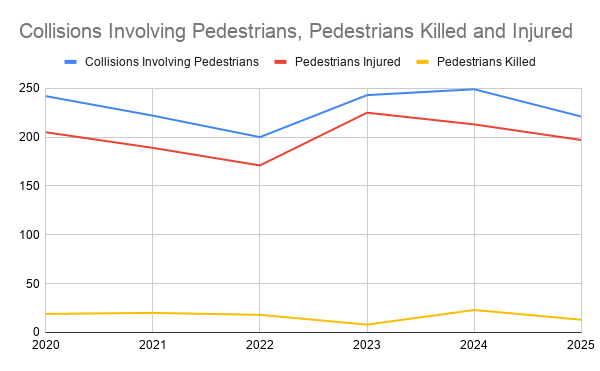
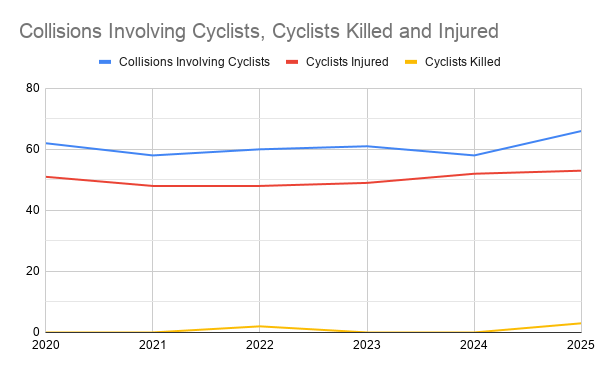
When the crash statistics are put into the context of St. Louis’s falling population, the data becomes even less positive. Over the six years studied, St. Louis’s population is estimated to have fallen by roughly 7%. When the VRU-involved collision numbers are then adjusted for declining population, it becomes even harder to see a pattern of improvements in road safety. Instead, the reports seem to largely show that traffic danger has persisted, though the crashes have increasingly moved from the city’s northside to southern neighborhoods.

Questions About Narrow Focus
This lack of demonstrable progress has some residents and advocates questioning Trailnet’s seemingly narrow focus on infrastructure improvements for creating safer streets. Their concerns are echoed by the other reports. JORS’s review of international safety studies states, “For instance, a speed-calming intervention may show limited success in environments where enforcement is weak or funding is inconsistent.“ Elsewhere, JORS repeated the theme of the importance of a multifaceted approach. “Pedestrian safety outcomes were more impactful when enforcement measures were paired with public awareness campaigns. Educational initiatives raised awareness about pedestrian rights and safe driving practices, fostering a culture of shared responsibility on the road. These combined efforts led to immediate behavioural changes and sustained safety benefits over time,” stated the JORS analysis. MoDOT’s report also recommends diverse strategies in reducing traffic violence.

The JORS analysis also backs the idea that behavior modification is an important part of creating safer roadways. “Together, technological upgrades and behaviour-focused strategies provide a holistic approach to enhancing pedestrian environments and reducing crash risks,” states the JORS report. This contrasts with Trailnet’s report that seemingly downplays the efficacy of behavioral modification. This diverse approach lines up with what Gastreich would like to see more of in our local road safety efforts. “The crazy drivers aren’t any less crazy with the speed bumps and traffic calming. They are still out there. I think what would help is education and enforcement more so than traffic calming. However, we were overdue for a dedicated bike lane on the bridges connecting downtown to South City,” said Gastreich.
On the education front, Trailnet defends the report’s lack of focus on education by noting the organization’s work on educating road users about how to be safer. “We provide bicycle maintenance classes, children’s bike safety rodeos, and support bicycle education through our Safe Routes to School grant work. We also participate in the Missouri Driver’s Education Coalition, which is working to establish a mandatory driver education requirement for Missouri high school students,” responded Trailnet’s Director of Marketing and Communications Chantal Incandela. Incandela’s response to questions about the report indicated that she is aware of the multi-faceted Safe System strategy suggested by the JOSR report. In fact, she stated that the report “reflects a Safe System approach to transportation safety.“ Responding to a question about the report’s finding that most fatal collisions occur away from intersection crosswalks and related educational opportunities, Incandela again referenced the Safe System approach saying, “A Safe System approach recognizes that people will generally choose the most direct route to their destination. When homes, businesses, transit stops, and other destinations exist on both sides of a wide, high-speed road, simply telling people to use distant crosswalks is not, by itself, a complete safety strategy. The transportation system should provide safe crossing opportunities where people are likely to cross.”

When questioned about the report’s lack of focus on traffic law enforcement, Incandela responded, “Trailnet also supports fair enforcement of traffic laws that protect vulnerable road users, and that position is reflected in our policy principles. Enforcement plays an important role, but it is not a systems-level solution. It addresses individual behavior after risky conditions already exist.” Incandela’s response seemingly puts the Trailnet report at odds with the broader body of research, which consistently finds enforcement to be an integral part of the Safe System approach to improving road safety. Incandela’s response went on to further stand behind Trailnet’s infrastructure focus by stating, “Street design, speed management, protected crossings, and connected walking and bicycling networks reduce risk for everyone using a corridor, whether or not enforcement is present.“
For its part, the JOSR analysis found that consistent and visible enforcement was an important part of creating safer streets. “Consistent enforcement, backed by supportive policy and public engagement, was essential to creating long-term improvements in pedestrian safety and reducing road trauma,” says the international analysis. Elsewhere, the study again reiterates the importance of enforcement as part of a comprehensive roadway safety program. “Proper signage and enforcement are critical complements to speed-limiting. The standalone static signage is not particularly effective unless supported by enforcement systems including speed cameras, radar feedback signs, and police patrols in visible areas,” it continued. The JORS study also positively mentions the efficacy of automated enforcement using cameras, a controversial topic in St. Louis.
Mayor’s Office Defers to SLMPD
Mayor Cara Spencer has often noted the fact that she enjoys bicycling through city streets, but her office had little to say in response to questions about improving street safety. When asked for comment, the mayor’s media contact Holly Robinson responded that “Since the Trailnet report is not a city deliverable, we’re not able to comment on the specificities of their data.” This is despite the data used to create the study coming from the city’s police department. Roberts did note Mayor Spencer’s support for greater traffic law enforcement, stating that “she does think that there should be more enforcement regarding pedestrian and cyclist safety.” Despite this, the mayor’s office deferred to law enforcement officials. “With state-control of the St. Louis Metropolitan Police Department, the logistics of that would be best answered by SLMPD and the Circuit Attorney,” concluded Roberts’ response.
Roadways Will Continue to Change
While the reports show limited impact on overall VRU safety in the city, Trailnet’s focus on infrastructure will continue to impact the city’s conversations around roadway safety. Drivers, pedestrians, and cyclists alike will look to future reports for evidence as to whether these changes begin to result in cumulative progress towards safer roads.