When the Hot Wind Blows
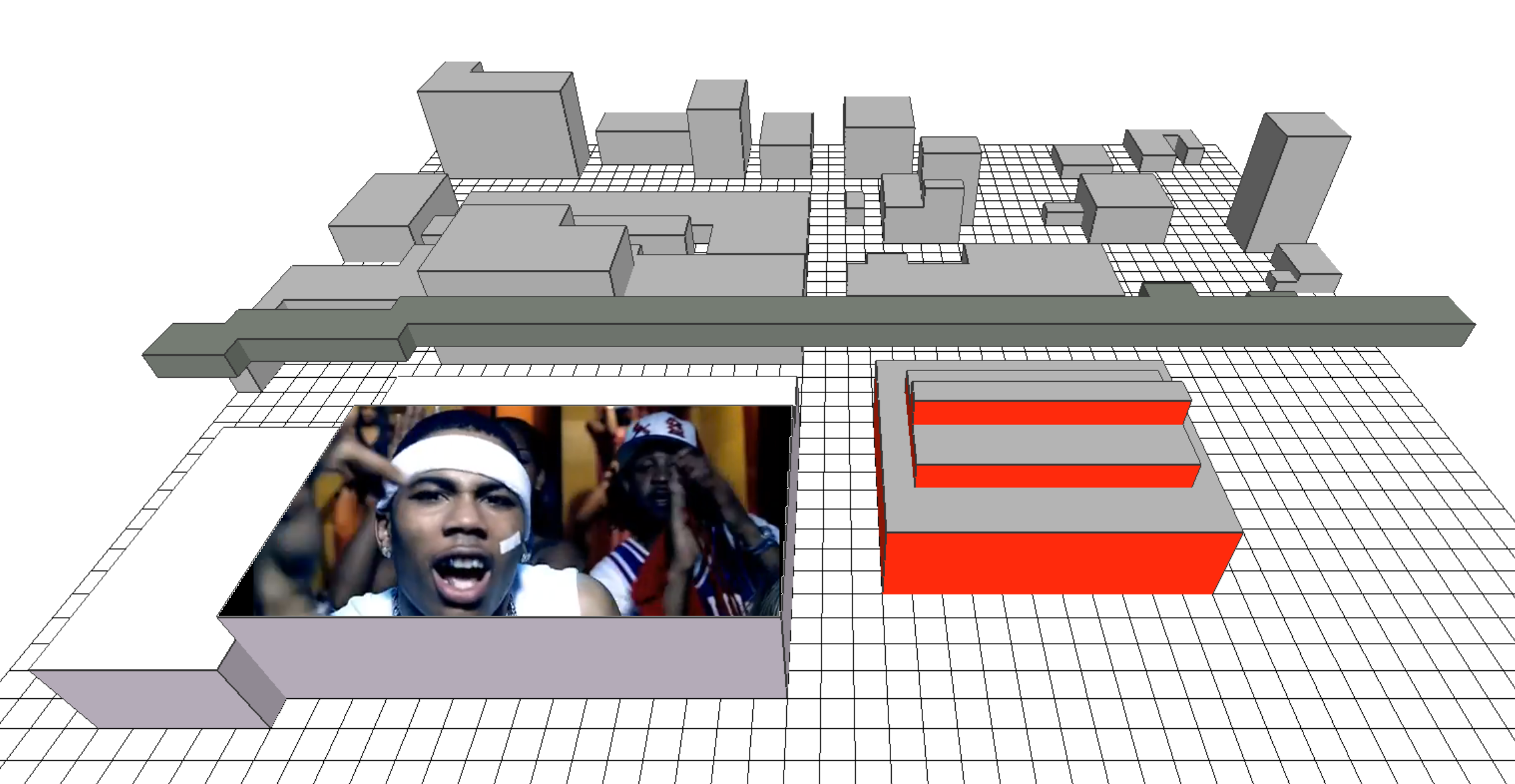
This article picks up from Hyperthermia by Design, where I described the understated yet profoundly speculative nature of AI data center construction and the singularity-or-bust economics driving it. Today, I would like to continue discussing the proposed data center in the Armory Innovation District in St. Louis and its expected contribution to the Urban Heat Island (UHI) already present in a densely built area. As I previously explained, virtually all power used in such a facility is converted to heat that must be promptly expelled from the building into the outside air. When built on a very compact site with little setback, like the Armory’s, the density of heat released from Megawatt-scale power consumption may reach levels unheard of in modern urban streetscapes. This form of heat pollution is quite new to urban planning, largely due to the novelty of these facilities, and, although the extent of genuinely hazardous heat pollution is uncertain, this data center will definitely elevate the air conditioning costs of its neighbors. The facility’s voracious hunger for power means that it will also be contributing to climate change. That this proposal is proceeding without any apparent mandate for an impartial environmental impact study should be deeply alarming.
The Proposed Data Center in Detail
The Armory Innovation District proposal calls for building a 3-story 525k square foot data center to replace the historic Famous Barr warehouse on Market St. in midtown St. Louis. As data centers go, this 11-acre site is puny. This means that the cooling equipment surrounding the building would sit very close to the property line. This cooling equipment would be blowing out exhaust heat directly by the sidewalk on Market, the elevated I-64 causeway, and even the historic Armory building. Per the builders’ “sunshined” permit application, this facility is targeting a 120 Megawatt (MW) rated capacity and a Power Usage Effectiveness (PUE) ratio of 1.35 or better. This ratio, where less is better, means the designers would like at least 74% of the center’s capacity powering the electronics, aka the “IT load,” and the remaining capacity for power conversion equipment and the cooling plant. Prior to 2024, data centers achieved PUE from 2.0 to 1.5. That the application says the facility will be noticeably more efficient illustrates the pressure placed by the generative AI boom on pushing the envelope. I will explain below why the facility couldn’t sustain 100% of its rated capacity.

An AI data center’s power consumption has 3 components: the GPUs and other rackmount electronics comprising the IT load, power conversion equipment, and the cooling plant. Although an AI model only consumes power on demand during normal operation, training a model beforehand could require sustained peak operation for weeks or months. In addition, financial pressures explained in my earlier piece compel data center operators to maintain full commitment of their hardware to minimize depreciation loss on their GPU investment. 100 MW is a realistic estimate for the Armory data center’s sustained peak power consumption, considering inherent technical limits, and all of this energy would be exhausted as waste heat on its 11-acre site. This density of power consumption is comparable to steel mills, electrochemical plants, and other more familiar industrial facilities. In contrast to those other facilities and even suburban data centers, the Armory data center would have very little setback from its property line.
The power usage and building size figures provided by the application give us enough information for a rough simulation of the Armory data center’s heat island effect. I used the Urban Weather Generator (UWG) from Ladybug Tools to estimate elevated temperatures at increasing distances. Then I used ENVI-met to illustrate how heat plumes might drift over the elevated I-64 causeway and beyond. While I adjusted these simulations for accuracy to the best of my ability, I am not a climate scientist. I still believe these results clearly demonstrate the need for a professional and independent environmental impact study of the Armory data center. Alongside these better-known effects, like air pollution and noise, this study needs to explore the facility’s heat pollution when operating at peak capacity during heat waves.
Simulating the Heat Pollution


The UWG software estimates an urban heat island by overlaying artificial temperature and humidity sources onto rural weather data. An important caveat is that the UWG only models in one dimension. It can not process spatial information like wind direction or building asymmetry. Despite this limitation, its results, when overlaid onto a recent heat wave, show peak temperature approaching 108F and in particular heat index of 123F as one nears the data center. The nighttime spikes in heat index are noteworthy, occurring due to natural rise in humidity after sunset combined with significant heat still flowing out of the data center. These heat index values are dangerous since they defeat a person’s ability to maintain a healthy core body temperature by sweating, with 131F considered lethal. Such conditions on a public road by the data center would happen late at night, making them unexpected and thus more hazardous.
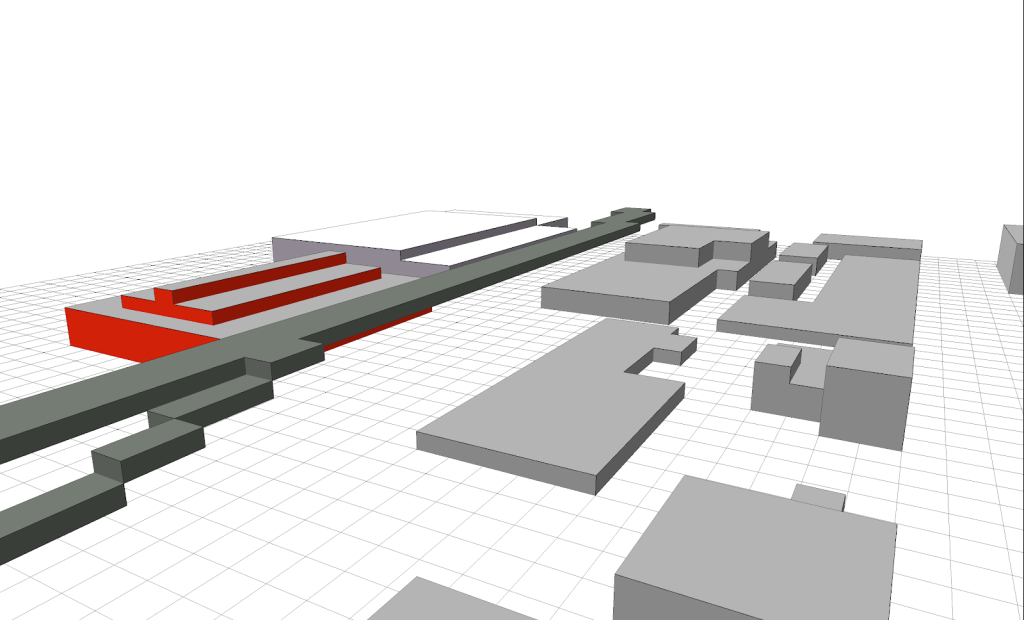
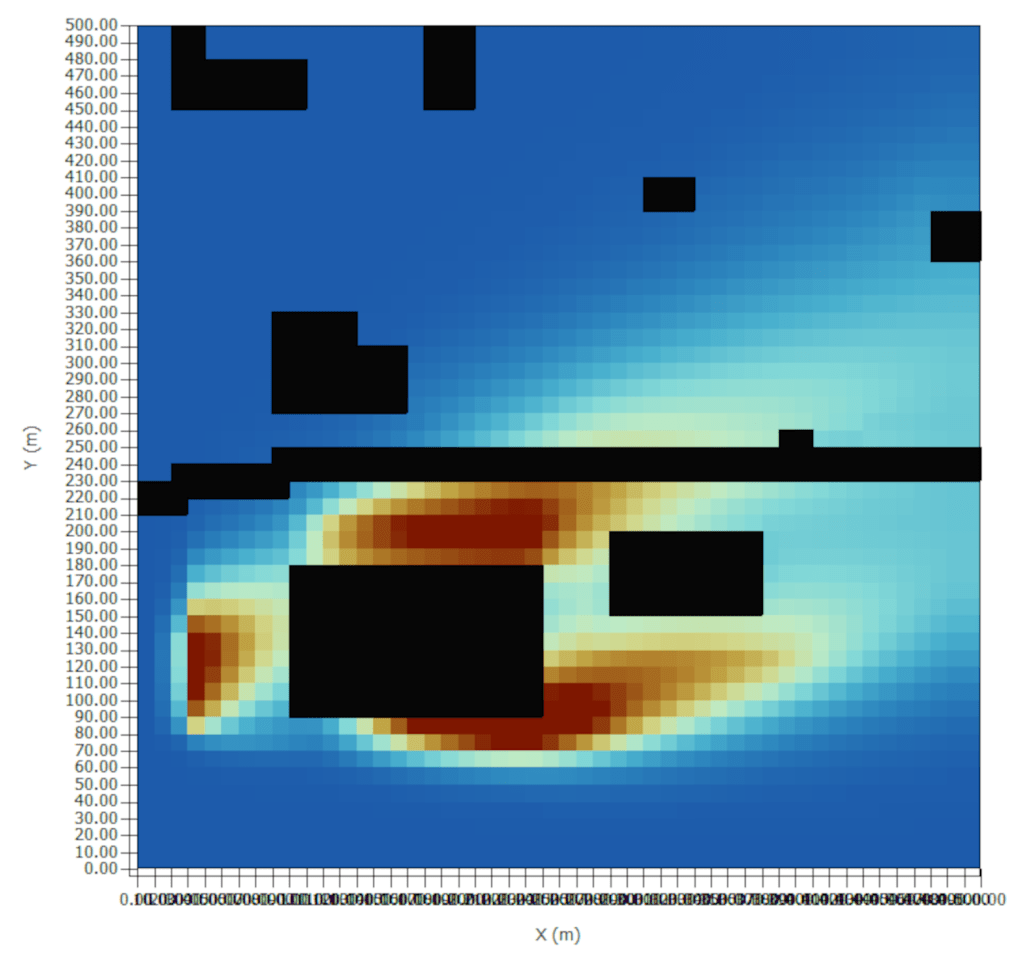
ENVI-met is a professional-grade modeling application used by architects and planners to simulate environmental effects in complex urban landscapes. Despite the low-rent Minecraft appearance, the scene above actually depicts a 500 meter wide 3D model in ENVI-met. The Armory data center (white roof) sits in the distance, the elevated I-64 causeway runs down the middle, and adjacent structures like the Foundry and the Armory building (red walls) complete the scene. To illustrate heat plumes, I modeled the data center’s chillers (shown on the permit application), making gaseous emissions into a gentle 6 mph wind blowing across the scene. The figure below shows the density of these plumes on the upper deck of the I-64 causeway, depicting a horizontal slice of the 3D model at 17 meters height.
This figure from ENVI-met is still just an illustration of what heat plumes from the Armory data center could look like. It should be considered together with the hazardous 108F temperature and 123F heat index extremes simulated by UWG above. I believe the limited results presented here nevertheless demonstrate the need for professional analysis. I also believe such an analysis has a strong chance of showing that the proposed data center could emit hazardous heat pollution. On this compact 11 acre site and at the desired 120 MW capacity, dangerous heat from the data center could reach people on public rights of way just beyond the property line.
Conclusion
So what can be done to remediate a project like the Armory data center? Unfortunately, the builders make their cost-cutting opportunism plain, picking an unsuitably tiny site in a redevelopment zone primarily for its cheap access to an electrical substation and ambiguous regulatory overview. They also indicate no desire to make any covenants about renewable energy or other concessions that would survive to future owners. Such decision-making does not point to a willingness to negotiate remediation in good faith. The builders have made clear they intend to sell the data center to an undisclosed AI company as quickly as they can.
As for other AI data center proposals that may emerge, alternate sites away from transit nodes offer the advantages of larger setbacks and possibly even access to the city’s downtown energy district for efficient reuse of waste heat. Furthermore, active international research into Organic Rankine Cycle power generation suggests a viable process may soon be at hand to recycle waste heat back into electricity onsite year-round, ultimately forgoing the pollution and noise of a titanic cooling plant. But perhaps the greatest advantage of sites outside of SLU’s dubious regulation-free redevelopment zone is the accountability builders could gain by engaging with the city’s effort to promote environmentally responsible and equitable data center development. When dealing with builders who see no advantage in such accountability, I must remind our civic leaders whose welfare they should be working to uphold.
This Google Drive folder has the python code, weather data, and ENVI-met files used to produce the figures in this story.
The City of St. Louis’ Conditional Use Hearing for the proposed Armory Data Center will be held at 8:30 am on March 19, 2026. The hearing will be virtual and held over Zoom.
Zoom Link: https://zoom.us/j/9616100275
Meeting ID: 961 610 0275 Passcode: FDhmG9
Or via phone at: 253-215-8782 with the following:
Meeting ID: 961 610 0275 Passcode: 892471

Ben West is a computer engineer who enjoys gardening with native species indistinguishable from weeds to the casual observer. He’ll introduce you to Missouri’s indigenous succulents if