
Montgomery County Residents Oppose Data Center Developments in Their Community
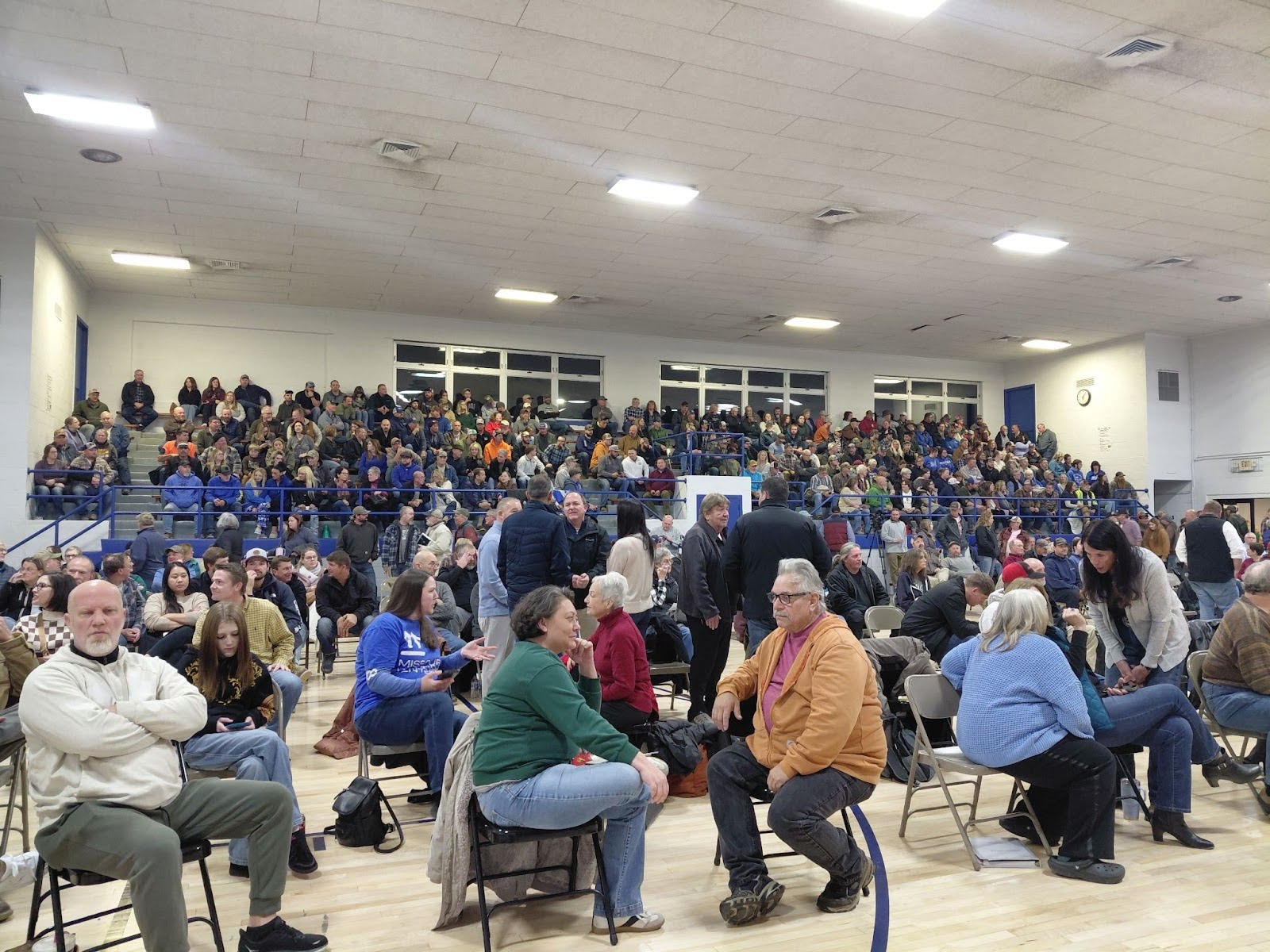
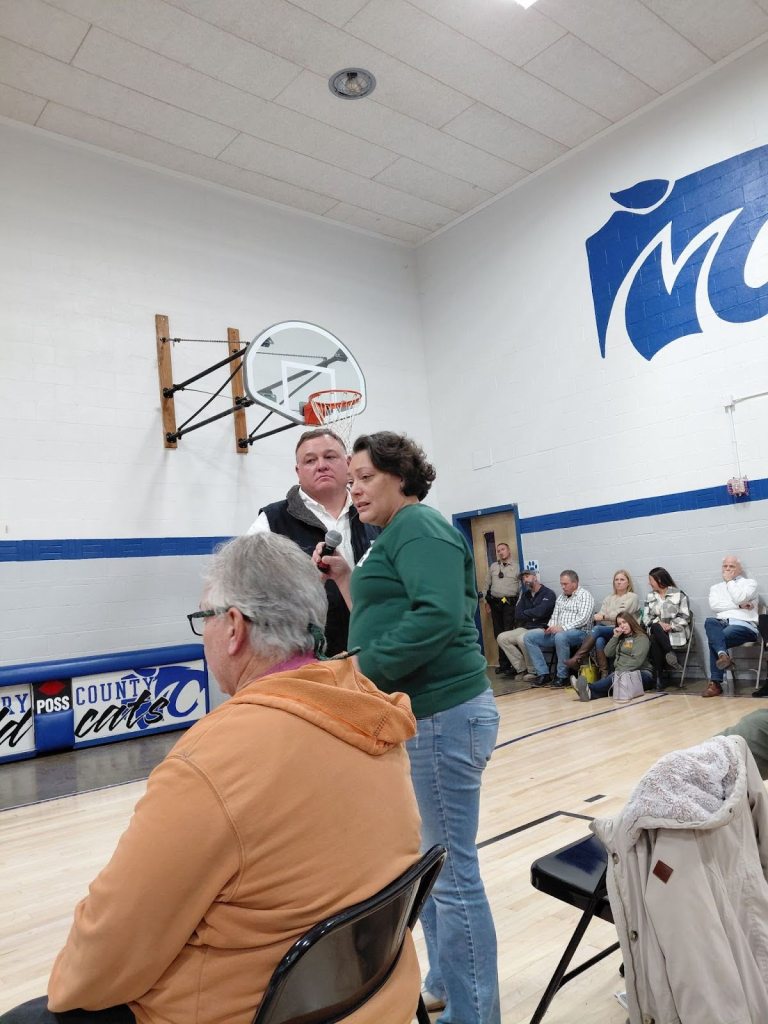
Several hundred people gathered at the Montgomery City Elementary School on the evening of Monday, December 8th. The meeting was ostensibly an information session with representatives from local government sitting on a panel and answering questions about two proposed adjacent data centers close to Montgomery City and nearby New Florence. The proposed data centers are part of a development for Amazon known as Project Green and a development known as Project Spade, whose ultimate user is still unknown. Once the event began, it quickly became a forum for people to express their anger and thoughts on the proposal and the approval process.
Montgomery City has less than 2900 people, while New Florence less than 700. Given the towns’ modest populations, the estimated 400 people in attendance was a remarkable turnout. For over two hours, the auditorium remained full. The vast majority of the people were sceptical of the claims made by local officials. Based on the information they have right now, many residents were clear that they do not want the data centers in their community.
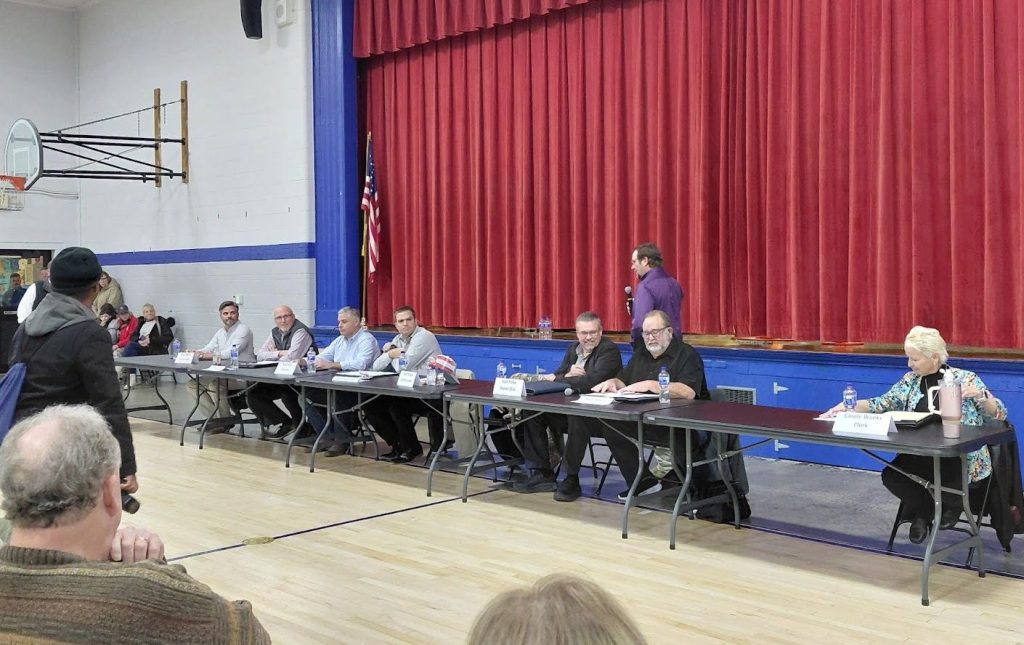
Steven Etcher, representing the Greater Montgomery County Economic Development Council, led the pitch for the data centers. He told the crowd that “there is a lot of misinformation out there about what is going on”, saying that the proposed data centers were an incredible opportunity, calling them a public-private partnership that will greatly benefit the community. He said that they will attract billions of dollars in economic development, thousands of construction jobs, hundreds of local permanent jobs, and tens of millions of dollars in new tax revenue, with thirty million dollars in additional property tax coming from the initial phase.
Steve Etcher works for MarksNelson, a business and technology advisory firm based in Overland Park, Kansas. MarksNelson has a partnership with Springline Advisory, which was created last year by Dallas-based private equity firm Trinity Hunt Partners.
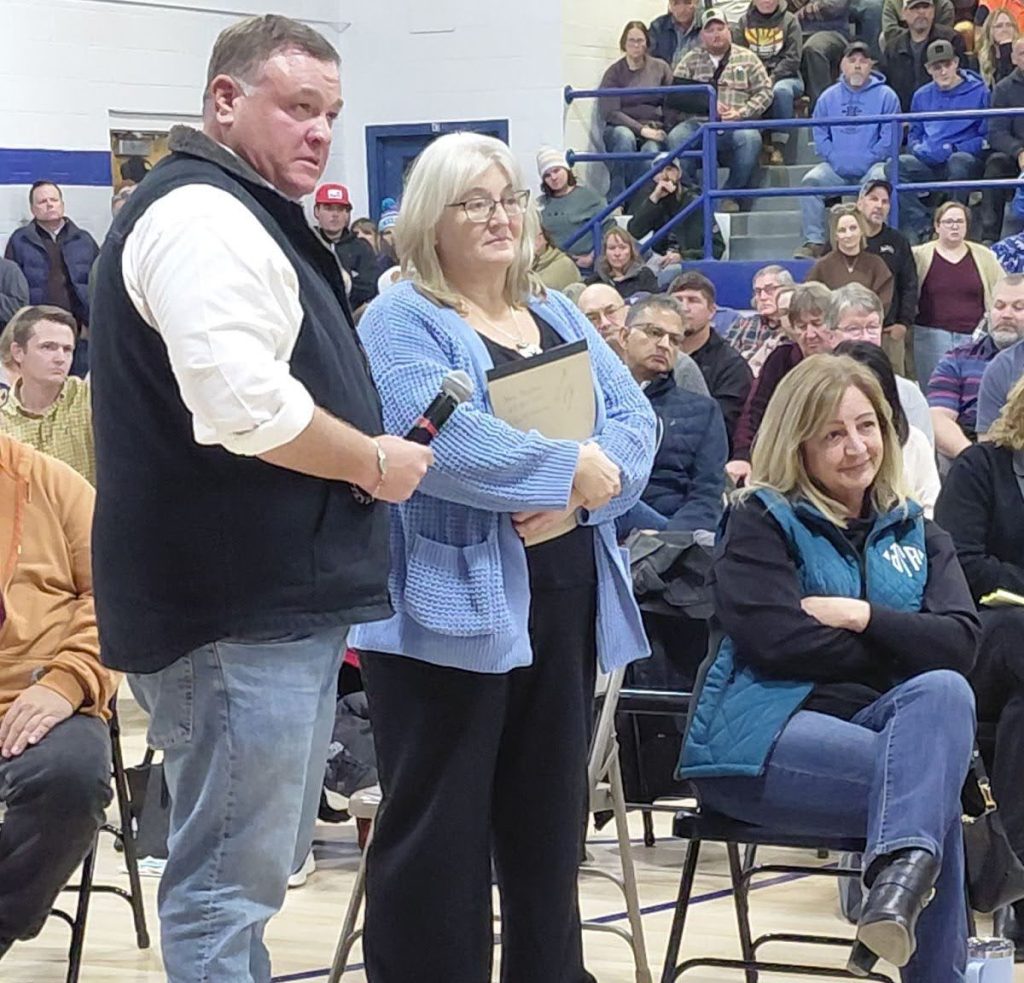
Residents in the area had multiple concerns with the data centers, which were sometimes expressed by yelling from the audience, though most used a microphone held by Missouri Times Publisher Scott Faughn. Residents’ concerns mostly fell into four different areas: water, noise and light pollution, utility rate increases, and a desire for greater transparency and participation.
Water
Protection of water quality and availability was on many attendees’ minds. Answering questions concerning water were Karl Finke from the Montgomery County Water District Board and Montgomery County Water District Manager Rich Moore. Montgomery County relies mostly on groundwater for its use. Moore claimed that the data centers should be able to extract water from a deeper level than that which residents use for their water, and it was stated that the two sources of water are separate from each other.
Multiple people questioned that assessment, saying that the data centers will consume far more water than the aquifer can handle. One man said that he is already pumping muddy water from his well, prompting a detailed discussion between him and the water officials on his specific case. “The aquifer will go down. Period. Some wells will take a few years to recover. Others won’t recover for a thousand years,” said local resident Bill Dreyer.
Panelists assured people in the crowd that the Environmental Protection Agency (EPA) and the Missouri Department of Natural Resources (DNR) will protect their water supply, though Dreyer noted that the DNR cannot protect their water from over-pumping. “There is no remedy,” he said, “because Missouri is not a ‘water law state’.” He was referencing that Missouri does not have a regulatory standard for water use.
There was a large group of people at the meeting from nearby Warrenton, where officials are also presently considering allowing the building of a data center. A man from Warrenton stated that the groundwater in both places comes from the same aquifer. “You’re taking my water too. Two data centers here and then one maybe in Warrenton – plus more droughts. There’s not enough water,” stated the Warrenton resident.
DNR does regulate water runoff – but multiple residents, including Brenda Buechele, were still concerned about runoff affecting their properties. Buechele pointed out that Montgomery County already has the highest age-adjusted cancer rate in Missouri, and industrial runoff reentering wells could make the problem worse.
Another resident agreed with this concern, saying that the data centers will be using new technology, and he wants to know how it will affect water quality. The resident pointed to evidence from an Oregon data center that he believed should concern everyone getting their water from the aquifer.
Noise and Light Pollution
Charles Garcia owns land adjacent to the proposed Project Green. Along with other concerns, he and his daughter Stephanie attended out of worries about noise. They say that the data center will use extraordinarily loud generators for backup power and could make life in their home unlivable. Another woman, who would only identify herself by her first name of Bobbie, said that she opposed the data centers because of “The noise, the hum. It’s 24/7, and you won’t ever see the stars again.”
Utility Rates
Jim Bratcher, a grocery store owner from Moberly came to the meeting out of concern for how data centers would affect the cost of electricity from Ameren. He was not alone in worrying about increasing electricity bills.
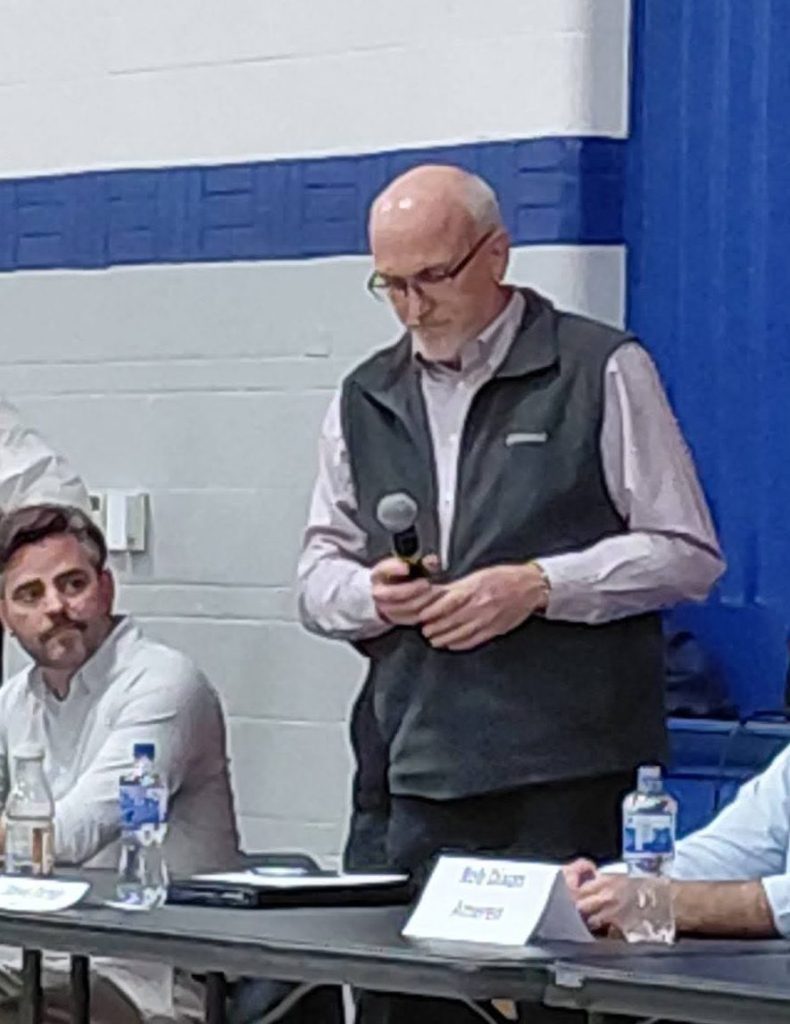
Rob Dixon, speaking for Ameren, told the crowd that under the provisions of Senate Bill 4, passed last Spring and interpreted by a recent Public Service Commission (PSC) case, data centers will “pay their fair share”. He stated that companies opening new data centers will be responsible for agreeing to minimum terms of service, pay 100% of upfront interconnection costs, and provide collateral.
After the meeting, Consumer Council of Missouri attorney John Coffman said that the Consumer Council had just filed a motion for rehearing on the PSC case. The consumer advocacy organization believes that the PSC did not provide sufficient protections for residential consumers. In their view, the state commission is providing Missourians with few protections, when compared to other states. For instance, large data centers will have to put up collateral for two years of electric bills – money that will run out quickly if a data center shuts down quickly. Coffman thinks the period should be more like ten to fifteen years. “For the most part, we don’t even know what will be going on in these warehouses,” Coffman said. “They have trade secrets you can’t look at so authorities are making decisions blind.”
Two provisions of Senate Bill 4 pose an especially high risk to consumers. The first is the “watt for watt” provision (Section 393.401), which states that a Missouri utility cannot close a power plant unless it has secured an equal or greater amount of energy production to replace it. The second is a provision that allows Cost of Work in Progress financing for monopoly utilities (Section 393.135), meaning that utilities can charge ratepayers upfront for new plant construction.
“The world of data centers is a fast-changing world,” said Coffman. “A very competitive world, with winners and losers, and not all of these projects will succeed. What if Missouri has some of these losers? What happens if we have stranded assets? We will have overbuilt power generation, and the ratepayer will be holding the bag. The clawback provisions in Senate Bill 4 are insufficient.” Coffman continued, ”We are setting ourselves up to have too much power. Overbuilding and rates will go up higher. We are already on a trajectory for rates to go up 10% a year for a long time, even without calculating the data centers. Because of all the risks, there are not enough protections for the public.”
At the meeting, Janet Seper echoed this sentiment, while wearing a “Data Center – NO!” necklace. “Who will pay the bill when they leave town?” she asked. “We will.”


Representative Bruce Sassmann (R – Bland) has Montgomery City in his district, and he attended the event. At one point during the meeting, someone yelled to ask him why he voted for Senate Bill 4. He did not respond. After the meeting, I asked him what he thought of the data centers coming to his district. He stated, “You can’t stop progress.”
Transparency, Trust and Democracy
Many people were angry at Montgomery County Presiding Commissioner Ryan Poston, who represented the County Commission. His fellow Commissioners, Dave Teeter and Doug Lensing, did not attend. While facing considerable hostility from many in the audience, Poston at times remained calm and patient, while, at other times, he became testy with residents at the meeting.
Brenda Buechele made an impassioned plea to Poston: “You, the county commissioners, have not upheld the county plan to protect all the inhabitants of this county.” She called for an immediate moratorium on data centers in the county, to which people in the crowd cheered. In response, Poston said that lawsuits from landowners and developers would be triggered by a moratorium.
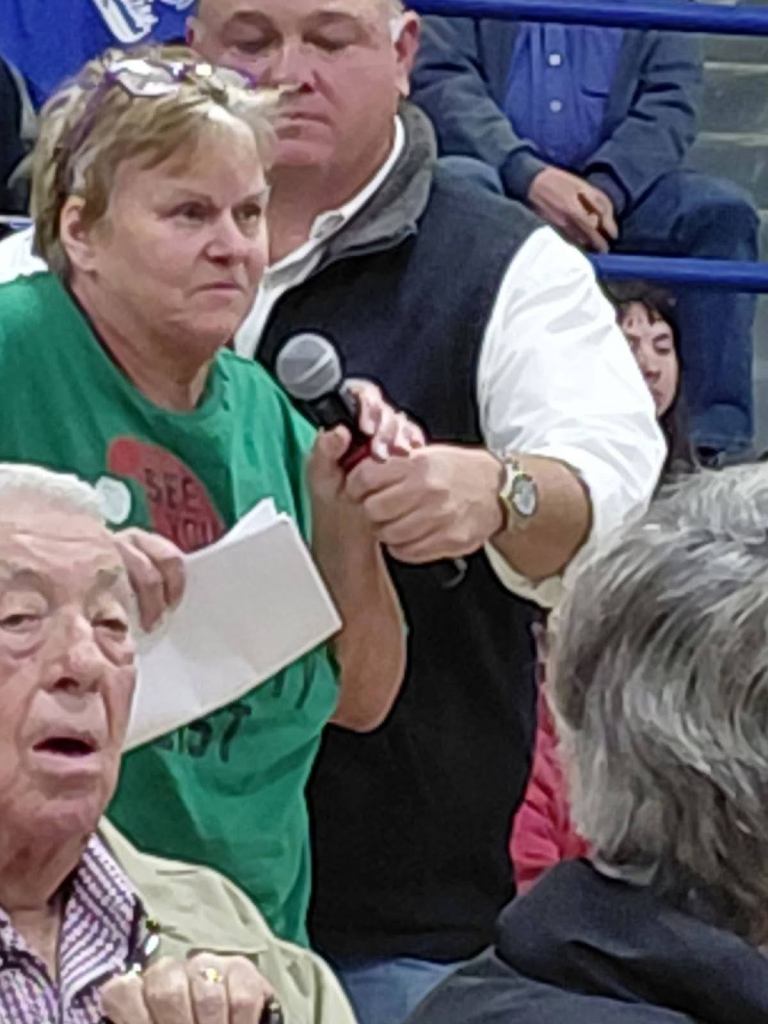
Harry Cope told Poston that “this is a crock – you got this community so divided.” Cope continued, “Last year Amazon paid $9 billion in taxes. They received $11 billion in subsidies. You say this will bring 200 jobs. How many thousands of jobs will AI eliminate?”
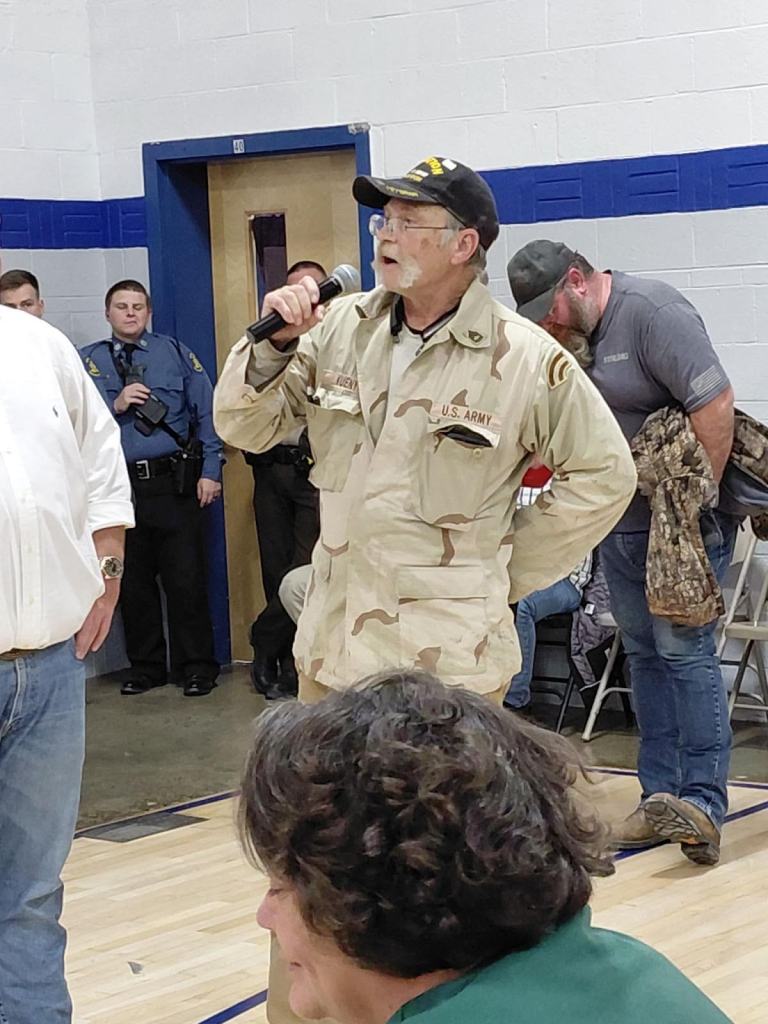
Resident Chuck Kueny brought up Tyson Food’s opening in Montgomery City. This major corporation received a 10 year tax abatement, then closed their plant after 9 years and 11 months. Poston responded by pointing out that it was Montgomery City, not Montgomery County, that granted the tax abatement. He also noted that it occurred before he held any government position.
“These billionaires have an army of lawyers bigger than any army of lawyers you can gather”, replied Kueny. “They will get what they want to get.”
One of the primary reasons crowd members were upset was the fact that elected leaders kept residents in the dark for months about much of what was happening. Many residents feel that they are continuing to hold back information from the public. “Nobody asked us if we wanted this,” said Stephanie Garcia.
Jean Thoele told me that the County Clerk is blocking her public information request. She paid $700 in mid-October for the County Commission’s meeting minutes and information about how much Montgomery County has spent on the data center issue. She has yet to receive any information.
One resident asked Poston why he signed a non-disclosure agreement concerning land data center land sales. Poston said the non-disclosure agreement only concerned one of the proposals – Project Spade. Preston said it was to protect those selling and buying the land, given the controversial nature of large data center development. He compared data center developers buying the land to that of a neighbor selling property to another neighbor. He stated that is not public business and it shouldn’t be publicized. This is despite the fact that the residential property transactions he referenced should be public record. The crowd erupted in anger with one person yelling “No, it is not. Out of town billionaires buying the land is very different.”
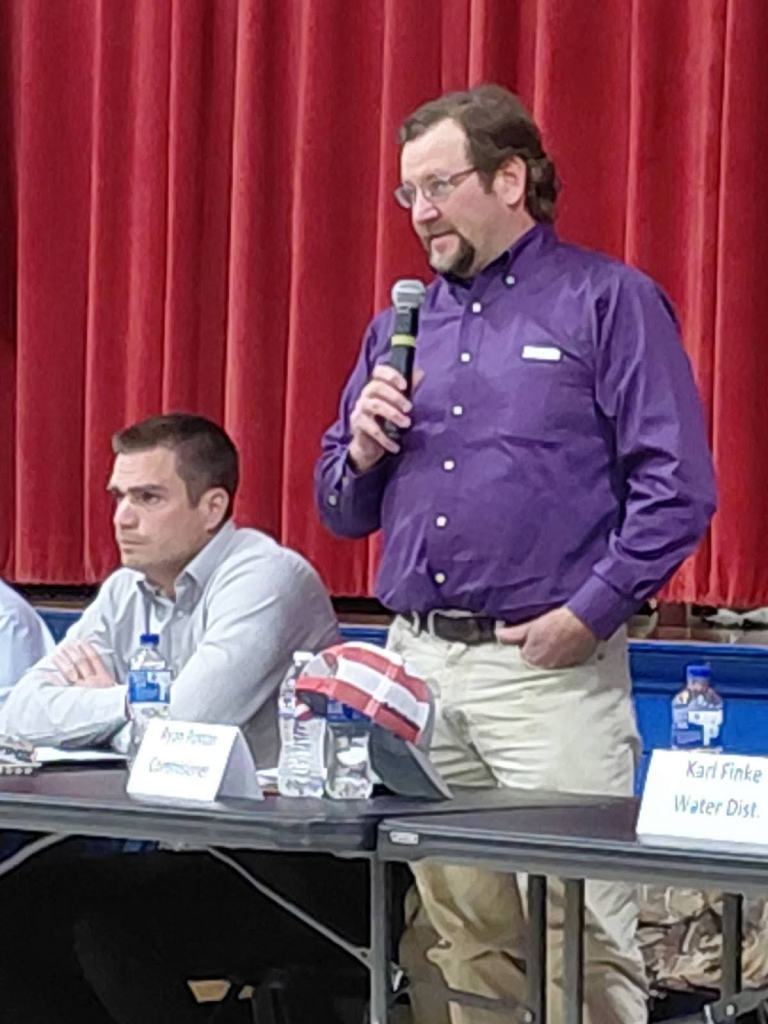
Tammy Ridgley asked why a company from Kansas City was hired to make decisions in Montgomery County – referring to MarksNelson and its employee Steve Etcher.
Other people also shared Ridgley’s skepticism of Etcher and noted that elected officials seemed to have abdicated many responsibilities to him.
An attendee from Warrenton implored the crowd not to believe what Etcher told them, saying that Etcher told the same things to folks in Warrenton. Etcher responded by trying to convince people that he was not influenced by what the final result would be. He said that he has no investment in the data centers – he is paid a fixed amount. “I do not own or sell any property here – I do this to make a difference.”
Etcher claimed that he had longstanding and deep ties to the community, and he said that he was only looking to do what was best for it by facilitating what he claimed would be a huge windfall, stating that the project would bring $1.5 billion in tax revenues to the community. “You are competing across the world for these economic opportunities,” he told the assembly.
At this point, someone yelled, “We don’t want them,” which was followed by cheers. Etcher was then asked to share an example of a rural town that was glad that they brought a data center into their community, and he cited the case of Altoona, Iowa, which has a Meta data center that data center promoters tout as a community-supported success, bringing jobs and tax revenue to the town. Meta recently made a multi-city television commercial buy with this video promoting data centers, using Altoona as their example
This reference by Etcher prompted a lot of yelling back and forth – people pointing out that Altoona is a suburb of Des Moines. Etcher said that it was not that way before the data center went in years ago. Someone asks if the people who approved it 20 years ago are glad of what happened now that their town has changed from a rural community to a suburb. “We moved out here to be rural”, yelled an attendee. “If we wanted to live in the city, we’d live in the city,” they continued.
Poston said that the community needed growth and development, and he said that they need the data centers, because they already turned down a meat packing plant before because of concerns that it would overwhelm the public school district with “English as a second language students” – clearly a reference to immigrants coming into town and working at the proposed plant.
But Montgomery County Collector of Revenue Anita Sullivan did not see an urgent need for any new large development. “We are growing, we aren’t dying,” she said. She added that the County should deny any authorization of any tax subsidies to Amazon or others looking to build data centers, as the proposal “is a danger to our community and our way of life.”
After the conclusion of the meeting, the Presiding Commissioner was asked if residents’ concerns had convinced him to call for a moratorium on data centers in Montgomery County. He stated that they will continue to hold meetings and that the commission is discussing it.
Update: This article was updated to correct the spelling of a testifying community member’s name.


