Reflecting on a Year of Challenging the City’s Concealment Culture

November’s arrival has brought cooler temperatures to the region, and the leaves have begun falling from the trees. It also means that this website has been publishing for more than a year. I wanted to take this opportunity to revisit an idea first brought up months ago: the lack of transparency in city government is cultural. By this, I mean there is a set of norms and ways of acting that our elected officials follow. The effect of this is to intentionally reduce the public’s ability to learn about actions taken and the reasoning behind them.
In my reporting on this website, public record requests under Missouri’s “sunshine” law have played a key role. Our reporting on the city’s decision to give a tornado recovery planning contract to a firm tied to Paul McKee’s Northside Regeneration was heavily informed by documents and emails revealed by the process. The same is true for other stories that we have published. This is important because the website has intentionally worked in a manner that is not driven by press releases and advisories. We know that many of the most important stories aren’t going to be the subject of a press release, if, for no other reason, many important stories are ones that politicians would prefer were not in the news.
What readers wouldn’t know is that the main thing that the usage of public records requests has revealed is the effectiveness of the city government’s culture of concealment. Oftentimes, record requests return nothing useful. This is despite requests pertaining to issues officials comment on in their public statements to the media.
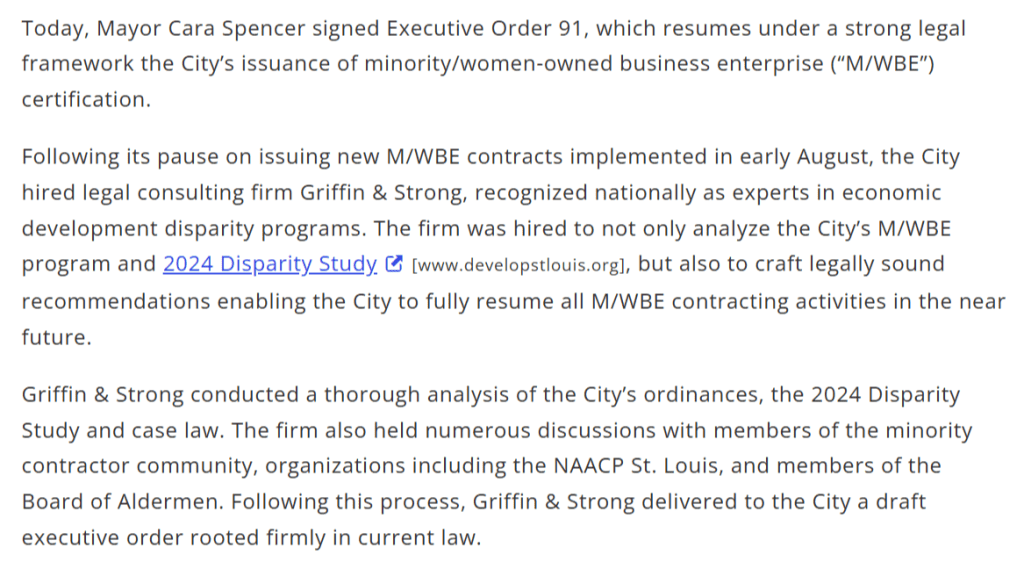
For instance, we requested any emails between the mayor’s office and the Atlanta-based firm Griffin & Strong, P.C. The firm was retained by the city to help draft a replacement for the city’s MWBE contracting and procurement program. The mayor’s later executive order restarting the MWBE program was said to have been based on the firm’s recommendations. Given the Spencer administration’s awkward and dramatic about-face on the program, I requested copies of any emails sent between the mayor’s office and Griffin & Strong, P.C. The result? According to the custodian of records for the mayor’s office, not a single email was exchanged between the Spencer administration and Griffin & Strong, P.C. Instead, the mayor’s office suggested that I seek records from SLDC. Stop and think about this. According to her office, the mayor made an embarrassing reversal based on recommendations from the law firm, while not exchanging a single email that could be made public under state law. While it makes sense that much of this policy discussion went through SLDC, as this is the agency in charge of the program, I still found it hard to believe that the mayor’s office decided on the policy contained in her executive order without exchanging a single email with the firm advising the city. I don’t know about your job, but I doubt the senior leadership at mine would make major decisions without direct communications with the legal counsel retained to advise them. Emails would almost certainly be one of the means of communication. Our request for records did include a limited amount of internal communication with the City Counselor’s office. None really reflected any conversations or gave insight into the process by which the mayor decided on the contents of her executive order.
It’s not just the mayor’s office. A recent request to the Board of Aldermen indicates that not a single email has been exchanged between members of the board and/or their staff relating to the most recent development in the continuing legal challenges that are stopping the board from enacting conflict of interest rule changes that were voted into the charter three years ago. This is despite the fact that the plaintiff in the latest appeal is Ald. Laura Keys. While the request did surface some documents relating to a January training for aldermen, there does not appear to have been any internal communication announcing either the city’s most recent court win in favor of the reforms or the latest appeal. How was this major piece of information that impacts the work of the aldermen not even mentioned in a single email?
For SLDC’s part, their slow response to a record request about former Spencer Chief of Staff Nancy Hawes was truly impressive. At the beginning of the administration, Ms. Hawes was named not only Mayor Spencer’s Chief of Staff, but also the chair of the SLDC board. Given her history as a real estate attorney and dual roles with the city, there was obviously a great deal of potential for conflicts related to her overseeing decisions involving developments from previous and potentially future clients.
The inquiry into Ms. Hawes’ previous dealings with SLDC began when the Spencer administration responded to an email stating that Ms. Hawes “did not represent developers seeking SLDC incentives.” Instead, then-Communications Director Beverly Isom stated that Ms. Hawes, “has focused on low-income housing tax credit and historic tax credit developments, where she represented the investor member, not the developer.” Given that these investors may still have material interests in matters coming before SLDC, a request was submitted for any emails sent from Ms. Hawes to SLDC in recent years. After months of being told that SLDC needed more time to fulfill the request, we were finally notified that some records were being made available on August 21st, almost a week after Ms. Hawes’ resignation as Chief of Staff was announced. SLDC has still not produced additional records, despite saying that they would be made available before the end of August. Ms. Hawes still serves as chair of SLDC’s board.
City Hall Insider Confirms Lack of Information is Purposeful
At first, I didn’t necessarily notice the extreme lack of information accessible using the state’s “sunshine” law, but, as so many requests continued to be returned with far less information than expected, the pattern became hard to ignore. The culture of concealment was apparent, but not in the responses from many departments. Rather, this aversion to transparency was revealed by the lack of information coming back. This begged the question: how are these important matters being handled without leaving any trace that would allow the public to understand what is driving officials’ decisions?
Searching for an answer as to why so little information was being revealed by most of my requests, I turned to a city hall source. I inquired as to how elected officials were primarily communicating. How were these important matters being discussed and decided without leaving any written record? His answer provided a window into the culture of concealment.
“There is a joke that the biggest learning curve in city hall isn’t learning to legislate or govern – it’s learning how to sidestep transparency requirements. Even low-level staff in seemingly mundane offices have adopted the strategy. I’ve been told by a few people I respect that it was a more recent change due to a mayor wanting to curb any potential bad press, and it having stuck as the de facto operating plan since it unfortunately works – but that change precedes my time here, so I can’t verify if that’s true,” stated the contact in city hall. They continued, “Most of this is done via phone calls, meetings with handwritten notes, and quick in-person drop-ins.”
As our contact’s answer shows, this is truly a cultural issue. Among those who work in city hall, a culture has developed that is focused on avoiding the state’s transparency laws. It has become normalized across departments. Local elected officials and their staff work in a manner that intentionally obfuscates the mechanisms behind their decision-making. This runs counter to taxpayers’ interests. This does not mean that public information requests are totally futile. As our reporting has shown, there is vital information that can be surfaced using the process. It does mean that requests will continue to be limited by the preference for concealment that pervades city hall’s culture.
Finally, it is important to note that almost every elected official you can think of loves to say that they support transparency when on the campaign trail. Those words are wildly out of step with their actual actions as officeholders, which clearly indicate that they are lying to the public about their devotion to transparent governance. If elected officials and their staff actually valued transparency, they would work in a manner that makes it possible. That said, you can count on this website to continue working to bring information to light and push our city government to be more honest with taxpayers.
As the website enters its second year of public service, we will continue to fight the city government’s culture of concealment. As always, thanks for reading!
UPDATE: This article was updated to include mention of communication with the City Counselor’s office regarding the new MWBE executive order provided by public records request.
If you are seeking to file a public information request with the city, you can use the city’s “sunshine” portal here. The individual custodians of record for various departments can be found here.
Emails from the Board of Aldermen regarding the ongoing legal challenges to conflict of interest rules placed in the city charter can be found here.
If you would like to support Mound City Messenger’s work pushing for more transparent governance, donations can be made here.