
Bring Metro Expansion Sales Tax Back to the Ballot
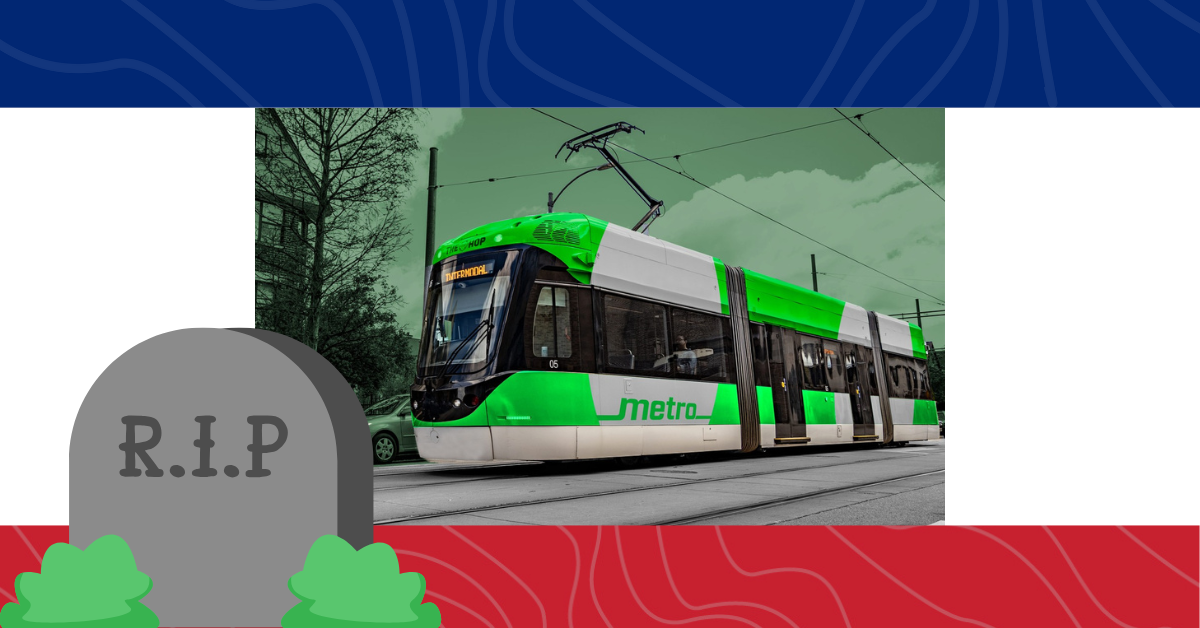
When the sales tax supporting the scuttled Metrolink expansion line was brought to the voters, I supported its passage. While I had some questions about promises made in the campaign’s messaging around expanded economic opportunity, the idea of making a significant investment in public transit linking neighborhoods to the north and south with Metrolink’s central line was very attractive. In fact, I live a block from the southernmost point in the route proposed for both the Metrolink “Green line” and the Bus Rapid Transit (BRT) that has now been raised as an alternative. Almost ten years later, I think it is time to repeal this sales tax. At the very least, city leaders should ask that it be reduced in line with significantly decreased construction cost projections or make a case that future public transportation upgrades warrant its continuation.
The most obvious reason to support a repeal pr rate reduction is that St. Louisans were promised these dollars would fund a much more expensive project. BRT costs are a fraction of those related to installing a new light rail line along the formerly proposed route’s 5.8 miles. Estimates vary depending on the study, but many point out that it can be done for around $20 million per mile. Other studies say costs are closer to $40 million per mile of new BRT service. Given that Jefferson is very wide and that the lanes will likely be installed on the existing roadbed, there’s no reason to assume that the project would come in on the higher end of cost estimates. As Trailnet CEO Cindy Mense said in KSDK’s reporting, “You’re not going to change the width of the street.” The cost for light rail installation would have run multiples of almost any BRT installation estimate. Like the BRT estimates, light rail installation costs vary wildly, ranging from $80 million per mile to over $300 million per mile. In the case of the abandoned rail line, it was estimated to cost close to $200 million per mile. Considering this wide disparity in costs, it is quite clear that taxpayers are paying the same in taxes for a project that will cost a fraction of the cancelled light rail line.
In the years since the sales tax’s passage, it has collected around $100 million in revenue. That’s tax dollars paid by all of us who shop in the city. As of last week, the Comptroller’s office says that $89 million is still in the account. This means that millions have already been spent on consultants for the cancelled Greenline project, but the vast majority of taxes collected remain ready to be spent. For the current year, the city’s budget projects over $10 million in additional revenue for the fund.

If we compare these numbers, it is clear that much of, if not the vast majority of, the funding needed to build the new BRT line is already in city coffers. At the lower end of $20 million per mile, the city would already have almost all of the money necessary to fund the route. Even at the higher end, the city would have much of the needed money in hand. Bi-State’s President and CEO Tauby Roach has even indicated that studies done for the light rail line would still be usable for the new BRT line, meaning some of the already invested dollars should be deducted from the estimated cost of BRT line. Additionally, much of S. Jefferson Ave. remains in poor repair, awaiting upgrades. This offers another opportunity to save costs on the BRT line’s construction, as it could be done alongside already necessary work on the southern third of the thoroughfare. Between financing based on future revenues and unspent Rams settlement monies, an alternative plan for paying the remainder should be something on which the city and Bi-State Development leadership can agree.
Now that we’ve dispensed with the math explaining why ending the tax wouldn’t doom the proposed BRT line, let’s talk about a big reason repealing the sales tax would be good: inflation has hit low-income households especially hard. In recent years, inflation has raged and driven prices of many daily items through the roof. As this is a sales tax, inflation has benefited the fund by increasing tax revenues beyond some projections. The flip side of the coin is that this also means that working people who are barely scraping by are paying additional sales taxes for a train line that will never be built. For many families, every dollar counts. Giving them even a modest reprieve would be a blessing appreciated by thousands of St. Louisans who are struggling under the pressure of skyrocketing grocery and utility bills.
While some will disagree with the idea of sending this back to the voters, I think it is the right thing to do. Just as I once thought voting for it was the right thing to do. It’s okay to change your mind based on new information. The city should bring this sales tax back to the ballot. If it can once again make a good argument for the levy, voters have shown that they are willing to make transit investments with their tax dollars. It is only fair that voters be allowed to decide whether the city’s new plan warrants their further investment.


