
An Optimistic Look at Kehoe’s Gerrymander
By Nate Kennedy
Late Friday afternoon, right as everyone was about to check out for a long Labor Day weekend, Gov. Kehoe announced he was convening a special session of the General Assembly to tackle two issues: gerrymandering our congressional districts and changing Missouri’s initiative petition process. The session is to begin on Wednesday, September 3rd.
In 2011, I was appointed by Gov. Nixon to serve on the state house redistricting commission. I have followed this issue closely ever since. Suffice to say, Kehoe’s policy goals for both of these issues are detrimental for our democracy, and I encourage folks to research the proposed “reforms” to the state’s initiative process. For the sake of time, I will stick to the gerrymandering issue.
Currently, Missouri’s congressional delegation consists of six Republicans and two Democrats. Kehoe and the GOP want to split Kansas City area Democrat voters into three districts, making it harder for Rep. Emmanuel Cleaver, or any other Democrat, to be elected from there. This would leave St. Louis’s district as the lone safe Democratic seat. This is being called the “7-1 GOP map”.
This is bad news for beleaguered Missouri Democrats, and these efforts should be opposed vigorously. I encourage everyone to call, write, and protest the Governor’s office and General Assembly this week. If the new map passes, there will be a court challenge. That suit’s chance of success is unknown. If the new 7-1 map should withstand the court challenge, Democrats need to be prepared, and there may be a silver-y blue lining behind the dark red cloud.
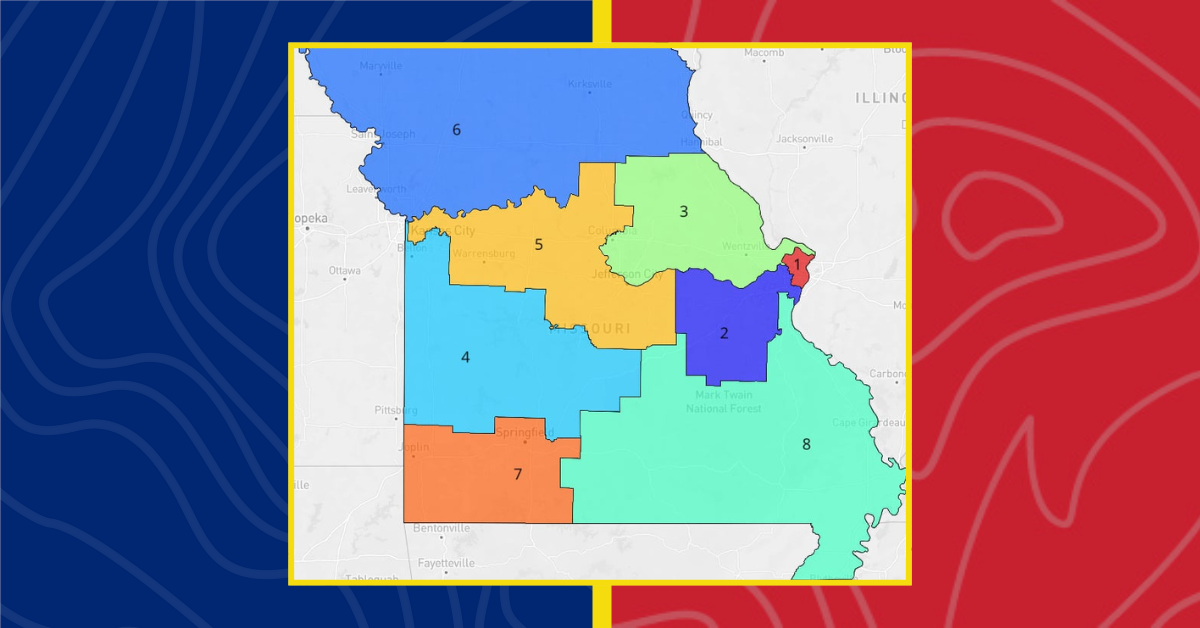
Using the online platform Dave’s Redistricting, I reconstructed Kehoe’s proposed map to the best of my ability and analyzed election results from 2016 and 2018 US Senate races. I used those two years because they represent the high water mark for Missouri Democrats in the last decade in a presidential and midterm cycle. Dave’s does not have 2022 or 2024 data available for Missouri at this time, but I don’t think they are as relevant for analyzing the full potential for Democratic performance in this case. I did consult some county level election returns for those years. After looking at the numbers, I believe Democrats have the potential to gain one to four seats if a midterm “Blue Wave” washes up on our shores, making it a 6-2 Democratic map instead. Let’s look at the numbers.
First, MO-1, MO-7, and MO-8 are virtually unchanged. The 1st district contains St. Louis City and north St. Louis County – areas that are heavily Democratic and contain the highest concentration of minority voters. The 7th and 8th districts span all of southern Missouri from Joplin to Hayti up to east Jefferson County and vote heavily Republican.
The next district that is changing the least is MO-2, represented by embattled Republican incumbent Ann Wagner. The DCCC has already announced they are targeting this district in 2026, and I doubt they will waver from that position under the proposed map. MO-2 and MO-3 swap territory with MO-2 taking in Gasconade, Crawford, Washington, and western Jefferson Counties. MO-3 takes in all of Warren and St. Charles Counties, shifting about 130,000 Republican, suburban/exurban voters between the two. St. Louis County still accounts for 70% of the district’s population. In 2016 and 2018, the GOP got just over 50% of the vote in the proposed district. Turn out is different between presidential and midterm elections, and measuring the difference between the two is key to determining Democratic potential for 2026. In the proposed MO-2, 184,126 Democrats came out to vote in 2016. By comparison, only 180,592 Republicans punched a ballot in 2018. This shows that the votes are there if Democrats can run on all cylinders and in the right environment.


Before I go further, let’s make some assumptions about the environment. 2026 is shaping up to be a Democratic wave election year, so what will it take to win if the gerrymandered map goes through in Missouri? First, Trump won’t be on the ballot and GOP turnout may be depressed for various reasons. Also, the only statewide office up for election is the auditor, so there won’t be a GOP senator or governor and associated PACs pumping in millions of dollars to whip up votes. All of these factors work in Democrats’ favor.
Unfortunately, Rep. Emmanuel Cleaver in MO-5, soon to be 81 years old, may retire after a proud career in public service if faced with a gerrymandered district, so we may lose that incumbent. In turn, the Missouri Democrats must recruit an A+ roster of candidates with fundraising chops to run in these new districts. Some possibilities are familiar faces from the past like former statewide candidates Jason Kander, Lucas Kunce, Chris Koster, or Crystal Quade. Some past or current state senators like Lauren Arthur, Doug Beck, and Stephen Webber or even folks from outside of politics with exceptional profiles might also consider throwing their hats into the ring. (And can we find someone like Iowa’s Rob Sand to run for auditor while we’re at it?)
Finally, the MDP, DCCC, and DNC would all need to make investments with dollars and boots on the ground to show that GOP gerrymandering must be stopped and no district will be left behind. Sixty-three percent of the Missouri population, five of eight districts, can be organized in ways we haven’t seen since the late 2000s – from urban downtown KC to rural Audrain, Barton, Crawford, and Daviess Counties. No voters should be written off. Granted, that’s a huge investment and work needs to start immediately, but Democrats can’t just roll over and assume the gerrymandering will disenfranchise all of us. They’ve got to fight! Now back to the numbers…
Since I mentioned MO-3 earlier, let’s look at that one now. Besides losing its southernmost counties, the 3rd drops all of its central Missouri territory and moves completely north of the Missouri River into NEMO. Boone County is still split, but the city of Columbia is made whole again. Putting most of Boone and St. Charles Counties together is an interesting proposition. The I-70 corridor is a relatively moderate area of the state. St. Charles County voted for the minimum wage initiative and abortion rights in 2024 and has remained only slightly red while other STL suburbs like Jefferson County have swung hard right. With the right candidate and top notch organizing in St. Charles, this district could yield results for Democrats in 2026 and beyond. In 2016, there were 160,713 votes for Democrats, and in 2018 there were only 166,611 votes for Republicans. This could take the district from GOP-leaning to a toss-up.
It is now time to go to the western side of the state to deal with all the funny business. The 5th district has long been the Kansas City/Jackson County-centered, safely Democratic district, but, under Kehoe’s map, it moves east down the Missouri River to take in a swath of rural, red turf. Instead of sharing a border with Kansas, it starts East of Troost Avenue, a historic racial dividing line, to take in most of the minority population in KC, along with Raytown and Independence in Jackson County. It makes a fork in Boone County to head north to Randolph County, and stretches south all the way through Jefferson City to Osage County. Democrats have a decent shot to hold on to this district despite the shenanigans, but it won’t be easy. This district currently gives Dems more than 60% of the vote every election, but will move into toss-up status if gerrymandered. In 2016, 158,718 Democrats turned out, marking 49.4% of the vote. In 2018, only 139,094 Republicans showed up, but that was enough to comprise 50.6% of the vote.
The rural, southwest Missouri 4th district is about to take in downtown KC. The west-central territory it ceded to MO-4 is swapped for the Jackson County suburbs of Lee’s Summit and Blue Springs, as well as a narrow strip of Kansas City that runs between Troost and the Kansas border all the way up to the Missouri River. It should also be noted that for the first time since 1982 Missouri’s two military bases will no longer be in the same congressional district under this proposal: Fort Leonard Wood in Pulaski County stays in MO-4, but Whiteman Air Force Base in Johnson County moves to MO-5. Rep. Ike Skelton, a Democrat, represented MO-4 from 1977 to 2011, and was ranking member or chairman of the Armed Services Committee from 1998 until 2011. Rep. Vicky Hartzler, a Republican, also served on the Armed Services Committee during her tenure, but her replacement, current GOP Rep. Mark Alford has not since he assumed office in 2023. In 2016, Democrats turned out to the tune of 153,973 votes, and in 2018 Republicans had 167,249 votes. The district is more Democratic than before, but needs heavy turnout and persuasion for Democrats to win it again.
Finally, we turn to MO-6, the state’s most northern district. Under Kehoe’s plan, it takes in a few thousand folks from south of the Missouri River in KC, and puts them in a district with Hannibal – way over on the Mississippi River. The district is so massive, it borders four states, tying with SEMO’s MO-8 (but there are only three counties between Illinois and Arkansas down in the Bootheel, and seven counties separating Illinois and Kansas). The northern Kansas City suburbs have been trending blue in the Trump era, which has been a bright spot for Democrats, but this district would be the least likely to flip under the new map. Republican Sam Graves has represented this district since 2001, making him the longest serving incumbent and no stranger to the KC suburbs. 147,082 Democrats turned out in the 2016 election, and 164,076 Republicans voted in the 2018 election, so a lot of folks will need to be fed up for the district to flip to the Democrats.
Despite Missouri moving firmly into the red state category in the Trump era, not all areas of the state have shifted in the same direction. Northern Kansas City suburbs and Jackson and St. Louis Counties have gotten bluer. St. Charles County has remained stubbornly light red. Taken as a whole, Republicans only got 50.2% of the vote in 2016 in the congressional districts they seek to gerrymander, so slicing that area of the state five ways may lead to surprising results. Educated and more affluent voters have trended Democratic in recent years, and they show up in midterms at higher rates, as well. Carving 63% of the state into smaller, winnable chunks may give Democrats an organizing structure to win back voters in suburban and rural areas and compete statewide again in 2028 and 2030.
If Kehoe’s gerrymandered plan goes through, 2026 will be an election cycle for the history books. It may be the first time in 50 years that one party has held all but one congressional district in the state (Democrats held nine out of ten seats in 1975). Or it may set an example of how political overreach can backfire. It’s up to the Democrats to decide their fate.
Nate Kennedy is a veteran political consultant with two decades of experience working in Missouri, Arkansas, and Tennessee. He holds a master’s degree from the Clinton School of Public Service, and currently resides in St. Louis.


