The Purpose of a System is What It Does: Interview with Janis Mensah

At 9am on a sweltering late July morning, down the labyrinthine corridors of the 8th floor of the Carnahan Courthouse in downtown St. Louis, former Civilian Oversight Board member Janis Mensah sits, stoic. The footage of the assault they were a victim of is being played, reversed, played again, paused, shown from a different angle, then slowed down. The gallery of supporters sits silently in the stale air of the courtroom as the prosecution interviews the officer who slammed Mensah’s head into the hard tile of the jailhouse floor.
Almost two years earlier, as a member of the Civilian Oversight Board, Mensah was responding to a fact-finding request at the city jail. Upon arriving there, they were asked to wait. A common occurrence for anyone familiar with visiting the jail. About an hour after their arrival, Janis was assaulted and detained by police officers, losing consciousness in the fracas. When Janis awoke, they found the summons and citation among their belongings.
Back in the courtroom, the questioning continues. Did the officer feel that Mensah was a threat? Did Mensah resist? Did the officer feel that force was justified? Could the officer have used more force? The stocky officer rattles off each predictable answer. The line of questioning is single-minded; there is no prior context to the officer’s assault of the defendant. Each action is legal. No mention of the officer’s prior relationship to the defendant. No mention of the duty the defendant was there to fulfill. No mention of the antagonism that naturally exists between the police and the people tasked with their oversight.
After the lunch break, the judge makes an announcement. The case has been dismissed. After nearly two years of dealing with the prospect of a trespassing conviction hanging over their head, Janis Mensah’s case is dropped. The prosecution has failed to properly file their case. The sighs of relief pass through the courtroom, and there is a brief moment of applause.
The support congregation is informed of a victory press conference at City Hall across the street. It just so happens that simultaneously, Mayor Cara Spencer is having a press conference. Self-congratulatory in tone, Spencer describes her first 100 days in office. She mentions the disastrous May 16 tornado that decimated swathes of the west and north side of the city. She specifically thanks the police and “local contractors”, with only passing mention of the droves of volunteers who made up the vast majority of the initial response. No mention is made of the obvious strangling poverty that made the tornado the disaster it was, as if it had torn a scab off the city to expose the real wound festering underneath.
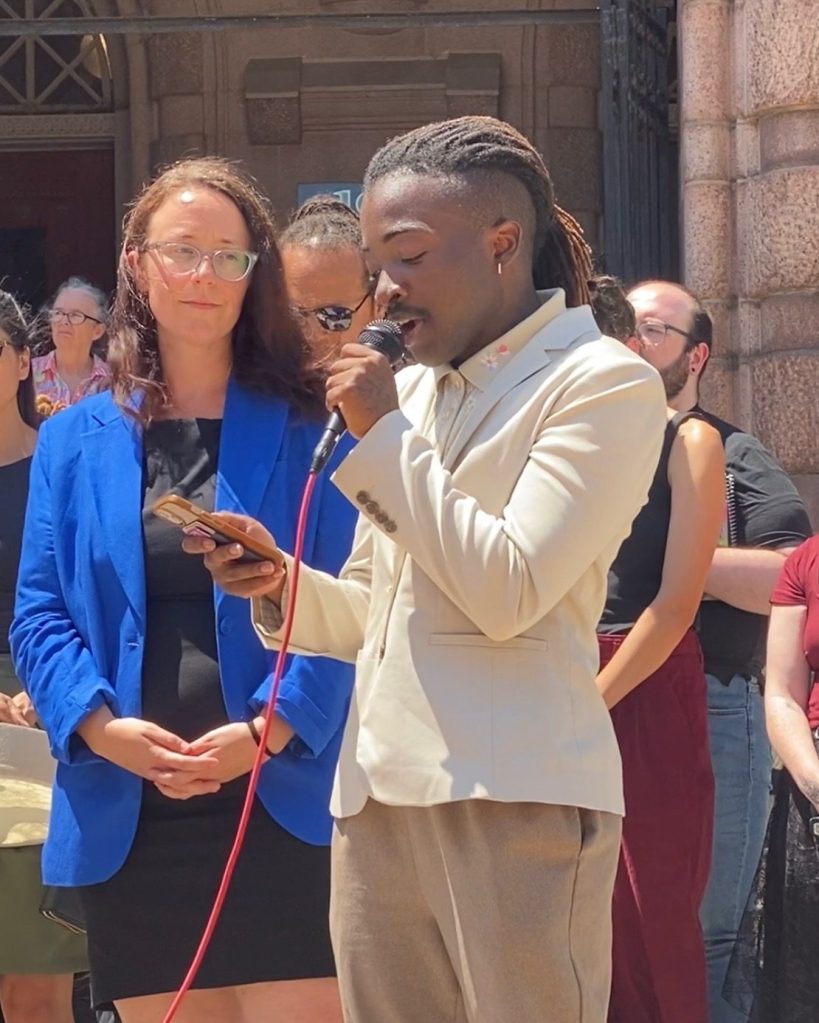
About twenty-five minutes into Spencer’s speech, she is confronted by Janis’ supporters. She has ignored the petitioning and the hundreds of phone calls to her office requesting that she drop the charges, as her predecessor ignored them. The mayor offers them a brief lip service, and the congregation retires to the hall, and then to a final celebratory banner unfurling on the steps facing 14th Street. For Janis Mensah, their personal pressure may have been released, but the struggle is far from over.
The following interview took place on July 25, 2025, the day after Mensah’s jury trial.
MCM: How are you doing today?
Janis Mensah: I’m good.
MCM: Must feel pretty good to be out from under all that.
Janis Mensah
Yeah. Things are still very surreal, but my freedom is starting to set in.
MCM: Can you tell me about the incident that started all this, in your own words?
Janis Mensah: Yeah.. Basically, I was the chair of the jail oversight board that Tishaura Jones started, finished my term after a year. And then I transitioned to the vice chair, and went… I was vice chair and just on the board and a lot of problems with the jail, including several jail deaths, I think, around 13, under that. The then commissioner, who has now been fired,, Jennifer Clemens Abdullah, and I went to the jail after unconfirmed reports that someone had died and someone who we now know as Terrence Smith, and went there to conduct an oversight visit, and, you know, their obstruction led to them calling the police unbeknownst to me, and the police show up, and within a few minutes have knocked me unconscious.
MCM: Right, so essentially what happened was you were there to fulfill your duties in an official capacity.
Janis Mensah: Yes.
MCM: And they wouldn’t speak to you.
Janis Mensah: Well, they were kind of back and forth about whether or not I could do an oversight visit, but the real crux of the matter is that while I was still waiting for them to come back and give me word about the oversight visit, they had already called the police to remove me.
MCM: And in your opinion, was this kind of a retaliation for you trying to fulfill your duties?
Janis Mensah: Yes, yes. I would say that it was meant to obstruct transparency and oversight and to cover up the reality of how terrible it is in the jail. I feel like it was retaliation for the leading role I played in calling for the resignation of the now-fired warden.
MCM: After this incident happened, it was some time before they told you that they were pressing charges?
Janis Mensah: No. I found a citation in my bag after I woke up in the emergency room, and that’s how I found out that I was being charged with anything.
MCM: So they didn’t even communicate it to you?
Janis Mensah: No..
MCM: How did things proceed after that?
Janis Mensah: Well, I continued to be on the board for as long as I could, because I still felt like I had a mission, which was to provide public oversight over the jail, and to represent the best interests of everyone involved in the facility. And that means people detained there- and staff. But I just saw more of the same with the board being really neutered and made ineffective. So I resigned, along with Mike Milton, who was also on the board, and actually was there that night.
MCM: How long after the incident did you resign?
Janis Mensah: Let’s see, I think I resigned in December, and this happened in August.
MCM: So after you resigned, they continued to prosecute?
Janis Mensah: Yes. Yeah, they did. It’s coming up on the two-year anniversary. It will be in about a month.
MCM: Okay. Yeah. Wow. So two years, you had to deal with this all hanging over your head. It wasn’t as if they really endeavored to give you a speedy trial.
Janis Mensah: No, and I think my experience is unfortunately a common one. I was awaiting a jury trial for almost 2 years, and I know the average time that people who are waiting for our jury trial in the CJC, I think they spend on average about 300 days. So it’s not uncommon at all. It certainly wasn’t a speedy trial, but it was also common.
MCM: There have been some recent events regarding the state taking over the city police
Janis Mensah: Oh, yes.
MCM: And now the state is threatening all of those still existing oversight boards. Yeah. Do you have an opinion on that?
Janis Mensah: Well, I haven’t followed that too much, honestly having been so focused on my case, but I will say that I was certainly a big supporter of local control of the police. I think it’s one of the only methods to having any control over the police. I think that public oversight and civilian oversight is incredibly important and it’s not 100% of the solution. I think it needs to work alongside a lot of other things. But I think it is the very, bare minimum and any obstruction to it is just evidence that the system is either very broken or is working very maliciously.
MCM: The purpose of a system is what it does.
Janis Mensah: Yes.
MCM: Would you, if there was a shift, would you resume a position on an oversight board? Would that be something you would consider?
Janis Mensah: You know, I have no idea. I think for that to happen, I would have to believe that the best way I could help the situation is to be on that board. And I think that one of the reasons I left the board is because I realized the work that I was doing off of the board to advocate for people incarcerated was more effective and more rewarding and more fruitful and the work I was doing on the board. That’s when I knew that this time for me was over. And certainly the fight was not over, but this position, this role was over for me. And that doesn’t even take into account or consider how much it was harming me.
MCM: Yeah, it must have been pretty stressful to have to engage like that.
Janis Mensah: Yeah.
MCM: So. I mean, in my opinion, what I know about how the police and government operates, it seems like the oversight board was a concession that they made that was set up to fail. Do you have any concept of maybe a more effective means of police oversight?
Janis Mensah: A more effective means… I’m not as certain with police oversight as I am with jail oversight. What I know is that the jail oversight ordinances were written very well, especially the first one. I do feel like it was written well. It did give a productive amount of power to the civilian oversight board, the power of subpoena, the power to tour with notice, but without conditions as to the time you were informed of that notice, the power to log investigations, to sit in on interviews with detainees. The ordinance was written well. What I think we needis buy-in and an obvious commitment to the spirit of the ordinance or to the spirit of the law, because I think that’s where we failed, is that there was no buy-in from the city. This was not an effort that the city was willing to put into their practices where their promises are.
MCM: So there was no real commitment from the city?
Janis Mensah: Right. Mm. The ordinance talked about the mayor moving mountains to ensure proper oversight if there was any obstruction, but that was just not what happened. In fact, the mayor was building the obstacles that we had to overcome.
MCM: We’re speaking of Tashaura Jones.
Janis Mensah: Yes, yes, yes.
MCM: What were some of the obstacles that she put in your way?
Janis Mensah: I think the city councilor’s office was an obstacle. I think this propaganda about the notion of proper training was an obstacle. The weaponization of this idea of confidentiality was an obstacle, just kind of not engaging, not responding to letters from the board, not responding to requests, to invitations to sit in on a board meeting, to hold public hearings. At every step of the way, either doing nothing or doing things that actually made it worse.
MCM: Can you give a specific story about a roadblock that you felt was intentionally put in the way?
Janis Mensah: Yeah, well, I can say that even though the past warden Clemens Abdullah was fired, maybe it was six months or so after the incident that happened with me in 2023, I felt like immediately after that happened, after radio silence, the mayor came out with a response, at least to the media, it was actually to our call for her resignation. The mayor came out with a response to the media that said she fully supported Jennifer Clem Abdilla’s actions, and that everything by the police was done by the book. And I think it’s sent a clear message. I felt like it sent a clear message that if you try to do the job you were given by the ordinance, you will be retaliated against. You will be physically hurt. You will be negatively affected in all these other parts of your life because of the fallout, and Mayor Jones was willing to support the people bringing all of that harm. I think it was a clear message to anyone who wanted to be civically engaged, who wanted to be committed in the same way I was, that you are not going to get anything done here, and if you even try, you will be persecuted and you will be prosecuted.
MCM: Now, this is Mayor Jones.
Janis Mensah: Yeah, Mayor Jones.
MCM: I’m not going to ask you to give a specific instance, but do you feel like Jones may have been acting like that under pressure from maybe police unions, or city police in general?
Janis Mensah: That’s a good question. Police in general. I’m not sure because I don’t know the inner workings of, and all of the politics with the mayor and the police and Tishaura Jones specifically, and what the politics may be with Cara Spencer, but I think for me, it’s simpler than that. It’s that the standard I hold public officials to is to overcome politics and to do what they promised voters they would do, and especially with the mayor, like Mayor Jones, where there was a lot of excitement around her progressiveness and around her activism. I met her in the streets of St. Louis at a protest. I was a big supporter of her when I worked for the Organization for Black Struggle when she was running. But to come from that and to have fallen so far is something that really, really is impactful for me.
MCM: Yeah, those actions certainly seemed to run counter to the positions that she held when she ran.
Janis Mensah: Absolutely. Absolutely. Especially around a jail when we know the conditions are the same as the, like all of the rhetoric that Mayor Jones used to talk about the workhouse, about inhumane conditions, not fit for human life, those all apply to the CJC. And her response to the CJC was nothing like her response to the workhouse.
MCM: If I can aim us back towards your personal experiences, can you tell us about what some of the feelings you were having during this trial over those last couple of days?
Janis Mensah: Well, I was feeling a lot of things. It’s a really dehumanizing process. And this seems like such a small thing, but I used to love wearing suits, but to feel like I had to wear a suit so that the judge and the jury could see my humanity is an experience that was very, very dehumanizing. To have to go into trial knowing the statistics and the disproportionately negative outcome for defendants who are young, black, trans. It was very, very, very difficult to know that jail was even a possibility on the table- and that I could be in the same circumstances as the people I advocate for and alongside every day. It’s just terrible. Going through this whole process has made me think a lot about slavery, and a lot about freedom, and a lot about how terrible it is that we treat each other in a way where we would put hundreds of people in boxes the size of an elevator car, with no access to sunlight or plants or anything that makes life worth living, not really able to talk to their family, to shower, to have recreation, to have movement. I was just thinking about some of the worst aspects of our society. And it was terrifying. And it was really, really, really difficult to have to watch a video of the police brutalizing me in a way that could have ended in my death be played,over and over in front of so many people and to have to have no reaction to that, for the sake of my relationship, with the jury. I don’t wish it on anyone.I kept feeling bad for people who would go through the same thing, but don’t have access to lawyers as amazing as Maureen Hamlin and Will Waller at arch city defenders. But people who don’t have the support of so many community members, hundreds of people, organizations, everything like that, people who are accused of more violent crimes, that carry more stigma. And I just, I can’t imagine how they go through it.
MCM: Sadly, I was only able to make it to yesterday’s hearing, but it was very. It was striking to me, at least. I was trying to put myself in the position of somebody that had to watch their own assault played back and analyzed and picked apart. And I literally could not imagine it. You’re a strong person for being able to go be a spectacle like that for people. Maybe that’s not a good descriptor of how…
Janis Mensah: No, I think it really is, because I was actually writing a poem about this and it was about how I would like to be a spectator again. I don’t want to be. the main character in this tragedy. I just want to be on the sidelines again.
MCM: It’s been reported in other outlets that you are a jail abolitionist.
Janis Mensah: Yes, I am. Absolutely.
MCM: Can you speak to that just a little bit?
Janis Mensah: For me, it means that I believe in pursuing a world without jails and prisons, and that is specific to my jail and prison abolition. Currently I’m focused on jail abolition in St. Louis, particularly, because I think this is an important site for abolition, and that abolition can and can and will happen here. My abolition is fused into a greater sense of the evolution of slavery, jails, prisons, and police.
MCM: Oh, that 14th Amendment.
Janis Mensah: 13th.
MCM: Ok, yeah excuse me.
MCM: Well, your optimism is infectious. Do you have any closing thoughts or remarks about your experience?
Janis Mensah: Yes. I want everyone to know that just because the case is dismissed doesn’t mean that all of the energy and momentum that people have put into supporting me should end. I think that it has a natural place to go, because the issue that I went to address when this incident happened is still very much so an issue. There has been no justice over Terrence Smith’s death or over any of the other 20 deaths that have happened since 2020, that there was a man, Samuel Hayes Jr. who just died in the facility on Saturday. I think that this energy and momentum should continue to shift into a collective call for action, and in my opinion, a call for abolition, because there is nothing that the city is doing that will prevent another jail death. I just think that no more jail deaths means no more jails.
MCM: Right on. Okay, thank you for talking to me, and I’d like to say, I think I speak for the entirety of the Mound City Messenger staff when I say, congratulations again on your case outcome and on the occasion, today would have been Emmett Till’s 84th birthday.
Janis Mensah: Wow.
MCM: So, I think that it is really an auspicious day to be able to speak with you. And on behalf of myself and I think many, many other people here in the St. Louis area, we thank you so much for your strength and bravery and for being such a unifying voice, I think, for people in the active community.
Janis Mensah: Well, thank you.