
HAMLET Fills The Air in Shakespeare Glen with Sorrow and Tragedy

The St. Louis Shakespeare Festival proved the showbiz adage “the show must go on” by successfully opening Hamlet just two weeks after a tornado tore through Shakespeare Glen, destroying much of the set as well as some equipment, including a light tower, before continuing its devastating path to the north of the park. That the show opened on time is a real accomplishment. That the production is a spectacular success is a tribute to the skill, passion, and dedication of the company’s artists, on and off stage, and the entire production crew. The play itself, one of Shakespeare’s most memorable, is a riveting, tension-filled drama that embraces the Bard’s script, celebrating the language and tragic plot.
The sudden death of his father brings young Prince Hamlet home to Denmark just in time for his mother’s remarriage to Claudius, Hamlet’s uncle – an event Hamlet considers even more rash and sudden than his father’s passing. Hamlet’s sullen, vengeful inclinations intensify when his friend Horatio and two soldiers take him to see an apparition, who suggests that Claudius murdered the old king. Hamlet’s suspicions are confirmed by Claudius’ reaction to the play “The Mousetrap” (not Agatha Christie’s version, but one arranged by Hamlet with a troop of traveling players). Hamlet’s thirst for revenge increases, marred only by his accidental killing of Polonius, the king’s advisor and father of Ophelia, the recipient of love letters from young Hamlet. Hamlet flees to England, thwarts the plot against his life by his uncle, returns to Denmark, learns of Ophelia’s death, and is challenged to a dual by Laertes, whose poisoned rapier is destined to kill them both – but not until Hamlet’s mother drinks the poisoned wine Claudius has prepared and Hamlet kills Claudius. Fortinbras arrives to discover the carnage, and Horatio tells him of the tragic events.


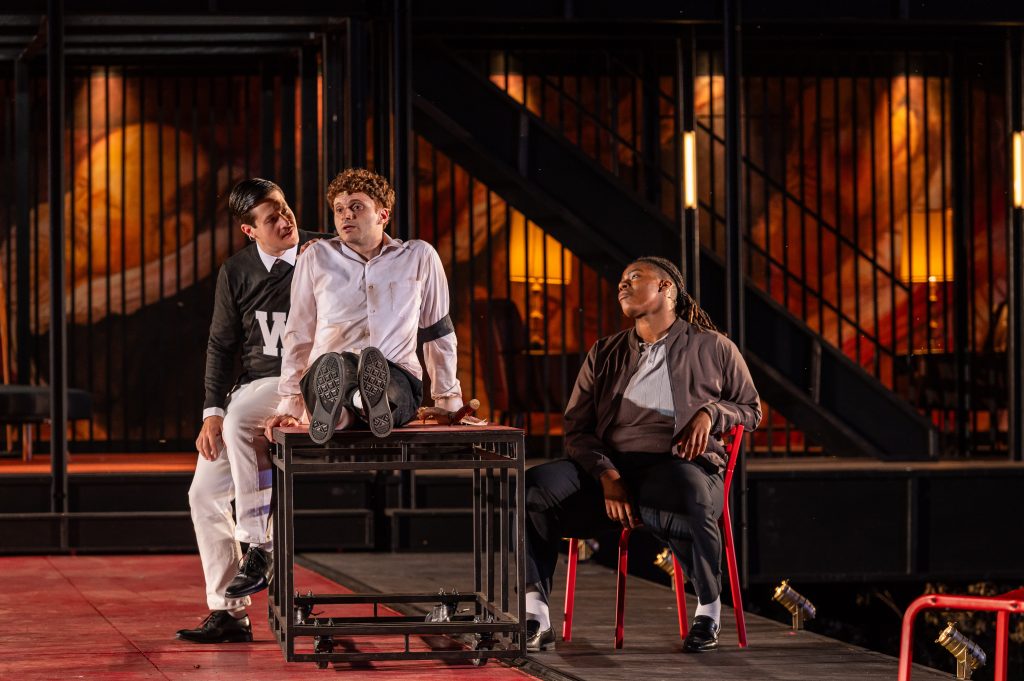

Michael Khalid Karadsheh is captivating as Hamlet, immersing himself in the prince’s turmoil with a pulsing anger that is almost manic but always rational, and an inner dialogue that reveals deep pain and reflective uncertainty beneath his exterior rage. Reginald Pierre is steadfast and keenly aware as Horatio, the only person Hamlet can truly trust, with fierce loyalty and a calming voice that’s always in Hamlet’s corner. Sarah Chalfie radiates with warmth, genuine concern, and then confusion and unbridled despair as the doomed Ophelia. Glenn Fitzgerald is ambitious and reckless as Claudius, and Jennifer Ikeda is a perplexed but not uncaring Gertrude. Mark Nelson is humorously loquacious and overly confident as Polonius, and Mitchell Henry-Eagles and CB Brown are obsequious and easily manipulated as the well-intended but unaware Rosencrantz and Guildenstern. Finally, Grayson DeJesus is particularly impressive as Laertes, replacing an injured Vaughn Pole, and effectively stoic and determined after just a week’s rehearsal.
Director Michael Sexten skillfully guides the cast through the machinations and plot twists that reveal the sad story, embracing the script with a welcome commitment to its language and poetic rhythm. A contemporary setting and unexpected staging, beginning with a well-choreographed dance during the opening wedding scene, add visual interest and context to the classic play, keeping the audience involved in the unfolding tragedy. The multi-level stage, designed by Scott C. Neale, provides abundant areas for the action, which also briefly moves through the audience, while the sound design from music director and composer Brandon Wolcott, performed by musician Brady Lewis, envelops the production with its haunting, sad melodies. The result is a familiar production that feels fresh and bristling with tension.
The St. Louis Shakespeare Festival’s Hamlet captures the tragedy of Shakespeare’s script and adds modern sensibilities without losing the essence of the original. With a little romance, suspenseful manipulations and deception, surprising moments of genuine warmth and humor, and a climactic ending filled with swordplay, there’s a little something for everyone in this play and, although younger viewers may be challenged at times, the show is suitable for all ages. Longtime fans of Shakespeare, first-time attendees, and everyone in between are sure to be entertained by the fast-moving, if often contemplative, tale filled with sorrow, emotion, and tragic consequences.


