
Allen: Destroying North St. Louis Has Been City Policy for Decades Pt. 2
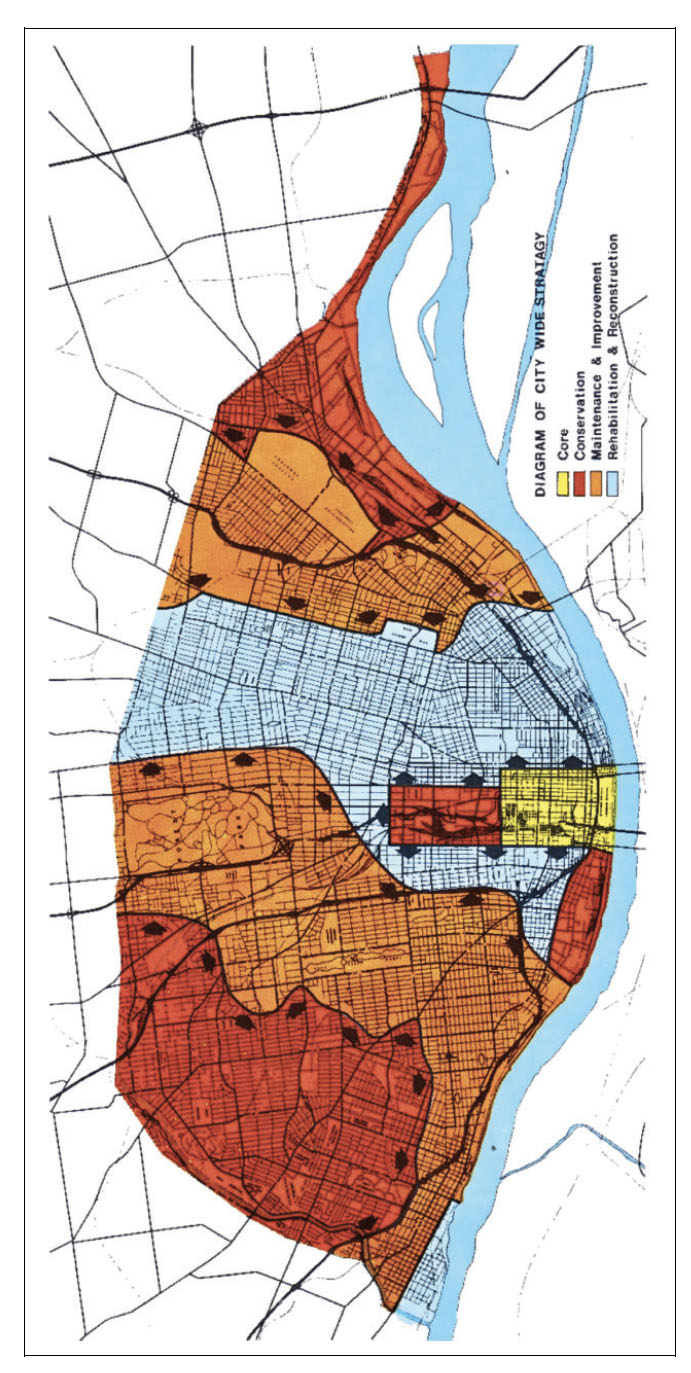
This is a continuation of yesterday’s piece by Michael Allen. Click here to read the first part.
By the end of 1975, Poelker appointed Roach to head the Community Development Agency. Although he denied any embrace of the “triage” idea in a newspaper interview, in February 1976 he directed federal funds to claim 27 houses by eminent domain if necessary on the 3900 and 4000 blocks of Evans Avenue in Vandeventer to expand Killark Electric’s plant. (That same plant is where St. Louis Development Corporation currently is building The Monarch, its workforce development center.) The residents and owners protested, and Roach said the city needed every bit of economic development it could grab to survive. Later that year, the Missouri State Auditor investigated a contract held by Eagle Realty to provide rent and repair services to the city’s Land Reutilization Authority since 1973. The investigation led nowhere, and Eagle would hold that contract into the 2000s.
In 1981, Roach’s successor on the Board of Aldermen, Vincent C. Schoemehl, became mayor. Schoemehl eventually hired Milton Svetanics as his chief of staff. After a high-profile rape in an abandoned north side building, Schoemehl unveiled his $2.7 million plan to demolish 1,067 buildings in north city in July 1987. He called for a “total commitment” to demolishing vacant north side buildings, and got his way in a 26-1 vote by the Board of Aldermen. By then, Roach was vice president at the private Pantheon Corporation, a company considered a “friend and political ally” of Schoemehl who would land a master redeveloper contact in the city’s Compton Hill area (now the “Gate District”) in 1980. When the Board of Aldermen rescinded that contract in 1988, following very little building, all that Pantheon really had achieved was driving Black residents and businesses out of the area.
Toward the end of his mayoralty in 1991, Schoemehl offered in the St. Louis Post-Dispatch a rather naïve explanation for why the north side was suffering so much vacancy and deterioration. “It’s just a matter of economics,” the mayor said, claiming that the north side had more “old houses” than the south side and a lower percentage of homeowners. The same set of Post-Dispatch articles showed that 44% of all city property at the time was owned by absentee owners, a dynamic for north city that the mayor left unaddressed. Schoemehl’s housing conservation project Operation ConServ included 21 areas, only seven of which were north of Delmar (and none the most resource deprived areas). Schoemehl opined that he would not intervene in the worst north side areas without complete rebuilding “in a most strategic fashion.” The urban triage doctrine would never need to be named to be pursued.
In 2007, developer Paul J. McKee Jr.’s blockbusting purchasing pattern across the near north side was exposed to the public, and his “Northside Regeneration” scheme unveiled. McKee’s project would uproot thousands of residents of JeffVanderLou, St. Louis Place and Old North, and lead to the destruction of a lot of the surviving buildings in areas hard hit by past waves of demolition. Few paying attention would have noticed that McKee had contracted land acquisition to a company called the Community Program Development Corporation (CPDC), owned and directed by Lou Berra, Poelker’s former deputy chief of staff. CPDC in turn subcontracted a lot of the work of knocking doors and buying up Black families’ houses to Eagle Realty, then run by Harvey Noble and Steven Goldman. The same power structure that distributed contracts and power in the 1970s was still benefiting from the publicly-financed destruction of north St. Louis.
The processes that enabled the City Plan Commission’s triage model precede 1973, and include the St. Louis Metropolitan Real Estate Exchange’s 1923 and 1941 referendums setting Jim Crow boundaries for property ownership and lending in flagrant violation of the 14th Amendment. These were coupled with informal practices across the lending institutions and insurance companies, which still flout federal fair housing laws, and many official plans including McKee’s Northside Regeneration project and the resulting National Geospatial-Intelligence Agency (NGA) relocation. (Ironically Team Four nemesis Bill Clay’s son and successor as Congressman, Lacy Clay, eagerly supported the NGA project and using eminent domain against Black families on its site.) There is nothing natural about the disaster that has robbed the north side of wealth, safety and population, and there is nothing conspiratorial about the white political actors actions against its future. Unfortunately, the material interests that fomented “urban triage” are alive and well, and, as Northside Regeneration shows, even in the hands of some of the same actors. Schoemehl has returned to political relevance as a mentor to current mayor Cara Spencer.
The past is not even past, per William Faulkner, but it also is not destiny. St. Louis city government’s destruction of north St. Louis has been a series of deliberate choices that have maintained a certain power hold. Mayor Spencer was not even born when the Team Four memorandum was written, and the tornado situation is begging her to break the chain. Rebuilding all of what was lost just this month certainly is not possible, although more could happen than people assume. Rebuilding what has been destroyed under decades of white political control won’t necessarily happen either. Yet there is no reason why the city government cannot honor each and every person still living in north St. Louis by recognizing that they are the city itself – a daring act that would undo the doctrines of the 1970s that asserted that people were lesser citizens because of the conditions of their neighborhoods. It’s time that St. Louis ends Jim Crow urbanism, and the tragedy of the tornado may prove to be an essential and needed clarion call.

Michael R. Allen is visiting assistant professor of history at West Virginia University, and until last year, executive director of the National Building Arts Center and a faculty member at Washington University in St. Louis.


