
A Spectre Haunts Omaha


As the nation enters into economic uncertainty brought about by the erratic posturing of the current White House regime, in tandem with the post-COVID austerity and existing high interest rates, the already great burden on working people continues to increase. Property values and rents are rising, along with the costs of everything from food, to clothing, to auto parts. There doesn’t seem to be any hint of relief efforts from lawmakers, who seem to be engaged more with spectacle, culture wars, and justifying the export of billions of dollars to various proxy wars abroad.
In the face of increasing housing costs, the tool that working people have to represent themselves is the same tool that they’ve been availing themselves of for over 200 years – union organizing.
While the idea of a union member might conjure an image of a denim-clad, hardhat-doffing steelworker, the reality of unions is more diverse. Labor unions cover everything from service industry and retail workers, to healthcare, coding and IT, the eponymous wrench-swinging UAW workers, ironworkers, and linemen, to the public sector workers who keep the gears of public services turning. Public sector unions, in fact, have a much higher percentage of unionization (32.2%) than the private sector (5.9%) and black workers have a higher percentage of union representation (13.2%) than white workers (10.8%) according to the 2024 Bureau of Labor Statistics finding.
Outside of labor- there are various types of unions struggling for the common person. Unions of all types are a core tenet of class relations in this country, and have secured for their members a higher standard of living than was ever going to be possible through workers negotiating individually for their wages and benefits.
Alongside labor unions, tenant unions are an indispensable weapon for the proletarian who has been largely priced out of the home buying market. Tenant unions are a major bulwark against an increasingly aggressive and ravenous landlord class. Tenant solidarity is especially important, given the ever-worsening trend of properties being consolidated among fewer and fewer hands. Knowing their importance to regular working people, what would be the outcome if the legal legitimacy of tenant organizing should come under fire?
An organization in Omaha, the first of its kind in the city, is facing this problem, and the outcome of this case could have nationwide repercussions.
Seth Cope is an organizing member of Omaha Tenants United, a group of young socialists seeking to improve living conditions for their town’s tenants. A simple, human-hearted goal, though one for Seth that’s proven difficult enough in practice.
“So we started back in 2018. At the time, we were doing this, a few of us, I guess I should say, were doing this sort of food distribution thing called Feed the People. And we didn’t want that to just be like a one-way street. We’re just giving people food and that’s it, because obviously there’s a lot of churches and other organizations out there that can do it on a much larger scale than a bunch of, you know, 20-something leftists can. And so we primarily saw it as a means to try to identify other issues going on in the people’s lives already coming there that we could potentially organize around, politically. And so, we’d always make sure to try to ask questions about people and get to know them and their lives. And kind of just like the recurring theme with landlords, landlords, landlords is their biggest this year. So, we were like, we got to start a project that is capable of focusing on this.”
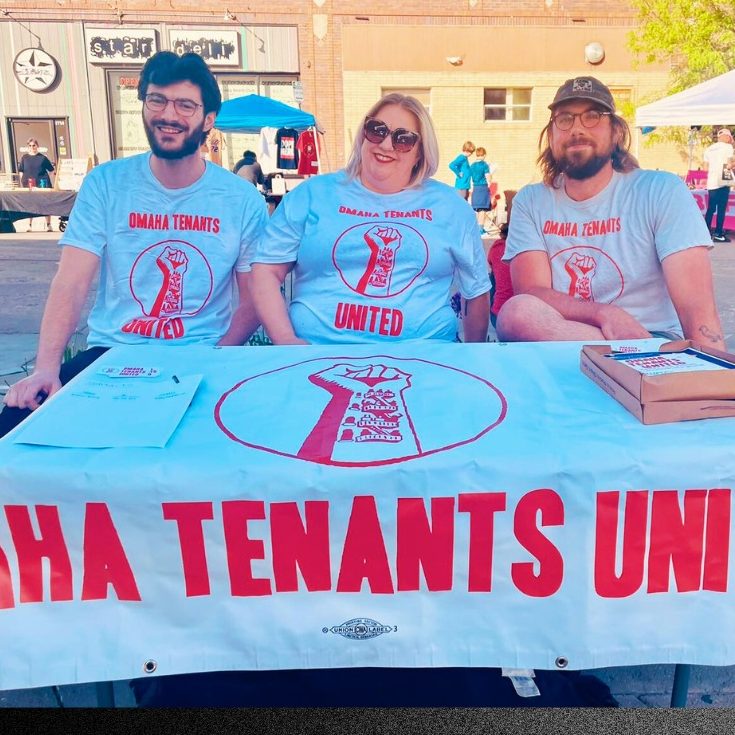
So from humble beginnings, Seth relays the first forays into their tenant organizing efforts. Hot water heaters, small repairs, and overcharges, providing reasons for tenants to build collective power. He recounts how easily they have achieved victories, as Omaha’s landlords seem to be genuinely shocked that there is any organization representing tenants at all.
“I mean, that’s obviously pretty small scale. It showed us that we can really get under these people’s skin. And when they see that there’s another set of eyes on things and people are rallying behind something… that can move the needle. And so for the next little while, we just kind of kept repeating stuff like that. We were just basically, you know, we didn’t really have any sort of social media platform back then, so we would literally just start knocking on random doors of landlords who we knew sucked, particularly like Dave Paladino, who was a notorious landlord. He died in a plane crash a couple years ago, actually, but he had a really grisly reality show that’s no longer on Netflix called The Super, it’s just him.
So we basically just go around to all of his buildings, or other landlords that we knew had a bad reputation, and we would just knock on their doors, see who’s having problems, and almost every time you get at least one or two people that do. And so that’s kind of just what we did for the longest time. We take individual cases like that. One of our big first ones against Dave Paladino was, there was another person who was coming to the food distribution that he was trying to rob of like $3,000 to move out, even though we had helped this person, like make sure that the apartment was clean and everything. And we basically just occupied his [Dave Palladino’s] office with like 30 people until he sat down and wrote a check giving all the money back, which was great.
For the next couple years after that, we continued really just doing individual casework like that. A couple small, like collective things involving like a handful of tenants, but nothing like permanently building a tenants union. And there’s probably some criticism to be had that we spend too much time doing those sorts of individual cases instead of trying to scale up to larger collective things, sooner. But I think the thing that needs to be understood about Nebraska… we’re not like LA or New York that have 150 years rich history of tenants organizing and building unions, you know. Like this was completely unheard of. So we kind of had to show that like directly confronting your landlord, organizing around demands works, because in Omaha, everybody thinks it’s like you call the inspector and if they can’t do anything, which, spoiler, they never can… that’s just kind of the end of the line. And until recently, people would, if they had the money, they tried to get lawyers only to find that nobody in Omaha represents tenants, because they all represent landlords. Now there’s a couple good tenant attorneys in town, one of which is representing us, currently.
And, yeah, so, I mean, all in all that stuff was successful, but now, as of 2024, we’ve really focused more on big collective issues. The first one occurred in the summer of last year. A tenant from an Elevate Living property, which is based in Minnesota, actually, reached out to us, and it was a huge complex of like 300 units. And I mean, we had probably spent a month or two just canvassing super hard, trying to hit every single one of those doors. The first couple times we just went out and tried to talk to a decent amount of people to formulate demands. Like, what could be some collective demands that are impacting everybody and that we can rally people around. And then, for the next couple months there, we just spent a great deal of time knocking on every single door, trying to talk to as many people as we possibly could to sign off on these demands in the form of a petition. Once we got to a level, I want to say we got like 50 or 60% of the building signed off, and that was also, you know, that’s not counting vacancies.
And just to get like a taste of kind of the crap that landlords try to pull with this stuff, you obviously flyer really heavily for that meeting, and we received a correspondence from Elevates’ attorney that we could not have a meeting on the property and that we would be barred from doing so. And it’s like, well, this is mostly all of your tenants, you know, and maybe like three to five OTU people. You know, they just think both us and the tenants are too stupid to know what the rights to freedom of speech and freedom of assembly are. And so we obviously just ignored that and had the meeting anyway. Nobody showed up to try to stop us. They thought we would just get really scared by a letter from a lawyer and lay down. In any event, we had a great showing at that initial meeting. We were able to secure the vote, pretty much unanimously, of everybody that was there to form Nebraska’s first tenants Union.”
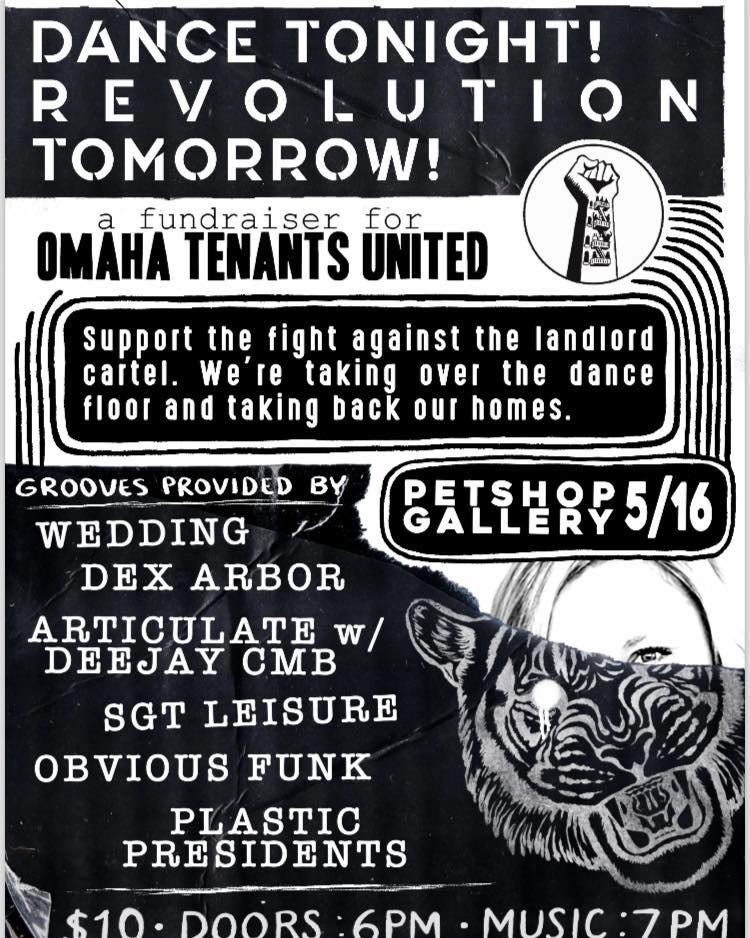
Through these first struggles born out of collective compassion and solidarity was born Omaha Tenants United. Just one of many upstart tenants unions coming into being around the US as bipartisan economic oppression continues to bear down on working class people.
Their victories would not continue without obstacles.
“Shortly after that, we were successfully able to organize three more unions, all with kind of similar stories as the first. But the most significant one, thus far, was with Tadousac Tenants Union. The property is owned by the Lund Company, who’s probably Omaha’s largest local landlord. I rent from them, and they’re a bit more concerned about their public image than others. So as soon as we got a story on the news about it, they were freaking out. They made, frankly, most of the repairs and stuff before we even sat down with them. But we were able to get them to agree to meet with us, including the president and CEO of the company, to have Nebraska’s first collective bargaining negotiations between tenants and landlords. We were able to get further concessions at that meeting.
That was actually the source of our first accusation of unlicensed practice of law (UPL), and that’s from Lund’s attorney, of course, because of the way that Tadousac started. We had an individual reach out to us about some crazy mold issues and this giant hole in their bathroom, which they had still not repaired. And so we really wanted to organize the building, but since her issue was quite pressing, we were like, ‘okay, we’re going to go ahead and send off an individual demand letter for you and then work on organizing the building in the meantime’. And she was a great tenant leader with them, really like committing herself to reaching out to her neighbors.
But in any event, we sent off that initial demand letter first. We immediately get hit with a letter from Lung’s attorney, Tara Holterhaus, her name will come back up here shortly, accusing us of the unlicensed practice of law, saying that they’re going to report us to the council of discipline under the Nebraska Supreme Court. We, of course, just think it’s a bogus charge to begin with. So we consulted our attorney on, like, some case law examples, because, you know, we want to try to do everything ourselves to the extent that we can, unless we’re forced to go into the courtroom. We kind of keep the attorney consults in our back pocket. So, we responded with some good case law, and, obviously, it’s just absurd. I mean, first of all, the Nebraska landlord tenant act very clearly states you can form tenant unions. And, you know, what is a union of any sort if you’re not able to speak on behalf of and with your neighbors? So we sent a reply to that, and that seemed to shut her up, because even the Lund president was super, super concerned about the fact that that letter was sent. It obviously riled up tenants even more. And so she admitted to us, verbally, that that letter should not have been sent and that was not an appropriate way to go about things.”
So we see a legal gambit, made by young attorney Tara Holterhaus of the Spencer Fane firm, whose website describes her practice as “creditors’ rights litigation in Nebraska, Iowa, and federal courts”.
It’s plausible to assume that this accusation was made in the hopes that it would immediately shut down OTU’s organizing activity without any further repercussions. It did not.
“So we thought that was done. And for what it’s worth, the original tenant, the demands were met. The bathroom was repaired, and she did, in fact, get a whole month of rent back, as well, which was also another one of our demands. So we thought it was pretty well done.
Our most recent unionizing effort, which unfortunately kind of fizzled out, was the Drake Court Tenant Union. The issue there is that this landlord, HD [Harvest Development] Omaha, comes in and immediately forces everybody onto month-to-month leases, and raises rent by as much as like $300-$400, you know, clear like renew-eviction thing. They want to try to force all these people out, because they know they can’t pay this, and they want to bring in wealthier tenants. So that unfortunately fizzled out. I mean so many tenants couldn’t afford to keep staying. We also got a letter from their attorney saying the same thing that Tara Holterhaus had, and we responded the exact same way we had before. You know, we’re not worried about this… it worked the first time… whatever. So, because he’d also put in that letter, it was seemingly an indication that they would be willing to meet with the union.
So, we wanted to focus on that, first and foremost. But in any event, we followed up for a meeting time- several times, and they would not give it to us. So we- two OTU people, along with four members of the union- just simply showed up at their office and said we wanted to meet. They actually let us in to sit down to meet with the CEO. They did make the OTU people leave, which is fine, whatever. But he basically told the tenants, and remember, this is four people… he said, I won’t meet with a mob, and he said that they would not recognize the tenants union. I mentioned those things because, I want to be clear, landlords think that they are their own, judge and jury.
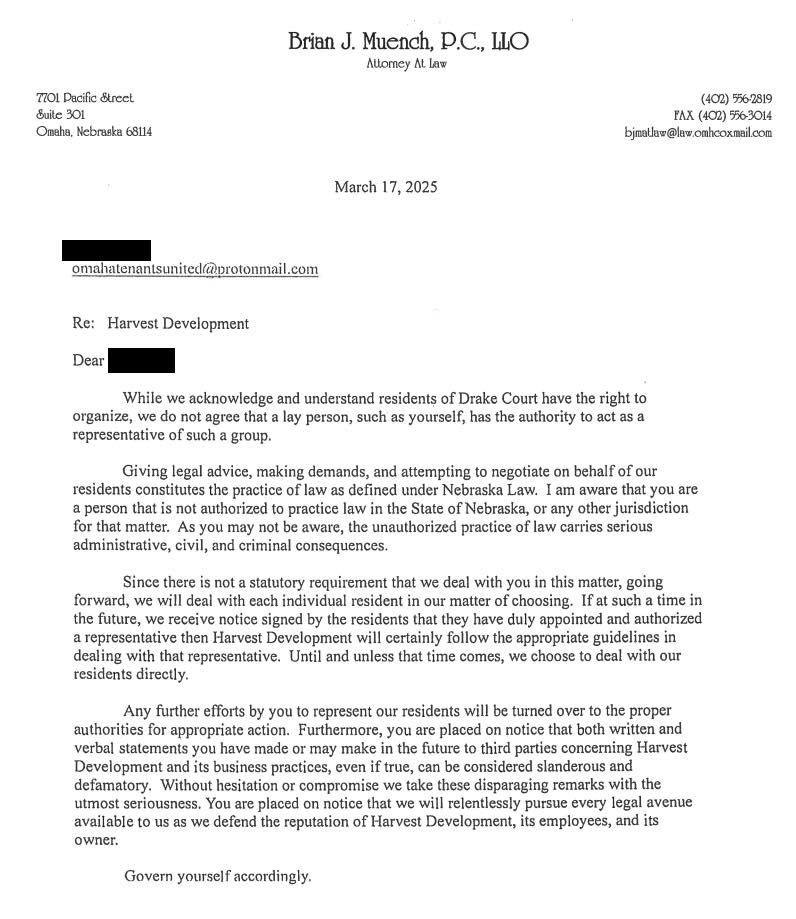
Because it’s not his, if you’re following the law, it’s not his decision to determine whether a tenants union is valid or not. That’s codified in Nebraska state law. But, you know, with just a wave of his hand, he’s, ‘Well, I don’t recognize it, I don’t care what the attorney’s at, and I’m not going to talk to a mob’.
That shows you just how scared these people are of organized tenants, too, which is also really important. So, they were still kind of bleeding tenants because people just, I mean, you can’t afford a $300 increase in rent out of nowhere. Like, you know, so on the one hand, there’s only so much we could do there.
I would say a few weeks later, it was the first week of April, we received a letter from the UPL Commission’s council of discipline, saying that they had found we are practicing law without a license. They did not provide any sort of legal theory or justification whatsoever to say why. They merely included four of our demand letters, from various landlords over the years. I mean, dating back like three years. They included a proposed consent decree, which basically said this would go away if we agreed to, it was effectively saying we won’t organize tenants anymore, which was obviously not a deal we were going to take. I think, once again, this is an example of just the low level of regard that landlords have for not only us, but their tenants. Like, to think that we would be scared into simply overturning Nebraska tenant law and our own organization. You really don’t understand our attitude if you thought we were going to sign that document.”
At this point, it might be relevant to contemplate the ramifications of what the Nebraska UPL Commission and Council of Discipline are proposing- that informing people of their rights under the law amounts to practicing law without a license.
Imagine the implications this could have under the current Trump austerity/xenophobia regime, that is currently looking to suspend due process and habeas corpus.
“So we, of course, submitted an appeal. They still have not even acknowledged that we submitted an appeal, which, you know, it’d be customary to at least say, hey, we received it, blah, blah, blah. But, I mean, the concerning parts about this, given all these letters come from over the years and across multiple landlords. It’s clear that this is a coordinated attack by the landlord lobby. And, furthermore, Tara Holterhaus, the attorney for Lund, is on the UPL Commission. And it’s our understanding that the original complaint was filed in September of last year, and we have some intel, from a former Elevate employee who wants to remain anonymous, that it was in fact Elevate that had submitted this. I guess they were all giddy in the office about how ‘Ha ha, what’s coming for them. They’re about to get served with this unlicensed practice of law’.
Apparently the complaint was lodged in September. It was then voted on in January of this year. Then it was not until April that we were notified that this vote had even occurred. We’ve requested documents for both the original complaints, so we knew what was going on here exactly, as well as the meeting minutes from when it was voted on. Because we’re at this point, we’re basically fighting blindfolded with a hand tied behind their back, since we don’t even know on what basis they came to the. You know, there’s no rationale.
They’re just asking us to believe them that they have a strong case here. And, just as importantly, to show that Tara Holterhaus, in fact, recused herself from the process. All of those records requests have been refused. When the UPL Commission has been asked about it by local media, directly asked if Tara Holterhaus had recused herself, the head of the commission, I believe his name is Mark Weber, says, ‘I can’t comment on that’.
So, you know I think they screwed up, and she did not recuse herself, and I think they thought we would just get really scared by a bunch of suits and a scary letter and go away. But, you know, that’s not the case at all. The stakes are way too high here because, if this is allowed to go through the same, whatever bullshit legal theory they’ve come up with for this, it would not only probably be weaponized against just about every tenant union in the country, but it could easily be weaponized against immigration rights organizations, you know, women’s reproductive organizations, and quite possibly labor unions. Because even in Nebraska law, if you go to the unlicensed practice of law statute, subsection E… there is a carve-out for labor unions that says UPL does not apply to labor unions. So, again, with Nebraska having a law that says you can form tenant unions… why would that same thing not apply?
It may not be this year… maybe not next year, but maybe in five years… if this is able to go through, are they going to turn around and start reevaluating that cutout for labor unions? And then could that be applied elsewhere outside Nebraska? That’s incredibly possible. And that would, I’m not even trying to sound overly doomsday or exaggerating, but that would fundamentally reshape the structure of the United States economy in some really damaging ways.”
What has materialized is: because a handful of rent-seekers decided to try and scare their tenants out of organizing, a Nebraska commission is pushing for a change that could fundamentally unglue the nation’s basic legal framework around organizing.
Cope continues:
“I do think they probably felt like, let’s see how this election goes, and maybe the Trump administration gives a little bit more favorable environment to pursue what I see as a completely frivolous, and, frankly, a slap lawsuit. So, I can only speculate, but it’s hard to reconcile the timeline of all this, without thinking there’s some deeper political calculations going on. If the UPL Commission does not accept our appeal and still rules, we’ll be going to the Nebraska Attorney General first. He’s a real, I can’t recall his name, but he’s a real firebrand of a Republican, to say the least. And so I would be pretty concerned that I could see things going sideways at the state level. I think if we had to take it to the federal level, despite everything going on right now… I do think we’d have better odds there. I mean, those judges are more… they’re more aware of the blowback of things like this. I think they would be hard-pressed to take this seriously. and want to engage in that. But that’s all speculation. I could be completely wrong, and I could just get railroaded at those places. Or we just simply win here at the state level and it doesn’t go any further. But, I am optimistic that we would ultimately prevail, one way or another. Because that would just be, it would be such a landmark case.”
It’s shocking to consider that this is a possible outcome. Just because a few kind individuals wanted to ensure the secure and safe living conditions of their fellow human beings. This is the end result of class antagonisms inherent in this country’s mode of production, however. A central contradiction in the prevailing philosophy of economy: do we protect the property rights of a handful of landowners, or the civil rights of millions of people forced to rent from them? One side, or the other, must be chosen, or these struggles will play out indefinitely.
OTU remains optimistic that their position will hold, and that the Nebraska courts will maintain the legality of tenant organizing within the state. Quoting their website: “We don’t always win, but when we take on a case we do everything we can to build tenant power. And that means fighting! We look forward to the future of tenant power in Omaha, in the US, and around the world.”
OTU can be reached here; on facebook; and instagram
All photos provided by OTU or from their Facebook page.


