
The American Songster Dom Flemons Wows At Focal Point, Talks STL Connections
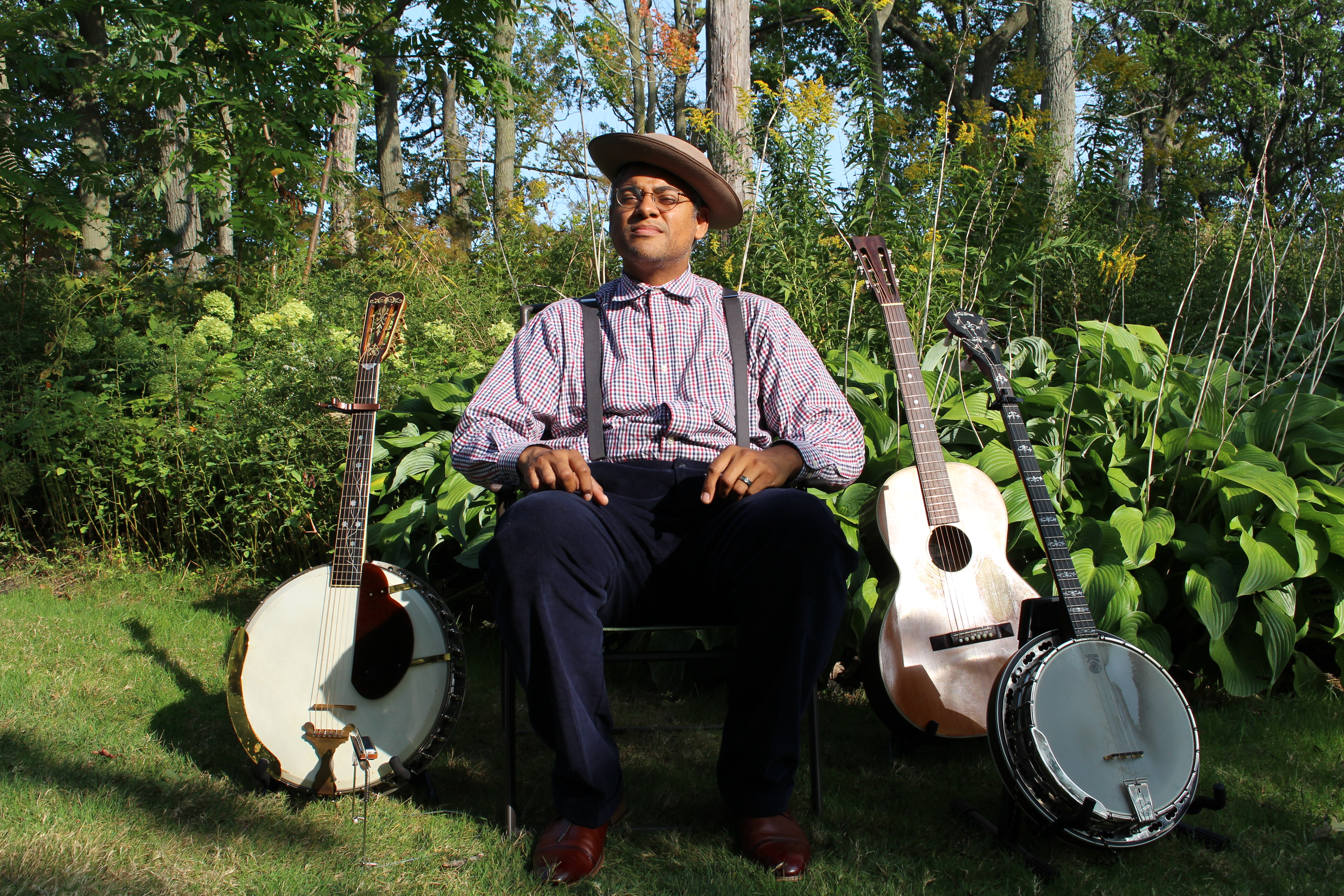
Seeing an artist with multiple Grammy nominations, and even a win under their belt, play a small listening room that only seats around a hundred people is not an everyday opportunity. For those of us lucky enough to attend last Wednesday’s Dom Flemons concert at Maplewood’s The Focal Point, it was a memorable experience. Known as “The American Songster”, Flemons is one of the nation’s premier folks multi-instrumentalists. The ease with which Flemons shifts between instruments, often playing two at once, is a rare talent. If his name sounds familiar, but you can’t quite place it, readers may also know Flemons from his previous act The Carolina Chocolate Drops. Their 2010 album Genuine Negro Jig took home the Grammy for Best Traditional Folk Album.
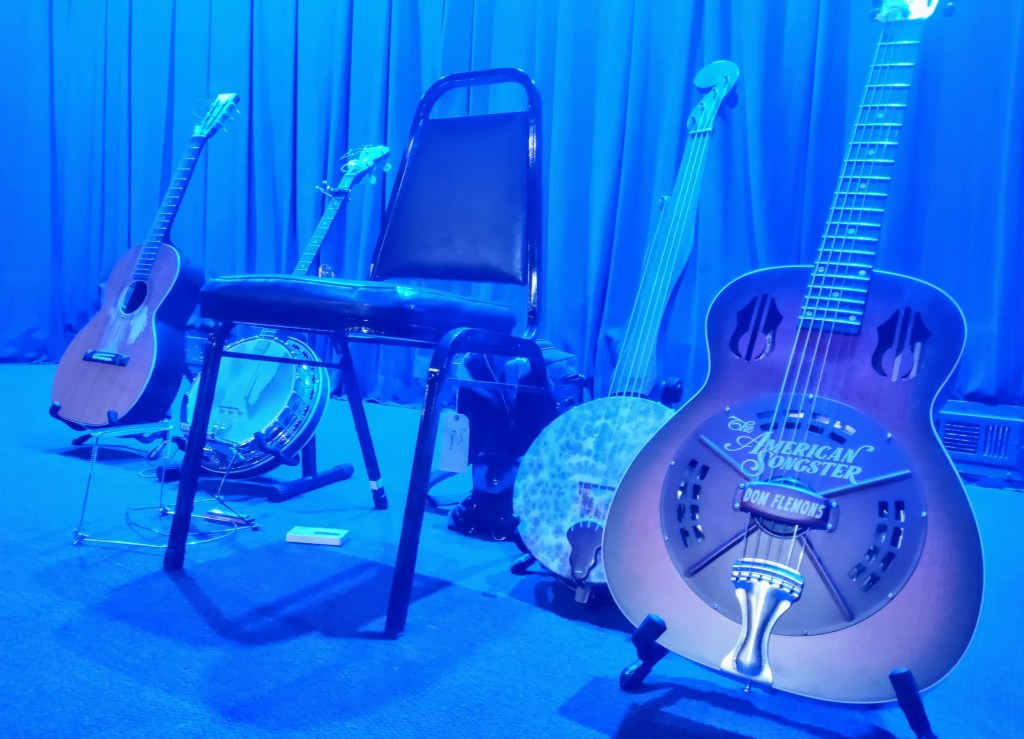
Last week’s concert wasn’t his first time at the hallowed Maplewood folk venue. He also performed there on his tour supporting 2023’s Traveling Wildfire. The album earned a nomination, along with records from artists like Joni Mitchell, Paul Simon, and Old Crow Medicine Show, in the Grammy’s Best Folk Album category. Both on stage and in our between-sets conversation, it was clear that Flemons has a special place in his heart for the intimate listening room.
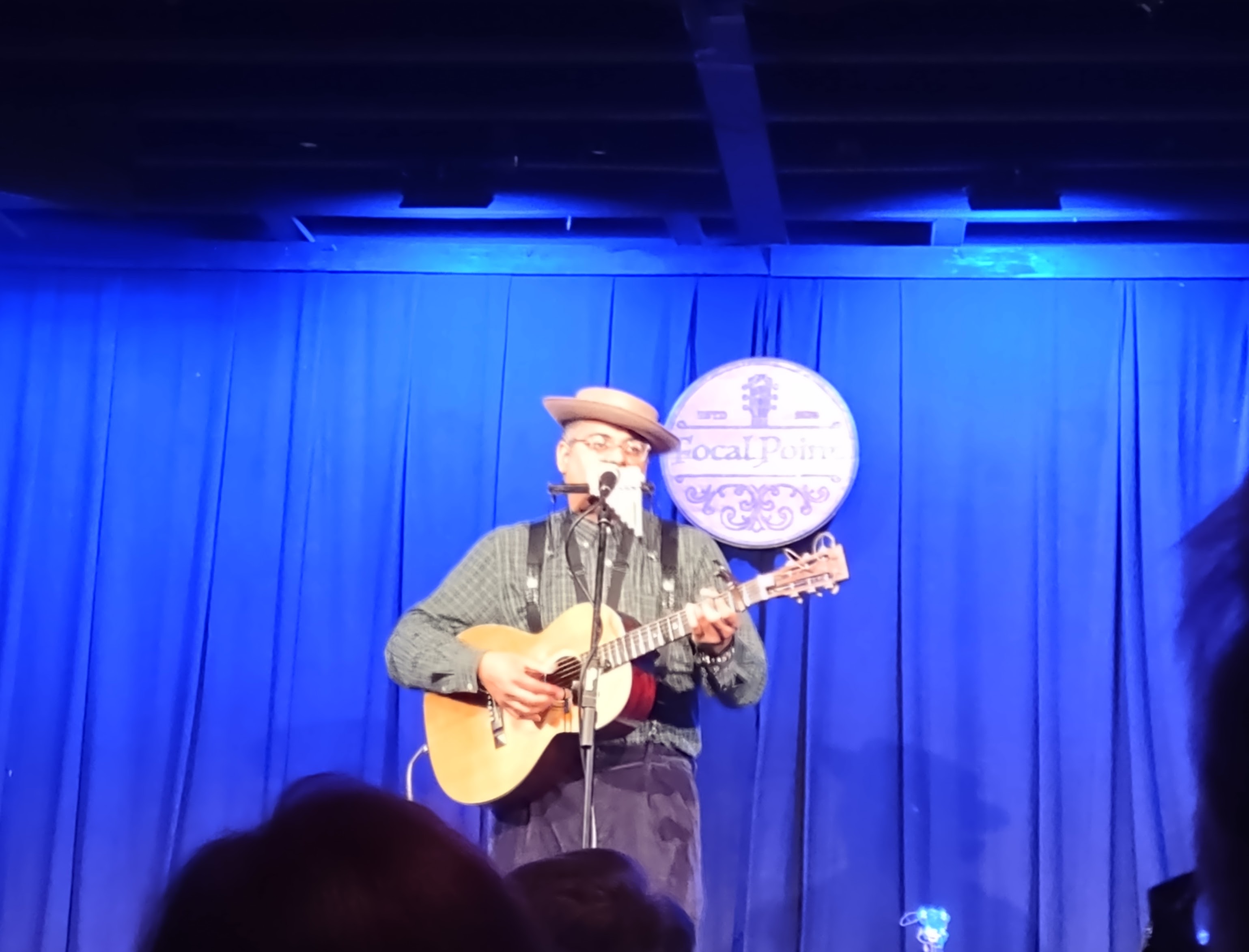
From the beginning of the performance, audience members were invited to learn more about the underappreciated contributions of Black artists to American traditional music. Not only did audience members hear Flemons perform folk tunes by Black musicians from yesteryear, we also learned about folk instruments like the quills, which is a traditional American instrument resembling panpipes. The instrument was originally constructed and played by slaves in the American South. There were multiple moments like this, all of which showcased Flemons’ call to educate others about American musical history and traditional folk instruments.
While Flemons is a phenomenal player and showman, his skills as a teacher, scholar, and promoter are equally important to his career. His conscientious work to educate others has played an important role in reclaiming Black musicians’ place in the story of traditional American music, especially relating to the banjo. This work spreading a love of the instrument and teaching is nationally recognized. Flemons is set to be inducted into the American Banjo Museum’s Hall of Fame in the Promotion category, specifically recognizing his devotion to broadening the instrument’s appeal to audiences that may have seen it as a folk instrument played almost exclusively by white people. Prior to his induction, all previous Black inductees were honored for their work with four-string banjos in the Jazz genre. Flemons will be the first Black inductee associated with the traditional five-string banjo.
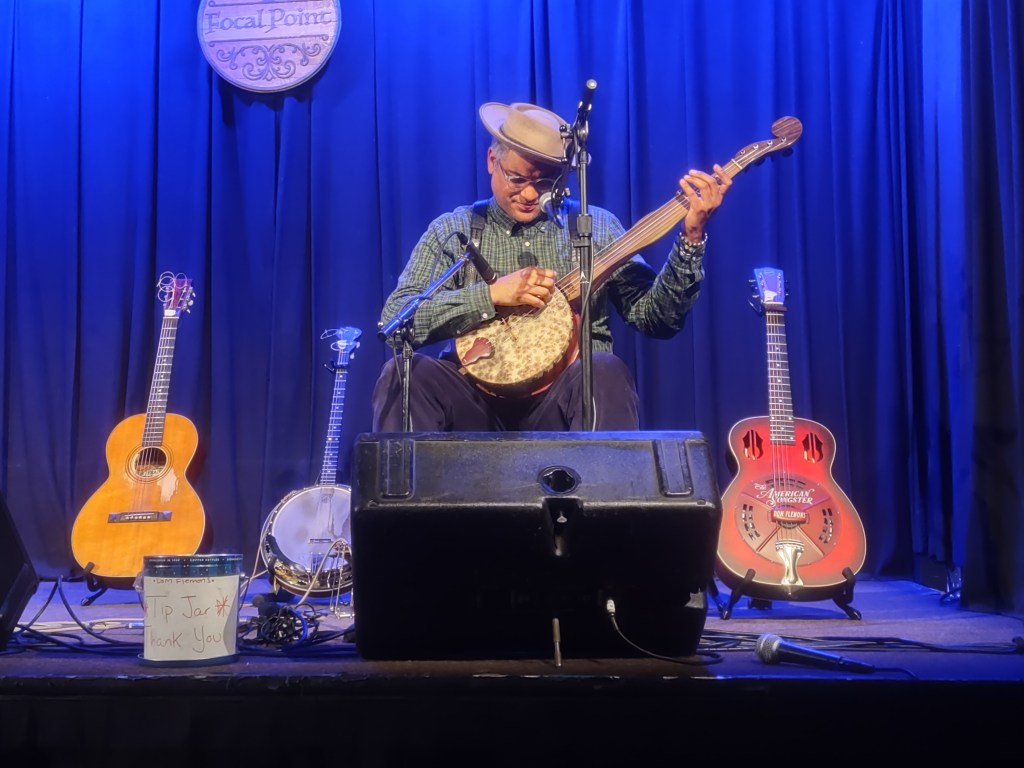

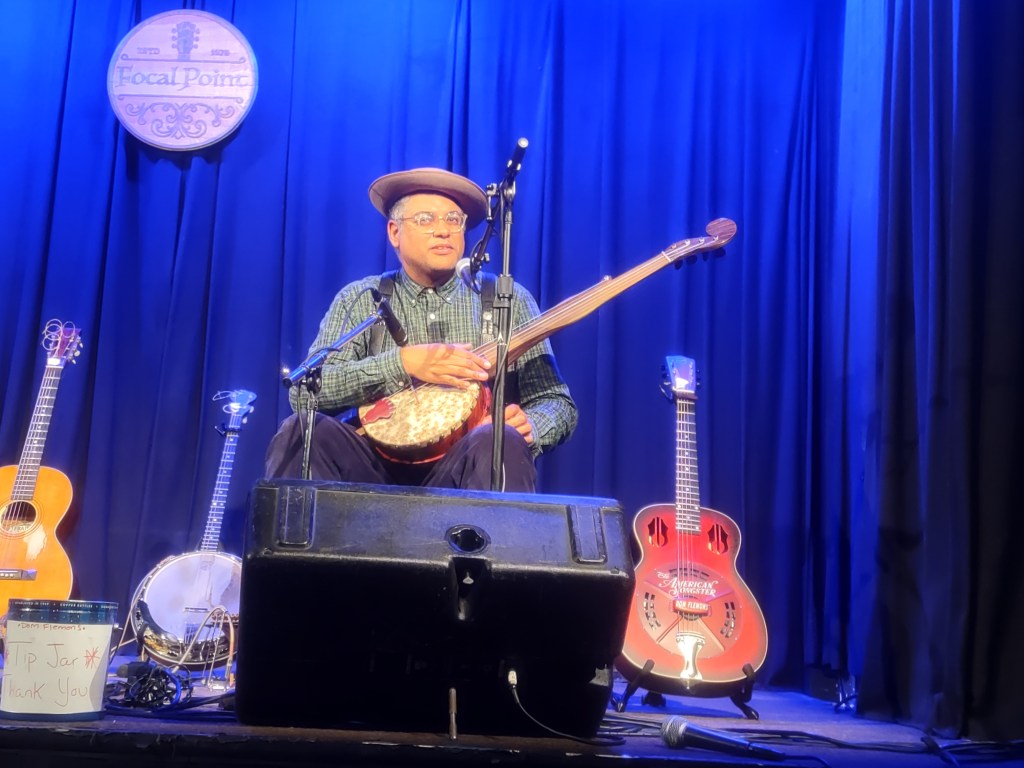
Also to this point, Flemons’ 2018 Black Cowboys record helped bolster a movement to correct the nation’s cultural-historical record by centering the music and stories of Black cowboys, who made up a quarter of the cattle workers in the West. This reclamation of cultural narrative has continued to gain strength. Beyonce’s recent Best Country Album Grammy win shows that Black artists, big and small, are claiming their space in genres from which they have been largely and wrongly excluded. For his part, Flemons is happy to have helped shift this narrative and will continue to help educate listeners about America’s diverse musical history.
After an earlier introduction, I was fortunate to spend a few minutes talking with Mr. Flemons in between the evening’s sets. Below is our conversation, edited for readability.

MCM: Dom, you chose to return to The Focal Point for your St. Louis stop on this tour. Was there a specific reason you wanted to come to such an intimate sort of space again?
Flemons: Well, The Focal Point is a legendary folk club. And I’ve played around St. Louis quite a bit over the last 20 years, and Focal Point is still my favorite listening room because of the size and the space, the intimacy, and then, of course, it’s in its 50th anniversary.
And the people that have been here, it’s just the right venue that serves the purpose that I’m trying to get across to the audience. So I’m all about trying to come to the Focal Point, just for that fact alone, this is the stage where Dave Van Ronk and Mike Seeger and I mean Taj Mahal. So many great legends have been in this space.
MCM: Thank you. Awesome. Going back to something you just said, you’ve come through town a number of times over the years. Have you built relationships with any of the local musicians in town?
Flemons: Well, you know, it’s been interesting, over time. See, when I first came here, I became very involved with the old time music scene. So people like David Landreth and Chirps Smith and people like that. This is before I lived in the Midwest, though. Then I got very close to Pokey Lafarge when he was based here. And so I got to know not only Pokey, but I ended up hanging out with the members of his band, Ryan Koenig and TJ Muller, Adam Hoskins and Joey Glenn. I met them at the time when they first started touring full time. I was in the peak of my touring years with the Carolina Chocolate Drops. Pokey was opening up for me, and I watched him build from a solo act to a band. So, I got to watch the South City Three grow. And so we got to be very good friends in that way. And then we were on the circuit together a lot. So I’m really close with all of them, as well as Mat Wilson from Rum Drum Ramblers. We also had another big moment in 2014 when we all did the Central Time tour together. We got to do a big, like review style show like that. Yeah, I’ve had a lot of different moments. Then guys like Bill Streeter with Lo-Fi St. Louis. I got to know him really well, and the folks over at Euclid Records. And so it’s kind of multi faceted.
MCM: So, yeah. You know, a number of people in town,
Flemons: I even got my first pork pie hat from Levine Hat Shop back when they used to be a proper haberdashery. They kind of corporatized after a certain point, but my first pork pie I ever bought I toured with, I bought it when it there back in 2007 it was back before they improved that area.
MCM: Washington Avenue, before the gentrification.
Flemons: Pre-gentrification. So I caught a little bit of that. Yeah.
MCM: All right, all right. So keeping going. You know, you mentioned that Traveling Wildfire got nominated for a Grammy (on stage) and, you know, this is your second Grammy-nominated album out on Folkways, which is like such a legendary label. What does it mean to you to A: get the kind of recognition of the Grammys, but B: also be on Folkways, which is just like the most famous old-timey label you can think of?
Flemons: Absolutely. Well, I mean, first, with Folkways. When I decided to put together my album Black Cowboys, the nature of that project was much more historical and thematic record than I had been putting out up to that point. I’d been doing much more of an eclectic mix of old time music and all of my records up to that point, and that one was so specific in its theme and its scope that I searched around for a label for it for a while, but then I realized that Smithsonian Folkways was going to be the label that would understand what to do with that record.
So, that’s when I started working with them. And they have a series, the African American Legacy series, which is in partnership with the National Museum of African American History and Culture over in DC, and I had known about that part of the label for quite a few years, and then I played at the opening ceremonies for the museum in 2016. So, I’ve been very involved with the museum for a while.
So, I knew that Black Cowboys as a concept and an idea would be something that would catch on nationwide, once it was legitimized within the academic sphere. Because up to that point, there had been moments where you would have black cowboys in films or books, and then there were a couple of moments where you did have black country singers that would emerge, like Charley Pride and stuff like that, but they were always sort of few and far between, and especially when it came to the story of the historic black cowboys of the West, it was always so scattered that there was never a centralized location.
So that’s why I chose Smithsonian Folkways for that specific record. And Traveling Wildfire was slightly different, because I wanted to delve into doing more original music. And then I wanted to do a definitively country and western-themed record. I kind of mixed it up with Country and Western and then interpretations of old-time folk songs, and also a couple of more contemporary folks. I did an Eric Anderson song and a Bob Dylan one on there. It’s a great label to be a part of. I mean, they just have such a phenomenal catalog from the past seven decades up into the present. It was just something that I just knew I had to do. And so that was great with that.
And then when it came to the Grammys, I mean, I’ve been a member of the Recording Academy since about 2008 and I’ve had a chance to go to the Grammys four different times, two times with the Chocolate Drops, won one time with them, and then two times on my own, didn’t win either those times, but it’s it was just four different amazing occasions where I got to be in the upper sphere of the music industry, for what it’s worth and being a traditional folk artist, it’s something that doesn’t happen often. It’s always a thrill and an honor to be able to do so. And I mean, I can’t say enough nice words about it.
And then Traveling Wildfire you know when I look at the category where I competed it’s like I lost against Joni Mitchell, but there was also Paul Simon, Old Crow Medicine Show, Milk Carton Kids and so that was the caliber of performers I was up against. That’s what’s so neat about being about in the Recording Academy, it allows my music to be treated as a valid part of the modern music industry, and it’s just been great. You know, as an independent artist, it’s beautiful to see that the Recording Academy has broadened its scope in ways to allow for more independents to make their way up the ranks.
MCM: So staying in the lane of historical work and music scholarship, and especially bringing back Black artists that, you know, may have been largely forgotten by the broader public… are there specific things in that work, whether they be albums or individuals, you feel like maybe you’ve been able to bring back to the public’s attention that stick out to you and mean something to you?
Flemons: Oh yes, every single song, like if you look at any of my records, every single song that comes from a traditional artist, I put it into the record specifically so that the story can be brought to the forefront, whether it’s Henry Ragtime, Texas Thomas, when I’m playing the quills, Papa Charlie Jackson, which is where I got the song, “Your Baby Ain’t Sweet Like Mine”. People like Gus Cannon, whose songs I’ve recorded before. Jim Jackson, Gosh, people like Jimmy Strother.
Who else is there? I mean even Eric Anderson and Bob Dylan. Even for that, I’ve gotten to meet a lot of people in the folk world. Like, I got to meet Odetta. I got to meet, you know, Mike Seeger, Pete Seeger, Mark Spoelstra, a famous singer-songwriter from the 60s, Patrick Sky. I met Dave Van Ronk, you know. And I got to spend time with all of these wonderful musicians and personalities. So I also bring that with me too.
MCM: Real quick, because I know you got to go. So last one, you were just inducted into the Banjo Hall of Fame, right? So, what was there a specific highlight from that experience? So I, you know, I’m not sure when was the last time a Black artist inducted into the Banjo Hall of Fame? I’m not really that familiar with it, to be honest.
Flemons: Well, I’m gonna be inducted this fall. Oh, I haven’t made it in yet. I’ve been inducted, but the ceremony will be this fall, in 2025. But I looked it up. I’m the fourth African American banjo player in the hall. It started out as the tenor banjo Hall of Fame, and over the years, they’ve broadened the spectrum to include five-string and all the different family of banjos, and the all three of the other inductees that are African American are not roots music artists, but jazz banjoists. And that’s Johnny St Cyr, who played with Louis Armstrong, Elmer Snowden, who played with Duke Ellington, Don Vappie from New Orleans. All of them are tenor banjo players that are in the jazz field.
And so I’m the very first one that’s going to be a roots music, traditionalist artist, and so that’s a great honor to be added in there. I’m being into the section to devoted to promoters of the banjo because I’ve advocated for the role of the banjo and broadening the scope of how people look at the banjo for many years. It’s a real honor, because it acknowledges the work that I’ve been doing. Because I’ve started out as an armchair scholar. I got a degree in English, so I’m able to put together academic treatises and things like that. But my music studying has always come from a fans point of view. So to be acknowledged for that part of it. It’s a dream come true, because it shows that being obsessed and having fandom around the music can grow into something that is tangible and worthwhile.
All live performance photos were taken by the author.


