
Over Two Recent Exhibits Art And Archaeology Combined To Tell Our City’s Story
By Kyle Olson
In the past year, there have been not one, but two exhibitions at St. Louis art museums with the word archaeology in the title. The first, Urban Archaeology, was on display at the Pulitzer Arts Foundation from September 2023 to February 2024. The second, Archaeology of the Present, opened just as the Pulitzer show closed in February and ran until July 2024 at the Mildred Lane Kemper Art Museum.
As an archaeologist with more than a passing interest in contemporary and conceptual art, I was intrigued but not surprised. Given St. Louis’ fraught history, it makes sense that its artists and cultural institutions have developed an interest in the relationship between the city’s material past, present, and future.


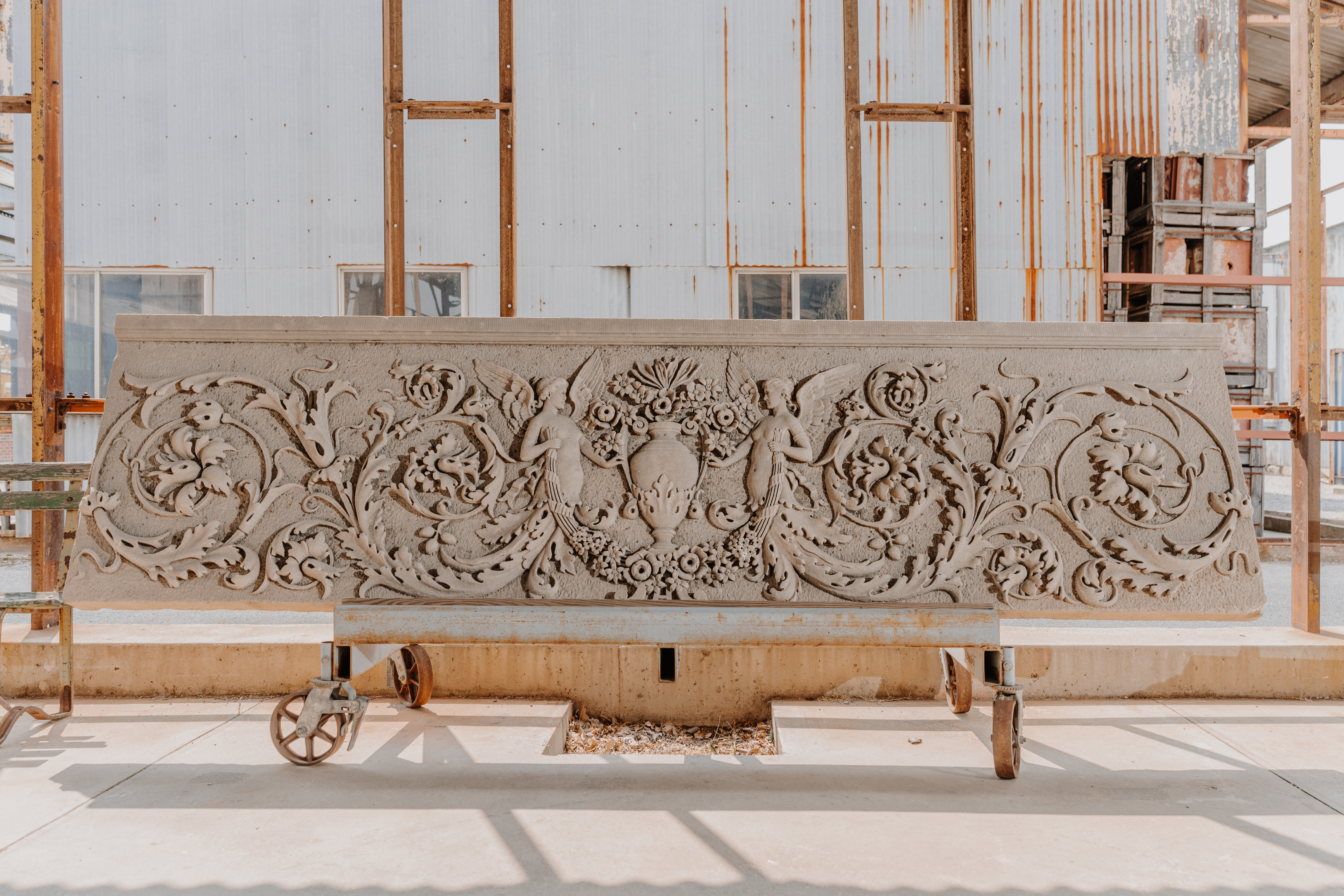
Terracotta
Missouri Pacific Building (later Buder Building), 1904
705 Market Street
Architect: William Albert Swasey; Manufacturer: Winkle Terra Cotta Co.; Sculptor: Attributed to Julius R. Rollin
72 × 24 1/2 × 14 inches (182.9 × 62.2 × 35.6 cm)
Collection of National Building Arts Center
But were these shows in any way archaeological, and if so, how? As we will see, both were concerned with monuments, fragments, and story-telling from objects. Each aimed in its own way to memorialize craft traditions, to testify to different times, and to compel us to think differently about our material world. Across diverse media and environments, both exhibits asked us to consider what the past means today. In a place like St. Louis, such questions have never been so urgent.
Urban Archaeology comprised a collaboration between Michael Allen, former director of the National Building Arts Center (NBAC), and the Pulitzer’s curator, Stephanie Weissberg. The exhibition examined the built environment of St. Louis by exploring tensions between preservation and renewal through a selection from the NBAC’s unparalleled collection of “building artifacts.” The objects on display were all salvaged in the wake of mass building demolition associated with urban redevelopment projects during the mid-to-late 20th century. The buildings from which the objects were retrieved were mostly constructed ca. 1840-1950 and include both landmarks and everyday structures alike, reflecting significant aspects of St. Louis’ technological and craft traditions. In presenting this legacy of construction and destruction, Urban Archaeology provided a unique lens on the urban landscape, prompting its audience to reflect on how this heritage continues to shape the life of the city and pushing St. Louisans to imagine new ways of relating to their built environment.
Does that make the exhibit archaeological? Yes, but perhaps differently than you might think. Regarding the show’s title, in an interview with Allen and Weissberg, STL TV’s City Corner host Steve Potter exclaimed: “That doesn’t make sense to me!” Responding to this prompt, Allen explained how the founder of NBAC, Larry Giles, coined the term “urban archaeology” to describe his project of architectural reclamation. Giles conceptualized the landscape of urban renewal in St. Louis as a sort of archaeological ruin, a gigantic dig-site full of treasures to be recovered. How did this come to pass?

After World War II, planners in St. Louis undertook a decades-long revitalization project in the urban core of the city. Entire neighborhoods and hundreds of buildings were demolished as the city reshaped itself. This spree of demolition created an “enormous cache of valuable rubble,” comprising a wide range of building and decorative materials which were available for the taking. Giles leapt into action to recover everything he had the resources and equipment to safely remove. As the project developed, it took on a more traditional archaeological character, in that Giles sought to understand how buildings work, how they come to be, and why they are demolished, just as an excavator collects pottery sherds to reconstruct a past craft tradition, lifeway, or knowledge system.
In an interview with The New Urban Order, Allen explained that for Giles, urban archaeology was an open-ended endeavor, focused on the multiple meanings that artifacts can have. Giles’ project focused on fragments of buildings, rather than the intact wholes that historic preservation and architectural history have focused on. Giles described the elements he recovered as ‘assemblies,’ i.e., not just random fragments, but coherent systems of cultural meaning that help us understand how the city took its present shape. At the Pulitzer, such assemblies could be observed in the station devoted to brick-making, featuring not only the bricks themselves, but also instruments used in their production, such as a Pyrometer. This device allowed kiln temperatures to be monitored from a distance, a double-edged technological advancement; at the same time that the Pyrometer improved the quality and efficiency of brick-making, it also contributed to the stratification of the labor force, moving the locus of control over production from the kiln’s edge to the supervisor’s office. The show also included numerous examples of the technical achievements of St. Louis’ building trades and their ornamental expertise in the deployment of refined glazes and new techniques for shaping stone and terracotta, reflecting the city’s prosperity at the time and which demonstrated the city’s “civic pride and power through artistic, technical, and architectural virtuosity” during its industrial prime.
Crucially, the exhibit’s objective was not just to give patrons an opportunity to “gaze at these things just for their beauty, but to really understand why this collection exists and how it was put together.” The show was instead designed to prompt dialog about memory and the material past of the city. It aimed to spark questions about how St. Louis will move forward with this legacy of destruction, without losing sight of the fact that the destruction of the urban fabric remains ongoing, especially on the north side. As Allen told Ladue News, the pieces on display at the Pulitzer “ask us to think backward and forward on a long timeline.” Urban Archaeology is, in this way, both an act of consciousness-raising and also a provocation. At its core, the exhibit raises a series of questions in light of this history: What do we want to save? To what end? For whose benefit? These questions are key and provide substantive bridges between Urban Archaeology and the practical problems of archaeology, itself a discipline with a history of engaging in large-scale salvage, in which past generations have left us a legacy of materials to sift through and make meaning from as we move into the future.
Archaeology of the Present also sought to connect history to today through fragments of material culture, although in a radically different—but no less archaeological—format. Viewers of Kahlil Robert Irving’s work have described his sculptures as not only resembling archaeological specimens but also noted that his overall practice as approximating an archaeological methodology. Over the past seven years, Irving has built a reputation as one of the nation’s most innovative artists working in the ceramics medium. His multidimensional practice revolves around the creation of intricately layered assemblages, as rich in historical reference as they are in artifice. Irving’s work takes urban life’s discarded material excess, reconfiguring it into new fossilized forms, creating an archive dense in citation, where echoes of the past are formed, fired, glazed, and then fired and glazed again. His pieces comprise and comingle objects and images often viewed as refuse or scraps, the forgotten leftovers of everyday life. While many of Irving’s sculptures appear as ready-mades, they are in fact all his creations. In Irving’s hands, these complex objects represent, reflect, and refer to a dizzying array of moments, individuals, and lifeways.


Archaeology of the Present represents a new stage in Irving’s practice, as the show comprised a full, room-sized installation displaying not just individual artworks but also a massive platform into which numerous objects were set. In a talk at Atlanta’s High Museum of Art, Irving described how the platform functions “almost like an archaeological site” in which windows are cut into the “floor,” allowing viewers to peer into the “ground”. Or, as he described it at the opening of the exhibit at the Kemper on February 23rd, the platform serves as a “pavilion of metaphors.” Framed this way, the individual sculptures themselves work as bridges between time-scales, and the architecture of the installation itself spans the gap between the materiality of history and the endless array of possible meanings and memories that objects can generate.
To make the platform’s abstraction concrete, in an interview with ARTnews, Irving was asked directly to explain how the concept of archaeology informed the show. His response highlighted his commitment to “the politics of material,” in thinking about how ceramics are used industrially, architecturally, and communally, to explore the many different applications of the ceramic medium in art and how it has evolved. For him, it’s not just about the objects, but about the technology and the social organization of ceramic production.
This theme is expressed in Archaeology of the Present with the giant ceramic pipe set vertically into the platform and can also be witnessed in numerous glazed ceramic sculptures that mash together elements such as the Gateway Arch and historical hobby-ceramics, thereby contrasting scales of size, prestige, visibility, and collective meaning-making in this medium. The politics of material is also visible in the tile-works “initially inspired by the mosaic floors of Hellenistic Antioch” that deliberately play with our perceptions by commingling engineered elements (like asphalt) with debris (such as discarded car air-fresheners and crumpled newspaper) in an act of “amassment”. Another work of this kind in Archaeology of the Present is a brick tower that simultaneously references St. Louis’s historic clay industries, the early skyscrapers of the city, and the more general category of stelae, a type of archaeological monument meant to memorialize an important event or moment.


Stepping back to view what this installation accomplishes archaeologically, through it, Irving peels back stratum after stratum of fragmented evidence that tells a history of our present. Importantly, his formal choice to refuse making the linkages in the work explicit or overly didactic creates space for a polyphonic associative experience to emerge between the audience and the installation. In deploying complex and layered metaphors using ceramics, glazes, facsimiles of debris and street detritus, and a massive platform, Archaeology of the Present stages a space for exploring emergent material memory. Taken altogether, the exhibit prompts us to consider how we relate to the ambiguous traces of the past in the present and how we can remake ourselves and our worlds anew from the scraps left behind.
What should we take away from these two shows? As critic Ari Amaya-Akkermans recently put it, the dialog that can emerge in the space between the disciplines of the past (archaeology) and of the future (art), can push us to redefine how we understand that time in between: the now. Meeting in the middle, we can begin to see how “the contemporary” is less a chronological period, and more a set of relations of differing durations between people and things.
What does this mean for a city like St. Louis? How might we gain from learning to look at our urban environment as an archaeologist does, or as an artist does, seeing our contemporary moment in this place?
Living here as a professional archaeologist, it is difficult to ignore the past surrounding us. But as I have learned from teaching local historical geography in my mapping course, few people, especially white St. Louisans, seem to know about the histories of dispossession and destructive violence meted out upon the urban—especially Black—population of St. Louis within living memory. It is not taught, it is not discussed, it is not known. Not everyone has forgotten, however, as we have seen with recent works such as Pillars of the Valley by Damon Davis, which defiantly remembers the neighborhood of Mill Creek Valley, callously destroyed during “slum clearance” as part of mid-20th century urban renewal.
The discipline of archaeology has many useful tools for understanding the remains of our contemporary culture. But, as Allen and Irving have shown, we may need more than shovels or trowels to activate the past for a better future. Doug Bailey—an archaeologist and art historian who has long challenged other archaeologists to move beyond discovering and telling stories about disappeared worlds—claims archaeologists should be more like artists. In his view, archaeologists should look at “artefacts, traces, features, analyses and perceptions from the past” not as scientific specimens, but “as if they were fresh, raw materials, palettes and tools in our creation of original work that has political intention and impact.” In Bailey’s eyes, the key strategies that can open up a space for this are disarticulation, repurposing, and disruption.
In the hands of those with a more artistic sensibility, such strategies have a clear impact. Both Urban Archaeology and Archaeology of the Present use each to stellar effect, whether through salvage and reassembly or via amassment and juxtaposition. Both shows took discarded elements of the built environment of our everyday lives and repositioned them in new contexts with new associations. The acts of disarticulation and repurposing in these exhibits illuminate—whether explicitly or suggestively– how we experience the urban landscape around us. Perhaps these exhibits managed to achieve some disruption too. If so, they will have succeeded in altering our understanding of objects and their uses, changing how we should understand the difference between decay and loss, and shifting what kind of possible futures we might imagine.
Translating the messy stuff of the past into an insightful narrative is not easy, but, when done artfully, it can be powerful. Difficult though it may be to achieve, providing people the chance to have an experience that connects them with another life in another time is important work. In a place like St. Louis, where many centuries-old local traditions have largely passed out of living memory, where so much recent history is characterized by the loss of built heritage and by the violence of decay and neglect, such experiences have never been more needed.

Kyle Olson is an archaeologist, anthropologist, and historian working on the history and heritage of Iran, Turkey, and the Mississippi Valley. His research and teaching focus on the relevance of archaeology to contemporary life, concentrating on the diverse ways that the past is used across cultural, political, and economic domains.


