
MetroLink Gates Put Ordinary St. Louisans In Their Place
By Michael R. Allen
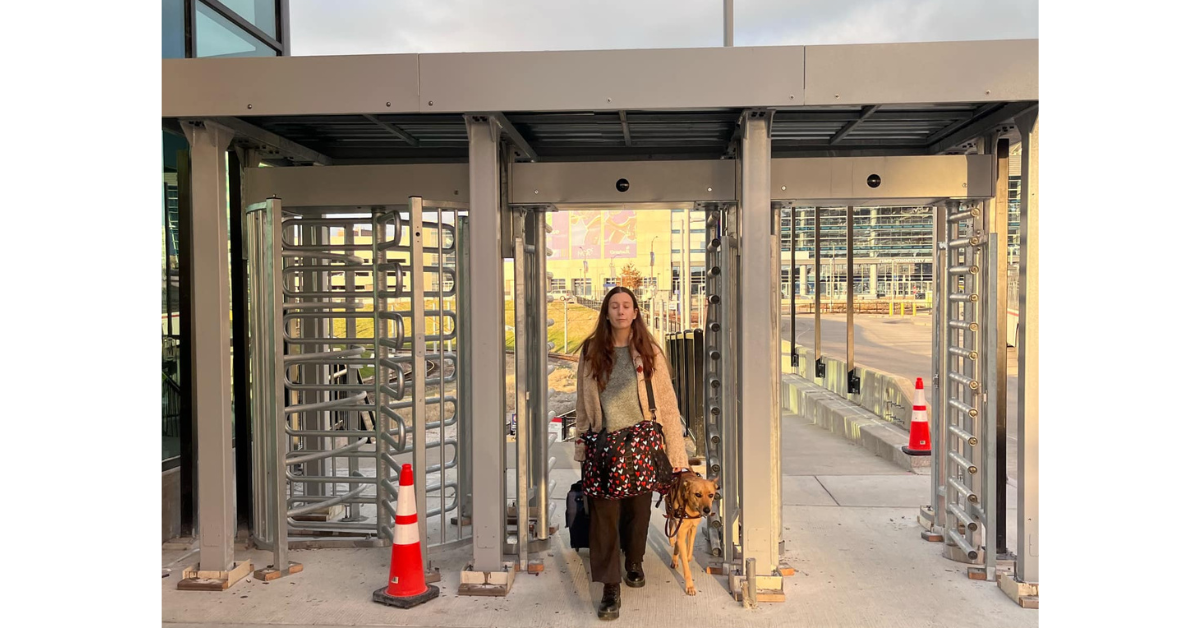
On January 1, in Belgrade, Serbia, mass transit became free to all users – locals and tourists alike. Around the same time, St. Louis’ Metro installed the latest set of its prison-gate entrances at the Delmar MetroLink station – part of a $52 million project to create secure entrances to the light rail system’s stations. The roll out began last year and is expected to be completed later this year.
Positing the comparison in online chat, I was met with familiar St. Louis defense mechanisms: No one earnestly and seriously can compare St. Louis with a European capital city. Never mind local boosters’ litany of statements about St. Louis being greater than Americans think, an unheralded jewel or a city whose truly exceptional aspects would someday be known worldwide. Now was the time to take care of the crime on the system, and such ideas as making the system free would never work as long as the bad people were causing mayhem on the train. Again, never mind the fact that, as Tony Nipert wrote on nextSTL in 2022, violent crime recently was eight times higher in Chesterfield than on the MetroLink.
The casual, quick dismissal of the suggestion that perhaps $52 million would be better spent on steps toward making the system free shows the malaise of civic imagination among ordinary St. Louisans. However, the blight on dreaming of public transit being treated as a beautiful commons instead of a fortified hellhole originates with the leaders at Metro, and shows a rampant attitude of contemptuousness for the very people who use the system.
Even the implementation of the mendacious, uglier-than-ugly security gates shows that the mentality at the top is poisoned. The gates have gone up before the swipe system that will allow people to open them with credit cards, meaning that security guards and employees have to swipe people through the portals much like jailers. Metro cannot remedy this until sometime “near” 2026, which is outrageous considering the huge cost of the security measures.
The leaders at Metro seem most interested in the optics of security – a performance for elites who don’t ride the train and media outlets who won’t report the true crime statistics that would show that public transit is much safer than even wealthy suburbs. The experience of the workers and other people who rely on the system – including disabled persons, students and, yes, tourists – does not seem to matter.
The nation now faces a time when the right-wing discourse around public transportation is playing up the supposed violent crime waves on trains like the New York City Subway (one of whose most violent recent riders is the vigilante Daniel Penny, who killed Jordan Neely and got away with it) absent any facts to back up such narratives. These stories primarily seem designed to turn people against investment in public transportation by maligning it as beyond repair, with a secondary target of using mass transit systems to advance punitive infrastructures designed to appease reactionary non-riders and intimidate the homeless and poor – the constant scapegoats of a nation now letting the world’s richest man dictate public policy.
Amid the frightening rhetorical attack on one of the nation’s last remaining necessary public goods – mass transportation – Metro decided to lean into the maw of ignorance emanating from people who want transit to fail under any circumstances. Now the actual riders must deal with the nuisance of a poorly -implemented, overpriced regime of supposed security that probably will have little impact on MetroLink’s actual crime statistics.
The way in which the Metro commissioners decided to spend $52 million of the people’s money shows their attitude towards those they serve. Rather than use the funds to reduce fares, reinstate lost bus and Call-a-Ride services, or actually ask riders what their priorities are, the commissioners leaned into the local variant of a national crusade that has no basis in actual facts.
Riders do report unnerving moments of potential physical danger, when Metro trains and stations had no security personnel in place, or when the private hired security guards did not intervene in situations. Selectively gating certain stations won’t ameliorate the need for active and engaged personnel present where people are boarding and riding. There seems to be no strategic planning around this matter, despite the willingness of the Metro commissioners to throw tens of millions at gates and consultants.
I don’t bring up Belgrade to fool myself that St. Louis could afford to make its transit completely free, but to show how the attitude of leaders of urban transit systems toward users matters. In Belgrade now, public transit appears as a welcoming thing, whose operators want people to enjoy its use and use it more. In St. Louis, the leaders are pathologizing some riders and telling the rest that their enjoyment and convenience do not matter. The heavy, sharp infrastructure of gates matches the concrete barricades that populate the streets of downtown St. Louis and the riverfront.

All of that infrastructure proclaims to people actually trying to peacefully use public space and enjoy their right to their city, despite the hardships of daily life, that their claim is rejected. They are not the keepers of St. Louis, but a subordinated class whose simple acts of getting home from work, or to the hospital from home, are mocked by the very people into whose hands the actual keys of the city are entrusted.
Michael R. Allen is visiting assistant professor of history at West Virginia University, and until last year, executive director of the National Building Arts Center and a faculty member at Washington University in St. Louis.


