
A Revolution In Free Fall Spirals Into Artful Ambiguity

By Frances Madeson
Sicilian playwright Tino Caspenello’s darkly comedic exploration into the dialectical relationship between the articulation of revolutionary ideals and the ability of human beings in extremis to uphold them is on offer in St. Louis as part of Upstream’s 20th anniversary season. It’s a rare opportunity to encounter a theatrical post mortem on a potentially revolutionary moment, one that slipped away. The play is a cautionary tale—a primer for future revolutionaries, an ingeniously creative don’t let this happen to you.
The script was published in 2013 in the brutal aftermath of the global financial crisis and two of its mass responses: the “Arab Spring” uprisings in nearby Tunisia, Libya, Egypt, Yemen, Syria and Bahrain, and the Occupy Wall Street movement.

After so much immiseration, displacement and brain drain, Pictures From a Revolution wants to know more about the internal dynamics of revolutionary struggle, and does so by poking fun at the behavior patterns that often doom movements. It continues the existential themes that were so central in Beckett’s Waiting for Godot, isolation and endless waiting for direction before taking action, and adds a heaping tablespoon of betrayal.
First produced in 2015 in Toulouse and Naples and once more in Paris in 2016, Upstream is presenting its American premiere, a vital role they’ve been playing in the regional theater scene for two decades. Many of their shows have been written, translated, or directed by founder and artistic director Philip Boehm, his own kind of triple-threat. On opening night, Boehm told me he seeks out for Upstream’s audiences “plays with resonance to the current moment.” With an active liberation struggle in Palestine and widespread discontent brewing in the U.S., he may be right on.
The play scrutinizes a trio of weary rebels holed up in a DIY encampment, nestled between soccer goalposts in a stadium on the edge of town where the night sky is still a wonder worthy of contemplation. Unarmed, and low on food, their existence is their resistance, and it’s by no means guaranteed. Their former leader has crossed over to the dark side and is now the minister of defense. His abandonment has unnerved the cadre. Victory is no longer an option. They nurse their wounds privately, lonely together, locked in a stasis that will be their struggle’s denouement. Occasionally, they seek guidance in the pages of a tattered volume where their movement’s code of conduct is enshrined in by-laws, all of which they’ve memorized but not fully absorbed.
584, the oldest among them, is overheard praying for God’s forgiveness, a taboo of their particular brand of revolutionary orthodoxy. 137 is a young man who snatches seeds from the beaks of birds to plant in a vegetable patch. 892, their new chief, is neither principled nor logical, and fairly easily misled. At a certain point he makes a comical confession to The Woman, who they know better than to trust, but nevertheless embrace. “A plan? But what are you talking about? None of us ever had a plan.”
It’s one of the show’s many relatable laugh lines.
The titular pictures that structure the play are Caspenello’s curated images of masterworks from the Western art canon, which are briefly projected at the top of the 11 scenes, one per vignette. The pictures pass by too quickly for most playgoers to make many narrative or aesthetic connections, though some will. Boehm encourages that by having the actors strike poses in moments of tableau vivant that copycat figures in the artworks. But beyond these superficialities, how else does the art function in the play? Primarily it makes us look. As anyone who’s ever been on a docent-led gallery tour learns, looking at a picture involves seeing the image, but also the negative space surrounding the image. Mere looking isn’t always tied to shifts in perception, but Caspanello seems to think it’s a good place to start, and baked it into the playgoing experience.
Abundant talent is on display at Upstream Theater’s premiere production of Pictures From a Revolution, but oddly not always in service of the show.
Lighting designer Steve Carmichael, scenic, production and sound designer Patrick Huber, and costume designer Michele Friedman Siler, are all Boehm’s longtime artistic collaborators. Eschewing realism, the production opted for a heightened abstraction. But abstraction can lead to detachment, and I would judge that it has.
Huber’s set, for instance, is sanitized of forensic evidence that could be traced to any particular struggle or demand. Material draped over the frame of the goalpost looks like a bespoke tailor’s quality goods, beautifully dyed and patterned. If it’s there instead of a flag, or a keffiyah (heaven forbid!), it’s unclear what it connotes. Otherwise, the set was pristine to the point of emptiness. A garden is mentioned, but there’s not a tool in sight. In the night time scene firelight softly flickers in a steel barrel, more glow than heat. Shadowy figures painted on a black wall give the sense of an indistinct world lurking or hovering nearby.
The aesthetics overall seemed disunited and chaotic, and the actors’ performances floundered at times. Isaiah Di Lorenzo, who played 892, was costumed like a refugee from Burning Man. His character’s passion is dancing the tango. I couldn’t put those two things together. His repeated hand jive seemed unserious, more like Curly from The Three Stooges than a man with the burdens of leadership in a lost cause.

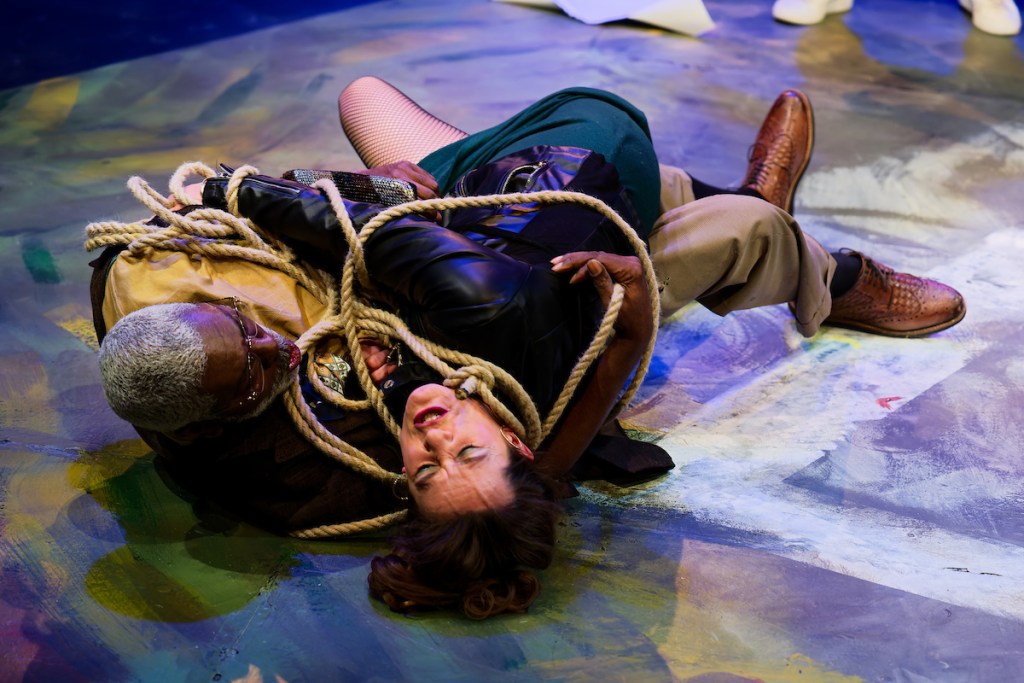
The Woman (played by Lizi Watt), was dragged in cursing, tethered to a rope when 584 was dispatched with the mission of lassoing a cow. The men aspire to revolutionary discipline, but are driven by human appetites—for milk, for meat, for flesh, for touch, for connection. “I was looking forward to milking her every morning,” 137 admits.
Watt’s portrayal of The Woman, a devious femme fatale who enjoys toying with her marks, was all surfaces shellacked over with a gloss of artifice, which is really hard to pull off. Her role is challenged with the longest monologues in the show. The first is a densely packed several paragraphs worth of invectives hurled at 584 and eventually the others when they join him in pulling her by rope into the encampment like a side of beef. As played, it came off as sustained histrionics. In the second, she erupts in phony tears while telling a story that is unlikely true, layering artifice upon artifice, and I was just kind of waiting for it to be over.
By contrast, there’s a scene in which J. Samuel Davis, playing 584, has to vomit repeatedly into a bucket lifted and held by Andre Elsamian, playing 137, again and again. The laughs come from the physical comedy executed in tandem with perfect timing when bucket reaches face.
Besides the rotation of the pictures, scene changes were indicated by the actors swirling themselves in or out of position in slow motion unison, or repeatedly humming a revolutionary anthem. Both of these devices had a dulling effect on the play’s advance. The cast were all good eggs to twirl around like human vortices. But the lack of the production’s militant clarity, a requirement for revolutionaries and theater makers, alike, came off as counterrevolutionary antics.
Frances Madeson is a freelance movement journalist and the author of the comic novel, Cooperative Village.


