Hard Lessons In Education Organizing

Editor’s Note: We will be featuring writing by rank-and-file workers, both union and non-union. Submit your labor stories to us at editorial@moundcitymessenger.com. This week’s story is brought to us by a member of AFT local 420.
Over the years, whispers about forming a union at KIPP St. Louis High School floated around but never took root—mostly because, with high turnover year after year, the teachers willing to spearhead the effort left before anything materialized. That changed at the beginning of the 2022-2023 school year when Audrey, my instructional coach, reignited the conversation.
The school was grappling with a multitude of issues. Safety was a major concern; guns had been brought into the building multiple times, and fights had become a regular occurrence. We were so understaffed that if anyone called in sick, the ability to properly supervise students was compromised. The facilities were in disrepair—mold in the corners, security practically nonexistent. Compensation did not match the climbing cost of living. It was clear that the administration wasn’t going to address these problems on their own.
Audrey and I started reaching out to a small, trusted group of colleagues. We knew we had to move carefully; the fear of retaliation from KIPP was real and palpable. We contacted local unions for support. While the United Auto Workers didn’t respond, the American Federation of Teachers (AFT) agreed to meet with us. By the time we sat down with them, we’d already begun conversations with other staff members, gauging what seemed to be rather high support.
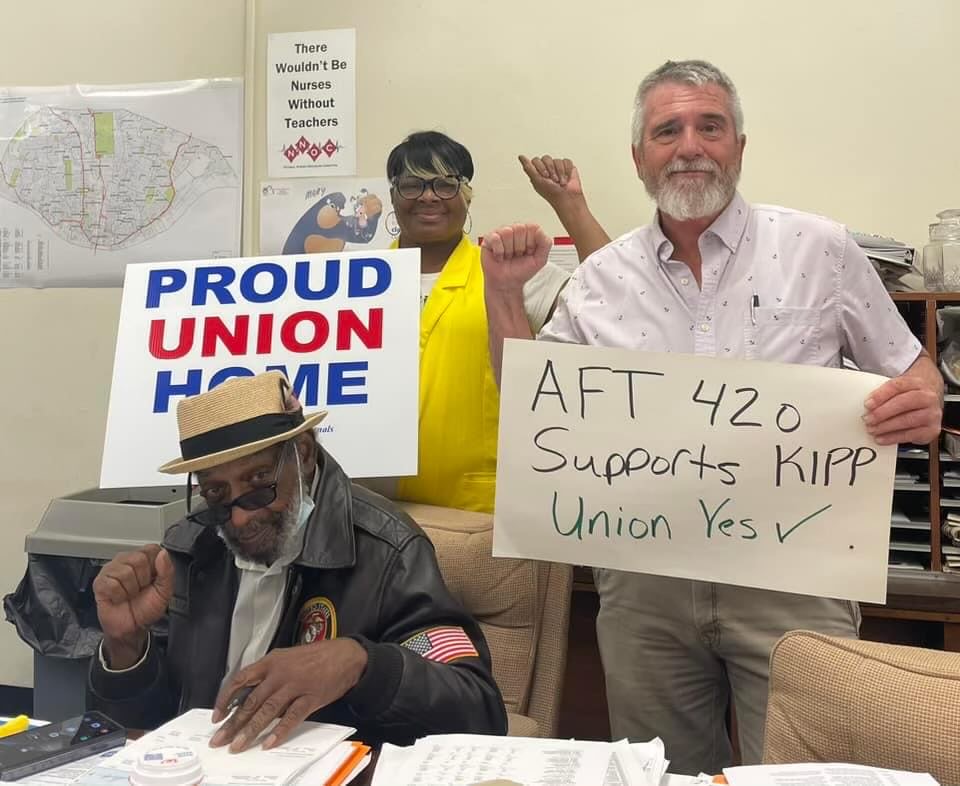
The AFT set a high bar—they wanted at least 80% support, anticipating that the actual vote might yield a lower percentage once the administration started pushing back. Gathering this support was nerve-wracking. They gave us authorization cards for folks to sign. Our strategy was to gather authorizations before KIPP caught wind of our efforts, limiting their ability to counter-organize.
Despite our precautions, KIPP found out after we held a formal meeting open to all non-supervisory staff. It was likely that someone tipped them off. Shortly after, Audrey and I were elected co-chairs of the organizing committee at a second meeting. The cat was out of the bag, but we had succeeded in gaining the advantage.
Surprisingly, the administration’s initial response was muted. It wasn’t until two or three weeks before the scheduled election that they ramped up their efforts. They held mandatory meetings where assistant principals tried to dissuade staff from supporting the union. In one of these meetings, nearly all Black staff members were present, except for the strong union supporters—a tactic that didn’t go unnoticed. They even launched a website opposing us, but it went live just days before the vote. It felt like they were scrambling.
In November 2022, we won the election with 66% of the vote. Not the 80% we initially hoped for, but a decisive victory nonetheless. KIPP began dragging their feet almost immediately. Our first bargaining session didn’t happen until late in the school year, long after the election results were certified. They were meticulous in appearing to negotiate in good faith, but their tactics said otherwise. They would tweak language in our proposals without changing the substance, insisted on at-will employment, and suggested that grievances be appealed to KIPP’s own board of directors—a blatantly biased solution.
Negotiations were scheduled once a month for just a few hours after school, despite our requests for full-day sessions. It was a clear stalling tactic. During this prolonged process, staff turnover was brutal. Around 50% of the staff left over the summer, including many strong union members. Turnover continued into the next school year, with some new staff only making it a few weeks before resigning. Recruiting new members became a constant task. While we managed to get new staff to sign union cards, getting them actively involved was another matter. The weight of the campaign was falling on a shrinking group of committed individuals.
Communication issues within the union didn’t help. The AFT advised us against sharing details of the negotiations, arguing that “bargaining in a fishbowl” is counterproductive. In hindsight, that was a mistake. KIPP was controlling the narrative, providing their own updates framed to their advantage. One of our own members, who eventually filed a decertification petition and probably was a rat all along, criticized the lack of transparency in our union chat.
Before resorting to a strike, we tried other tactics. We opened up bargaining sessions to all members, hoping more staff would witness KIPP’s stalling firsthand. We organized an informational picket, which got some coverage from the Labor Tribune and some attention from KIPP parents, but didn’t move the needle significantly. We went to KIPP’s regional office, with a petition signed by the vast majority of staff, asking for changes with safety and compensation.

Recognizing the need for stronger action, we organized our first strike toward the end of the 2023-2024 school year. We secured strong support percentage-wise—over 90% of respondents voted yes—but actual participation was lower. Notably, we never had any pledge for financial support from the national union, which made selling a strike much more difficult. Fear kept many away from the picket line, and some who had committed to joining didn’t show up or even crossed the line.
The first strike disrupted the school’s operations and garnered media attention from local radio stations, TV, the St. Louis Post-Dispatch, and a Randi Weingarten retweet of my quote to the paper, but KIPP remained largely unmoved. A second strike followed with even less participation. Our goal was to close the school, but they managed to keep it open, although they couldn’t proceed with the testing scheduled for that day. Burnout and demoralization set in, and organizing efforts fell on a few exhausted individuals. Plans for a third strike were scrapped due to low morale.
During this period, the decertification petition gained traction. We lost that vote by just two votes—a razor-thin margin that stung deeply. Many staff members were planning to leave KIPP and no longer saw the fight as theirs. They believed that decertifying the union would release the raises that had been frozen during negotiations. It was a tempting proposition for a weary staff, offering immediate financial relief in exchange for long-term workplace rights.
In the end, the decertification was successful, bringing our campaign to an end. It was a tough pill to swallow. While we didn’t achieve our ultimate goal, the struggle highlighted significant issues within KIPP and the challenges of organizing in such an environment, something more akin to Starbucks organizing than campaigns teachers’ unions are traditionally involved in.
Nate Gibson is a high school social studies teacher in SLPS and a member of AFT Local 420. He previously worked at KIPP High School in Downtown West. This is his account of the unsuccessful unionization drive at his previous employer.