
St. Louis in “Coyote Time”: Two Installations Mark the Long Present
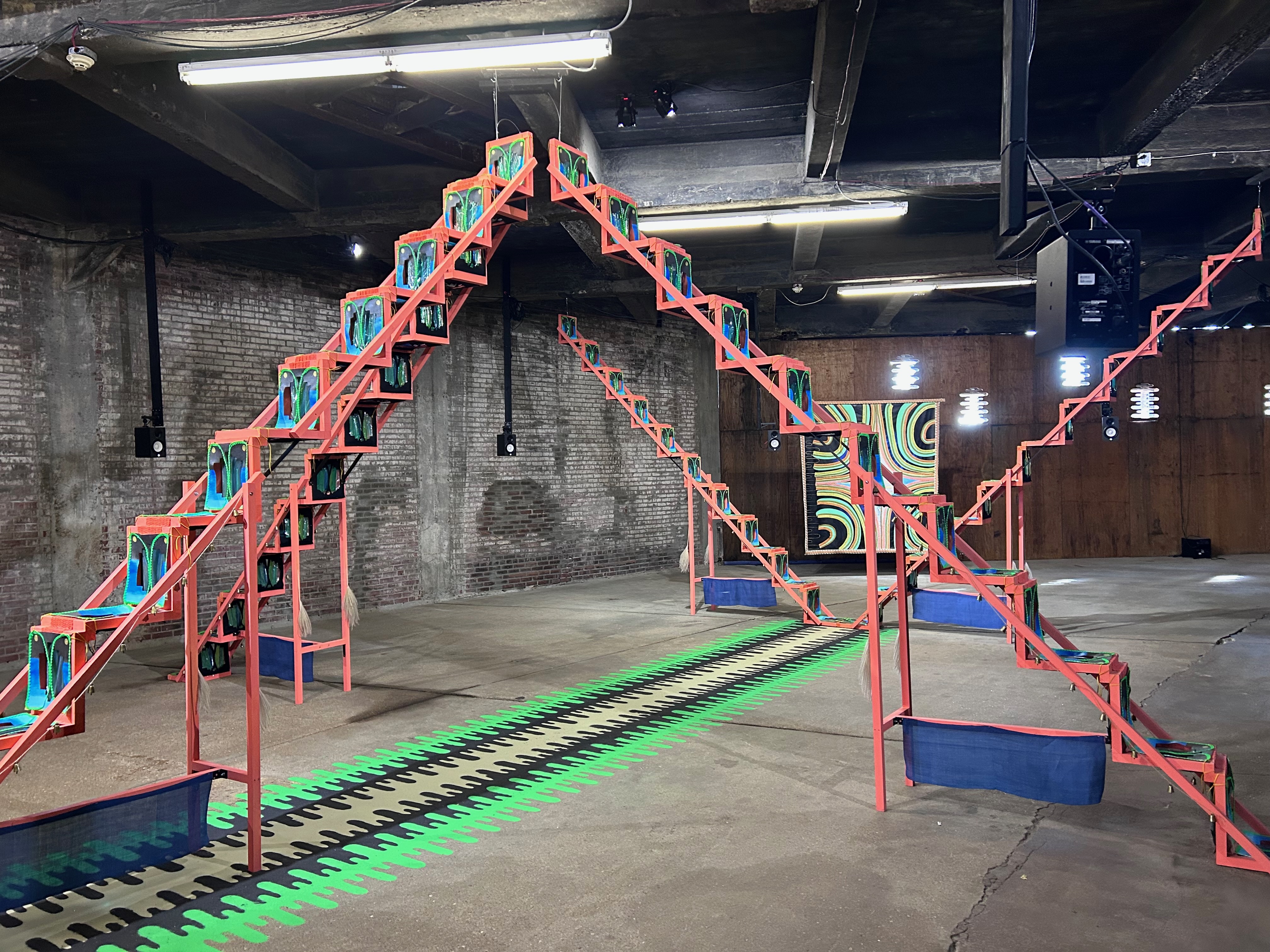
Twenty-first century St. Louis faces a litany of dynamics common to other major American cities now stuck in second- and third-tier status. The city sprawls across a geography so vast that urbanism bringing people together seems nearly impossible. The city slowly erases its north side while boosters pretend that new buildings in the center and bourgeois life on the south side are enough to pretend that St. Louis is not in a deep decline. Political and business leadership is dreadfully stuck on platitudes about growth and progress, missing the whole game of where St. Louis is actually headed. Meanwhile, 90% of St. Louisans live, work, and play outside of the city limits, making the dominant way of life suburban and disconnected from questions of the old city’s future.
Instead of a doom loop, St. Louis treads a dialectic circle, in which the fables of the civic elites and the open-secret underbelly of decline and chaotic urbanism are set against a vibrant culture of critique and artistic production, of which this publication is one point. Even this expat writer still toils along, attempting to engage a remarkable city whose tortured social and physical form seems always just short of the sort of input that might break the doldrums in favor of a new regional spirit.
The architectural theorist Keller Easterling uses the term “disposition” to analyze the possibility of design intervention to fall in different directions, like a rubber ball being released from a hand above the pavement. How do you get the ball to bounce the way you want? St. Louis’ current art triennial Counterpublic poses the question in a different but related term, “Coyote Time.” Artist Alice Bucknell deserves all credit for this term, which she takes from the video game moment when a character (such as Wile E. Coyote in the old Looney Tunes cartoons) is suspended in the air and must make a jump either to survival or doom.
In that analogy, St. Louis is one city that is both stuck and unable to make the next move, but also never falling more than a few feet down in the sky. No triumph, no doom – just the endless in-between.
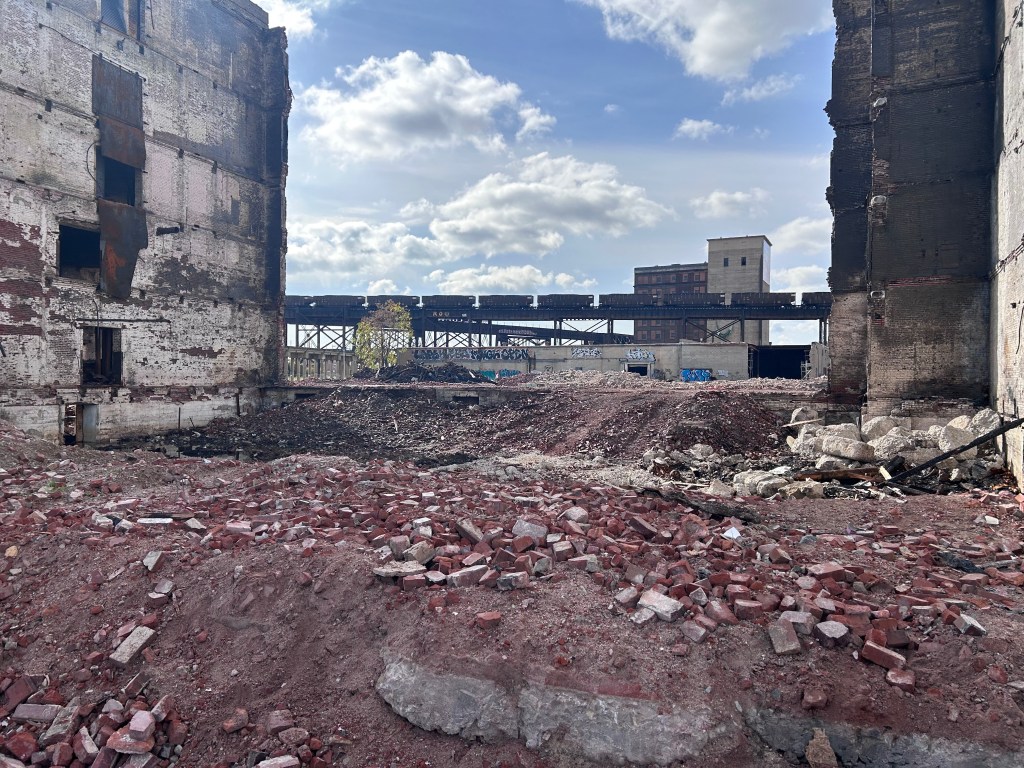
Among Counterpublic’s various installations, one work truly stands out as fully aware of something more rooted in the city than just a curatorial prompt: Anika Todd’s Siren Song, set down on Chouteau’s Landing. Counterpublic occupies one of the district’s industrial buildings that is part of the Good Development Group’s Gateway South project, which suffered a catastrophic fire in November 2025. Counterpublic’s locations around the district are in plain sight of the rubble piles and surviving sections of the Crunden-Martin Manufacturing Company complex, where broken water pipes still gush unmetered water and demolition fencing seems more conceptual than administrative.
While the fire was an unanticipated event during planning – there’s that disposition for you – Counterpublic’s presence does not address it. The gaping scene of destruction frames a view of the Gateway Arch and also the site where civic leaders have funded demolition of the abandoned Millennium Hotel as a sad signifier of progress-by-demolition. From the entrance to the main galleries, the city looks to be in profound distress, and very little of what lies inside offers any interpretation of what that may mean. The Chouteau’s Landing section is mostly curated by Stephanie Hessler and does include some very good work. This includes Won Ju Lim’s incredibly detailed Parasiting, Vaughn Davis’ iconic soft sculpture Shields Down, and Lisa Alvarado and Joshua Abrams’ Porous Streams Within. Oglála Lakȟóta artist Kite offers a deep time mapping, Wíhaŋyablapi (of St. Louis).
The problem with most of these installations is that their arrangement inside the warehouse (save Lim’s) seems utilitarian rather than meaningful. There is no vibing between the place and the work, not inside the building and certainly not outside. (Davis’ is also an exception, with a powerfully simple installation.) The end result of the installations is a sort of diversion of the material dynamics of place to a new romanticism – a rupture of acceptance of the status quo, but an aesthetic drive toward individual rather than collective and truly social forms of developing a new spirit. In St. Louis, the mass mood seems to be individual rather than collective, so it is hard to see how most of the work – as staged, not as intended — is confrontational enough to get any coyote to jump.
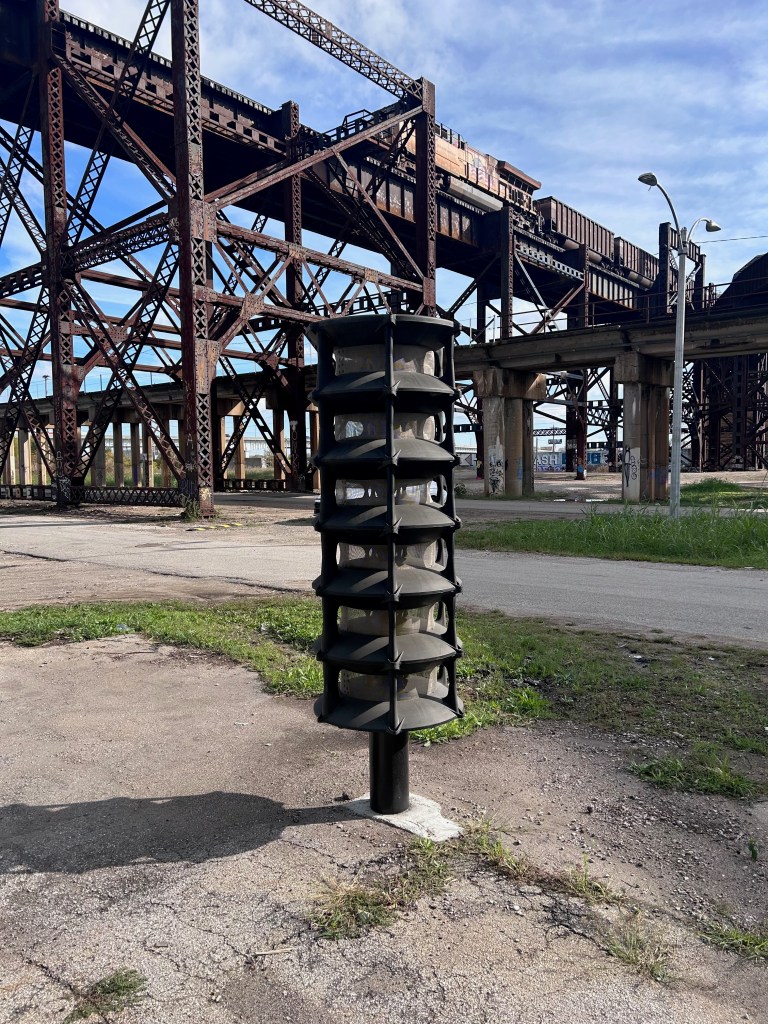
The exception is Todd’s work, which situates a set of public warning sirens in a cluster. From inside the cluster, one can see the flood wall that severs the area from the Mississippi River. The sirens evoke the failure of the St. Louis Fire Department to warn residents aboutof the devastating May 2025 tornado. Instead of a harsh call, they emit organic sounds that Todd recorded from the river itself. The entire experience is moving, place-facing, and historically-informed. The city’s deep fissures are audible in ways that shake. It really does ask where the coyote will jump. Siren Song agitates in provocative ways, and it is a shame that its presence will end in December. It deserves a permanent installation along the riverfront.
Across the river is an inadvertent coda to Siren Song. Over at the National Building Arts Center (NBAC) – another site for Counterpublic’s installations, all quite dynamic – the 1/10th scale miniature of the Statue of Liberty named “Little Liberty” now stands aloft the pedestal base that Center founder Larry Giles began building personally before his untimely death in 2021. Little Liberty was manufactured as a near-replica in sheet metal (or repousse) by the Mullins Company of Salem, Ohio in 1902. It originally stood as an advertising device atop an auction warehouse on Manhattan’s Upper West Side. In 2002, after the building became high-end condos, the statue was removed, refurbished and planted at the Brooklyn Museum.
Giles was a lifelong collector of an encyclopedic collection of architectural artifacts. In the early 2000s he both purchased a former steel foundry in Sauget, Illinois to house his collections and began a relationship with the Brooklyn Museum that resulted in transfer of a large part of their architectural artifacts to the NBAC. Giles presided over salvage in St. Louis’ worst years for urban destruction, after serving as a Marine in the Vietnam War. For Giles, the Statue of Liberty itself was too hypocritical to speak to what his nation had become.
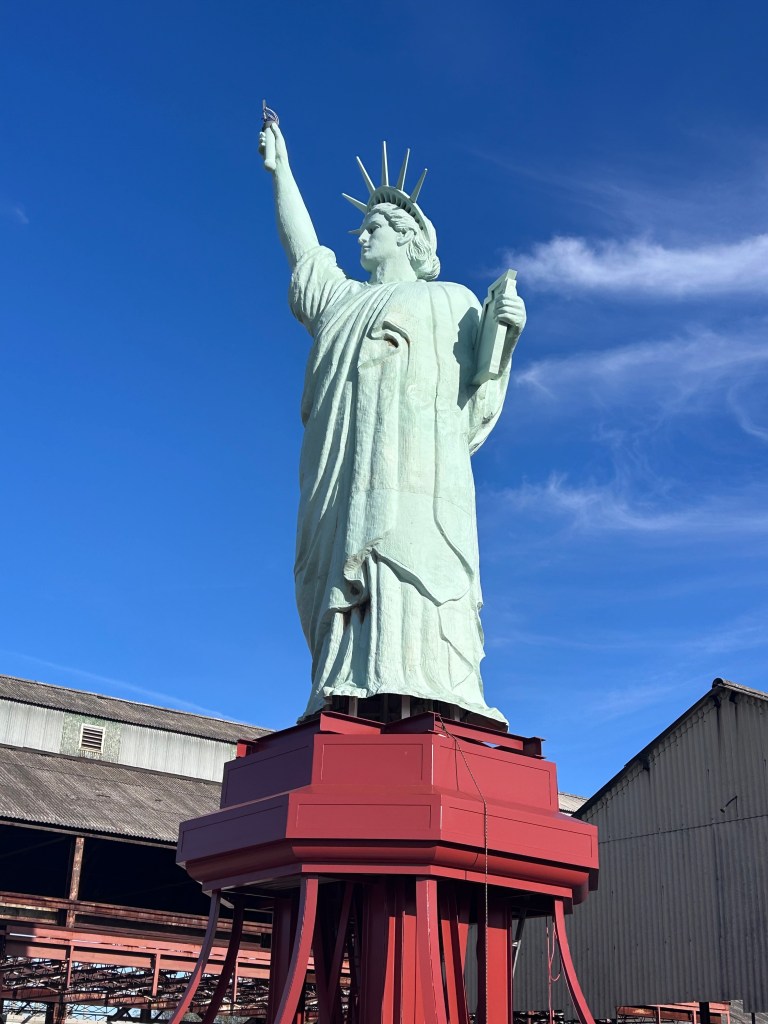
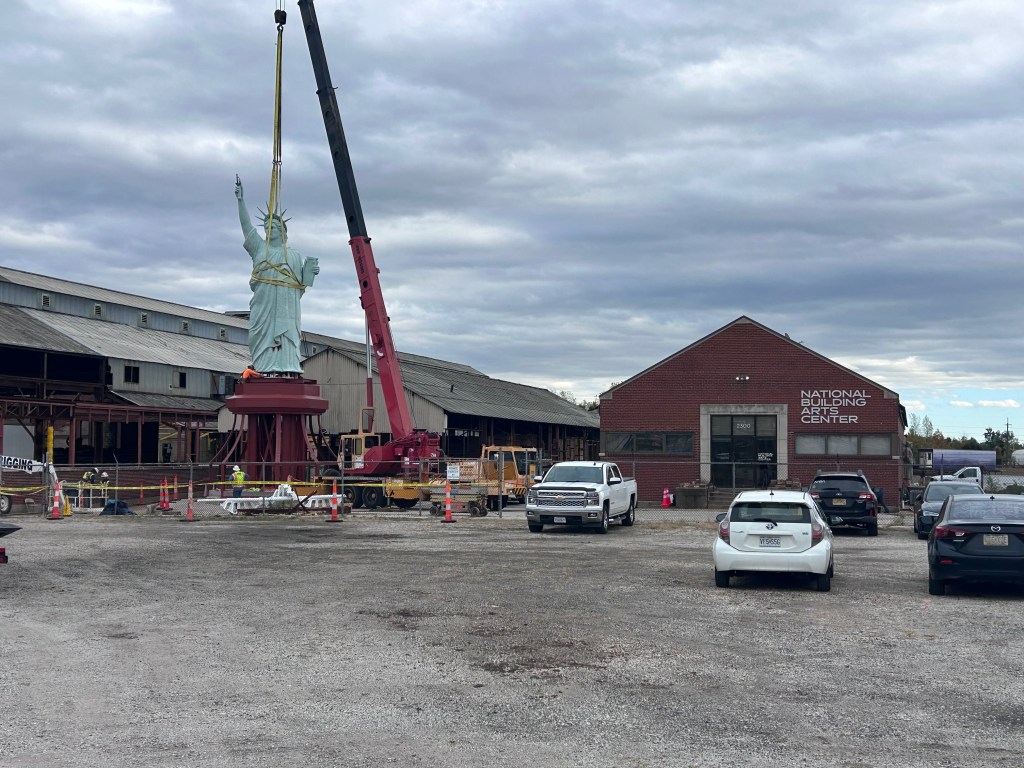
Little Liberty is a replica born of Rust Belt capitalism, made as a gimmick and set into a museum’s collections before journeying to Sauget. Its own tale is the kind that underscores that despite aesthetic faces and high ideals, cities are bound to capital’s ragged and often cruel decisions. Now Little Liberty rises in Sauget amid its petrochemical landscape, and the not-quite-precisely-replicated face of the statue stares across the river through process vessels and piping at the Gateway Arch. Nearby, the watershed remains heavily polluted from Sauget’s corporate titans, and the air quality is dubious at best. If there is any more honest moment in American iconography than this mini Statue of Liberty staring down the monument of Manifest Destiny, the Gateway Arch, please let this writer know.
Todd’s Siren Song and Little Liberty may not be the monuments that St. Louis wants, but they certainly are the ones it needs. Both push back against the ideologies of progress that tell us to ignore the chemical pilot flames and piles of demolished buildings and enjoy the city. Both situate a St. Louis that is neither a comfortable life of DoorDash deliveries to an insular 5-plus-one apartment nor a renovated south side two-flat made single-family where residents call the police on their own neighbors.
These works face off around the river and demand a real look at St. Louis, as it is and, more importantly, how it became this way. They ask a stubborn, stuck city to jump. At least some way, at least for now.


