
Antisemitism is Not on the Ballot – But Genocide is
Benjamin Singer and his Show Me Integrity non-profit have profoundly affected how voting and government work in St. Louis City. In 2020, in an effort led by Show Me Integrity, voters approved Proposition D, which created the city’s current two-stage, non-partisan election system. Show Me Integrity also led the campaign to pass Proposition R, which modified the rules for ward redistricting and created aldermanic conflict of interest rules. Singer also worked on the statewide CLEAN Missouri redistricting and ethics reform campaign in 2018, served as Communications Director for Tishaura Jones when she was the St. Louis Treasurer, and he has recently been a leader in the Respect Missouri Voters campaign supporting Missouri’s ballot initiative system.
So why, for the second time, are Singer and Show Me Integrity operating functionally as an appendage of Wesley Bell’s congressional campaign?
Just as it did in 2024, Singer’s Show Me Integrity Education Fund’s St. Louis Votes project is presently working with St. Louis’ pro-Israel Jewish establishment organizations and congregations “to boost Jewish voter participation ahead of Missouri’s Aug. 4 primary election”. This project does not seem to fit directly with Show Me Integrity’s stated mission of creating “more effective, ethical structures of government with transparency, integrity, and accountability”.
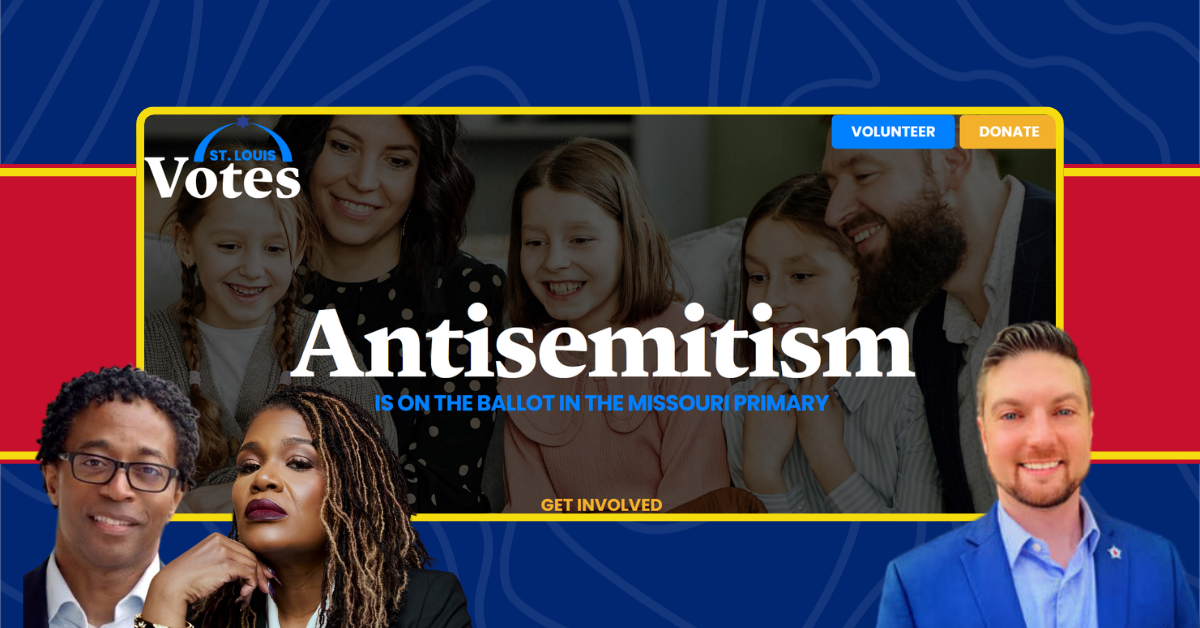
According to Singer, quoted in a promotional story on the project in the St. Louis Jewish Light, “Extremism, antisemitism and the future of Missouri’s democracy are on the ballot on Aug. 4.” This wording resembles St. Louis Votes’ similar 2024 campaign to increase Jewish election turnout, which also claimed that “Antisemitism is on the ballot in the Missouri primary”.
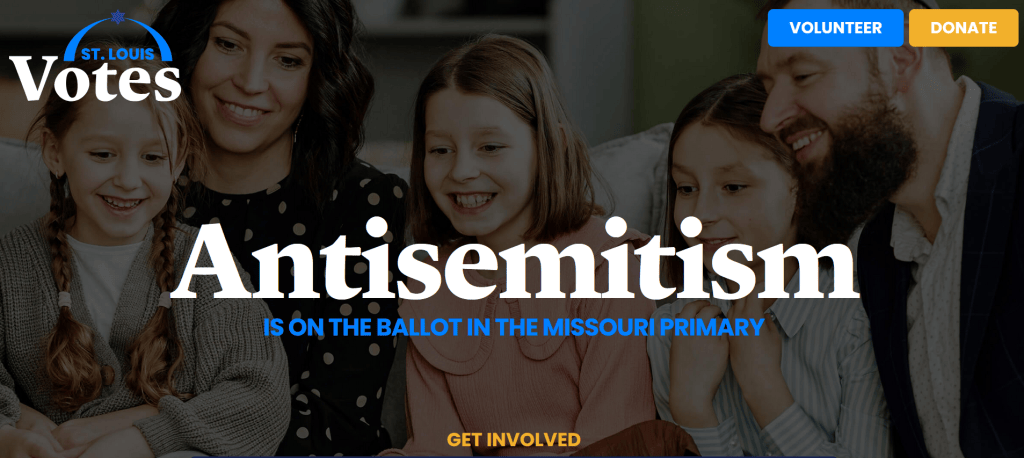
A screenshot from the now-defunct stlouistogether.org website, a hub for the 2024 St. Louis Votes Jewish outreach campaign
Supporting the 2026 campaign in the Jewish Light article is Rabbi Brigitte Rosenberg of United Hebrew Congregation, who says, “I think it’s our responsibility to vote. What is good about St. Louis Votes is that it’s not about any campaign, it’s about saying we have a voice. And we have a voice by voting.” Rosenberg is the only person besides Singer interviewed for the article. Rosenberg is an outspoken opponent of Cori Bush and a public supporter of Wesley Bell. Rosenberg has accused Cori Bush of “antisemitic rhetoric” specifically because Bush accurately described the behavior of Israel against Palestinians as “ethnic cleansing” and “genocide”.
Rosenberg is also a founding board member of the pro-Israel Missouri Alliance Network, led by former Democratic State Representative Stacey Newman. In a recent post in the “Jews in the Lou” Facebook group, Newman uses the same wording as the 2024 and 2026 STL Votes Jewish outreach project when she writes that “Antisemitism is STILL on the ballot” in a direct ask of people to volunteer for the Wesley Bell for Congress campaign. One of her fellow volunteers listed is Rosenberg.
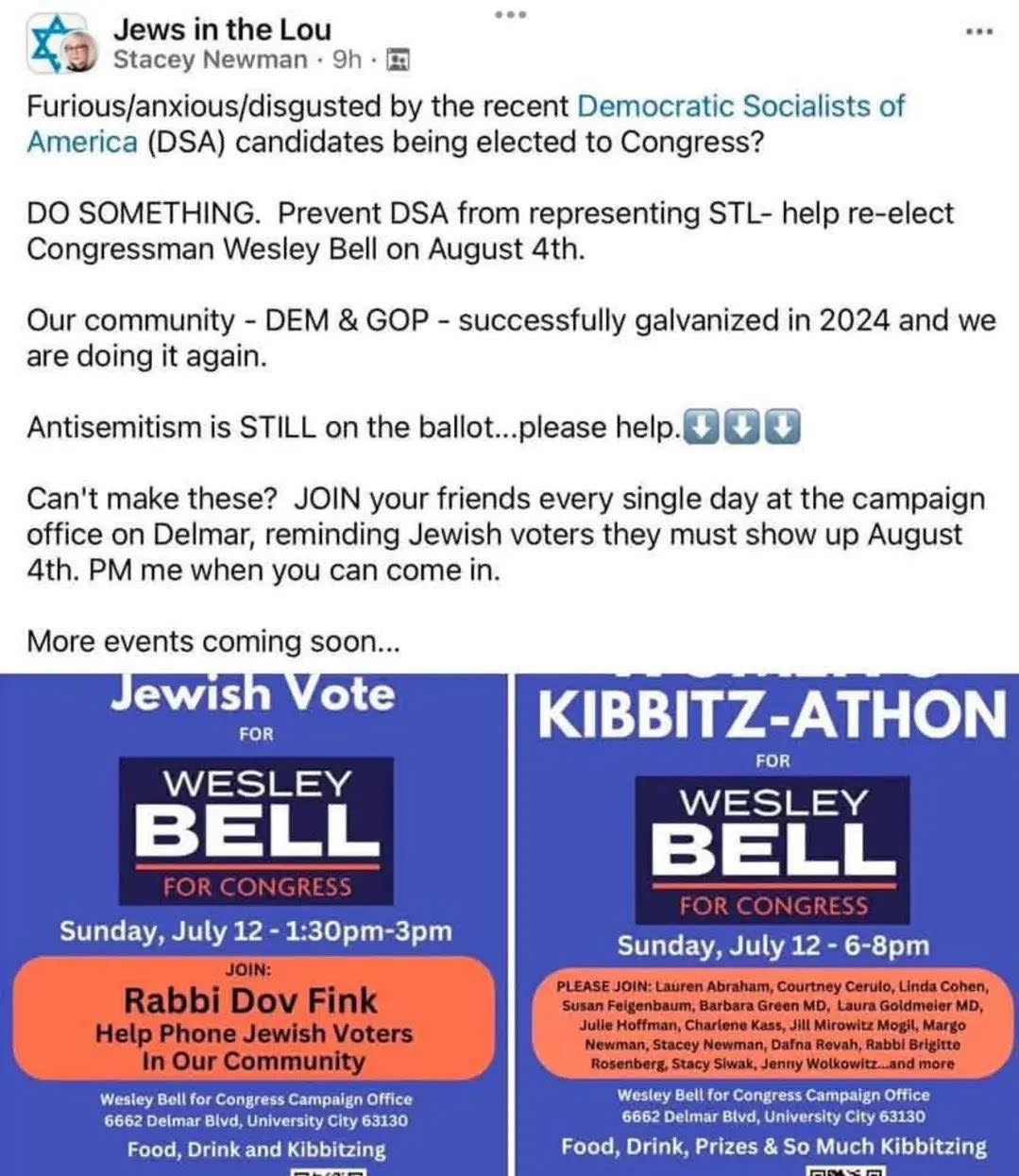
A recent Facebook screenshot of the “Jews in the Lou” group of a post by Stacey Newman
So here you can see a prominent Jewish leader using the phrase “antisemitism is on the ballot” to recruit Jews to involve themselves with the STL Votes campaign, while also encouraging them to make calls for Wesley Bell.
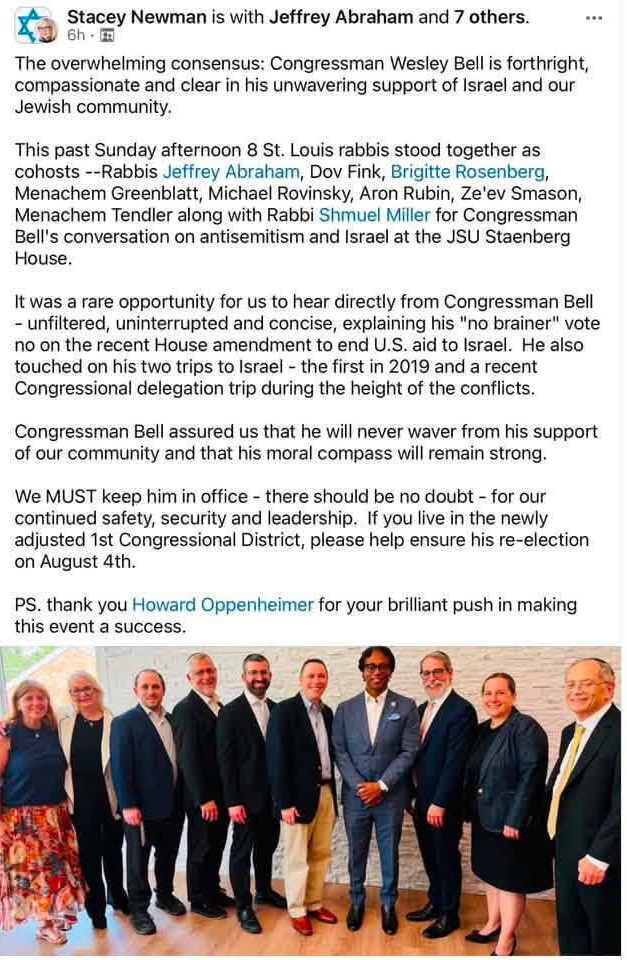
Screenshot from Stacey Newman’s Facebook page about supportive July 26 event with Wesley Bell, with Rabbi Brigitte Rosenberg
When I asked Singer where specifically antisemitism is on the ballot, he declined to answer. Instead, Singer claims that “When minorities vote in high numbers, leaders take notice”. It is worth noting that Jews already have a notably higher voter turnout rate in the United States than the general population.
Excellent reporting in The Forward in 2024 clearly exposed that the real purpose of the 2024 STL Votes Jewish outreach campaign was to boost Wesley Bell. As reported in The Forward on August 1, 2024:
St. Louis Votes has received the backing of both the local Jewish Federation and (the Jewish) Community Relations Council, which posted on Facebook to help recruit people to work for the group for $20 an hour. Jewish groups often participate in get-out-the-vote campaigns, but it is unusual for these efforts to focus on a specific primary in a single district.
Some participants in St. Louis Votes have also made it clear that they view the project as a way to help Bell.
“If you are already working directly with the Bell campaign, keep it up,” Steve Epstein, another veteran of the Westchester campaign, wrote in a series of Facebook posts seeking to recruit St. Louis volunteers. “We do not mean to compete with them, just to supplement them in the Jewish community.”
The Forward, “America’s leading voice in Jewish journalism”, quoted Singer in 2024, saying, “We have been very careful — because of that perception — to avoid anything that would imply we support or oppose any candidate. Our victory here is not a victory for any candidate; it is achieving record Jewish voter turnout.”
The reason he had to be careful was that non-profits such as his own, the Jewish Community Relations Council, the Jewish Federation, and individual synagogues cannot legally use their resources to directly campaign for a specific candidate. Many of these institutions are led by people who have endorsed Bell and accused Cori Bush of using “antisemetic rhetoric”. To my knowledge, none are led by people who publicly support Cori Bush. Singer’s organization provides the mechanism for these organizations to use their resources to functionally support Wesley Bell without endangering their tax exemption. As reported in the Jewish Light, the large increase in Jews voting in the 2024 1st Congressional District Democratic primary, assisted by St. Louis Votes, was instrumental to Bell’s victory.
The campaign in 2024 only targeted Jewish voters through exclusively pro-Israel Jewish institutions, concentrating on Missouri’s 1st Congressional district and concentrating only on the primary. St. Louis Votes did not engage in a campaign to increase Jewish voter turnout for the 2024 general election (Singer claims that this is because more people already turn out for the general election), nor did it make public claims that “antisemitism is on the ballot” for the general election (despite there being a candidate on the ballot for President with a long history of using antisemetic rhetoric).
The organization then did nothing to “boost Jewish participation” for the 2025 municipal elections. Now, a month before Wesley Bell and Cori Bush again face off, St. Louis Votes reappears to once again claim that “antisemitism is on the ballot”. According to Singer’s conception of the meaning of the phrase “Antisemitism is on the Ballot”, antisemitism would be on every ballot in every election. Yet Show Me Integrity’s St. Louis Votes campaign to increase Jewish voter turnout has only taken action and used that phrase during elections where Wesley Bell and Cori Bush are on the ballot.
Missouri’s 1st Congressional District is the only majority-minority congressional district in Missouri. According to a 2024 study by the St. Louis Jewish Federation, the St. Louis Jewish community is 92% white. By targeting and increasing specifically and only the voter turnout of Jews, this St. Louis Votes campaign is increasing the white vote and decreasing the percentage of non-white voters in the district. An indication of how this worked in 2024 can be seen on the St. Louis Votes 2024 Jewish turnout campaign’s website, where the organization cited only three early voting locations, all in predominantly white and affluent areas: Clayton, Maryland Heights, and Frontenac. Singer references a 2022 St. Louis Votes North St. Louis canvass, but the St. Louis Votes website and its Leadership Letter make it abundantly clear that the present focus of the organization is ”ensuring that every eligible Jewish voter in the St. Louis area, and our allies, turns out to vote”. While Singer claims the 2026 outreach to Jewish voters is less focused on the 1st Congressional District than in 2024, and the 2026 turnout page gives evidence for this claimed change, a large percentage of Jewish voters are in the 1st District, so this general outreach would still affect the district in the same way.

A screenshot from the now defunct stlouistogether.org website, a hub for the 2024 St. Louis Votes Jewish outreach campaign

Screenshot from the front page of stlouisvotes.org
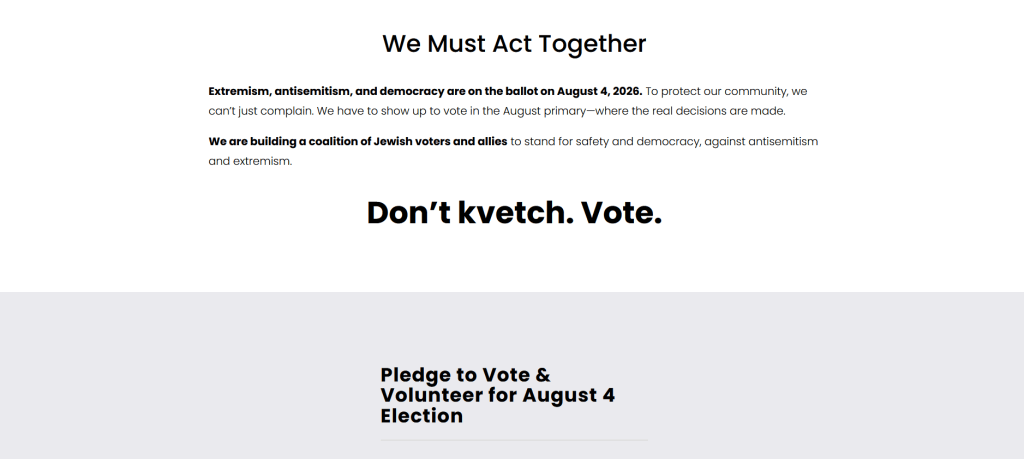
Screenshot from the front page of stlouisvotes.org
In his answers to my questions, Singer stresses his work and the work of Show Me Integrity and St. Louis Votes opposing Amendment 4 and Amendment 5. In fact, he invited me to attend a presentation on this subject done through Kol Rinah congregation (which I unfortunately could not attend). I also oppose Amendments 4 and 5 and support community education in opposition to these proposals. However, this does not explain why the St. Louis Votes campaign specifically targets the Jewish community for higher voter participation, once again claiming that “Antisemitism is on the Ballot”, working directly with organizations and influential individuals who have been outspoken in accusing Cori Bush of antisemitism, specifically because of her policy positions and statements critical of the State of Israel because of its violent actions against Palestinian people. In 2024 St. Louis Votes had the same August primary Jewish outreach campaign despite not advocating for or against any August ballot initiatives.
Israel is committing genocide against the Palestinian people. Wesley Bell is beholden to Israel through massive donations from AIPAC, and he uses his position in Congress to make sure that Israel has the material and diplomatic support it needs to continue its genocide. When Cori Bush was in Congress, she worked to stop giving material and diplomatic support to Israel as long as it committed genocide and denied basic human rights to Palestinian people. Antisemitism is not on the ballot for the August Democratic Primary in Missouri’s 1st Congressional District, but genocide is.
—————————————————————————————–
I posed six questions to Benjamin Singer in preparation for this article. Singer responded to these questions. I then posed five more follow up questions, to which Singer also responded to all the questions except the 11th. I have included here my questions and Singer’s answers verbatim.
1. Your statement this year to the Jewish Light and the messaging that your organization used two years ago claim that in the August primary “antisemitism is on the ballot”. Can you tell me where antisemitism is on the ballot in the 2026 primary election?
“‘Antisemitism is on the ballot’ means that when bullies are pushing down Jewish children at school and yelling ‘Hitler was right,’ Nazis are demonstrating in St. Louis County, bigots are vandalizing Jewish homes and drawing swastikas on schools, and people are issuing bomb threats to synagogues across the region, we want our leaders to do something. When minorities vote in high numbers, leaders take notice. These attacks are happening to our families, friends, and neighbors. Voting is a peaceful way for community members to make clear that our safety and equal dignity matter.”
“We never endorse or oppose candidates or tell voters that any candidate is antisemitic.”
“Minority communities deserve the same safety, dignity, and respect as every community.”
2. Two years ago the outreach was done for Jewish voters only in Missouri’s first congressional district. Will this also be the case this year? If so, why? If not, why not?
“This year we are expanding to include St. Charles County, in addition to all of St. Louis City and County, as Jewish and other minority voters facing discrimination continue to spread out across the St. Louis region.
“Our limited time and budget did initially have us focus on historically Jewish areas, where Jews have continued to face the most violence, and where our initial organizers lived: in the City of St. Louis, University City, and surrounding areas. We wanted leaders to pay attention to what our community was experiencing. Ultimately our enthusiastic volunteers ended up phonebanking Jewish voters and engaging Jewish organizations across St. Louis City and County, including parts of CDs 1 and 2. Our public communications in 2024 publicized voting locations in both CD1 and CD2.
“As background, until a court decision in 1948 and then the federal Fair Housing Act of 1968, Jewish families were excluded from many cities and neighborhoods, and primarily lived around the City of St. Louis and University City. Some restrictive covenants still banned people of ‘Hebrew descent’ from living elsewhere.”
3. Two years ago the outreach was done for only for the August primary election. Will there be a similar outreach for the general election?
“We’re planning to contact voters for November. We contacted voters about the November 2024 election as well.
“That said: While most voters turn out in the general election, primary turnout is dismal—only about 25%. When a minority group is only 2% of the total population, we have to show up in high numbers in low-turnout elections to be noticed. Minority communities deserve the same safety, dignity, and respect as every community.”
“The legislature placed serious measures on the August 4, 2026 ballot: Amendment 4 would make it more difficult for citizen-initiated amendments to pass, and Amendment 5 would replace the income tax with higher sales taxes. Surveys show that most voters don’t even plan to show up to vote, let alone know these measures are on the ballot. It’s extremely important to show up and vote early. Early voting starts July 21.”
4. How does an effort to maximize voter turnout specifically for one ethnic and religious group fit with the principles behind the Respect MO Voters coalition, Proposition R and Proposition D, achievements that you tout on the Show Me Integrity website?
“Our pro-democracy movement focuses on holding government accountable, which requires voter participation.
“When turnout is only 25%, more Missourians need to vote if we want to be able to hold elected officials accountable to the people.
“We have helped Black and Jewish Missourians turn out to vote since 2020. Both communities have historically faced discrimination and threats on their lives.
“Minority voter turnout for historically marginalized groups is nothing new—many groups across St. Louis, Missouri, and America do similar work as part of the constant struggle towards the American ideal of equal treatment under the law for ALL people. In order to fight for equal justice, minority groups need to turn out at higher rates.
“For example, when the COVID pandemic began in 2020, Missouri NAACP President Rod Chapel pointed out that hospitalization rates were 2 times higher for Black Missourians than for non-Hispanic white Missourians. While voter participation helps hold leaders accountable, there was legitimate fear about polling places becoming super-spreaders. We built MOVote.org and worked with the Missouri NAACP to help get the word out about this resource for absentee voting and connected them with funding for their outreach.
“In 2021 we continued this work by holding an event and creating materials for several local NAACP Branches across Missouri to help their communities vote in low-turnout municipal elections.
“In 2022, the City of St. Louis held a special election, which usually means low turnout. So we partnered with a North St. Louis organization to canvass neighborhoods to ensure voters knew about the election and how important it was to show up and make their voices heard.
“In 2024, when Jewish St. Louisans faced increased violence, intimidation, harassment, and isolation, our pro-democracy organization had the opportunity to do voter turnout for my own community for the first time. We consulted with our board and we agreed that helping more Missourians vote continues to be part of our mission and is the right thing to do. We were disappointed but not surprised at online comments from people who seemed to have a problem with Jewish St. Louisans voting.
“In 2024 Missouri NAACP President Rod Chapel and I agreed to apply for funding to help Missouri NAACP members vote that November. We were frustrated that the grant proposal was denied.
“The NAACP has been a leading voice for voting rights, equal access to the ballot, and civil rights since its founding in 1909 by Black leaders, abolitionists, and Jewish activists standing up to discrimination against Black Americans after a race riot less than 2 hours from St. Louis.
“In 2025 we partnered with the Missouri NAACP to ensure their members had a voice in our community-driven policy process.
“We continue to seek funding to support shared voter turnout work to help Missouri NAACP members get out the vote across the state.”
5. What people and / or organizations are the largest funders of the STL Votes Jewish outreach campaign for 2026?
The donations for St. Louis Votes come from 5 St. Louis residents and total $18,000.
6. The Jewish Light article cites and quotes Rabbi Brigitte Rosenberg of United Hebrew Congregation as a supporter of the STL Votes Jewish outreach campaign. She is also an outspoken critic of Cori Bush and has been a public supporter of Wesley Bell. How do you respond to speculation that the entire campaign is really a way for supporters of Wesley Bell and opponents of Cori Bush to use non-profit organizations and money to help Bell win?
“Our volunteers have reached out to Jewish organizations, rabbis, and other leaders across the region and do not discriminate based on their positions on ballot measures, candidates, or geographical location. In fact, some support different candidates in the election you’re talking about. None of the first synagogues where we met with rabbis about participating in 2026 are even located in CD1.
“I’d like to close with a quote from a Jewish student at SLU. Jewish students at SLU have reported items being thrown at them on campus. One of those students was quoted in the university paper as saying, “The thing about antisemitism is that it starts with Jewish people, but it never ends with Jewish people. When Jewish people are the victims of hate or prejudice, it’s often the first step before other minorities and vulnerable populations are targeted themselves. … There should be nothing controversial or political about condemning anti-semitism or prejudice.”
———————————————————————
Follow up questions
You write that STL Votes engaged in Jewish voter outreach for the 2024 general election. For the 2024 primary election STL Votes had an extensive campaign, including paid canvassers.
7. What was done for the 2024 general election for Jewish voter outreach?
8. What was the budget for the primary election compared to the general election?
9. Is there any public record of this 2024 STL Votes November election Jewish voter outreach (such as an article in the Jewish Light)?
10. Did the STL Votes 2024 general election Jewish voter outreach campaign tell Jewish voters that antisemitism was on the November 2024 ballot, as it did for the August ballot?
11. Did STL Votes engage in Jewish voter outreach during the 2025 municipal elections?
Questions 7 and 8:
See table below. Apples and oranges. The issue we worked on in August was turnout (which is much harder), and the issue in November was information.
As I mentioned below, turnout in November elections is already more than twice as high. In the 2024 presidential election, you can see it was almost 3 times as high.
You keep calling St. Louis Votes “Jewish voter outreach” but it’s more specific than that. It’s been focused on increasing voter TURNOUT among these St. Louisans, like when we canvassed North St Louis. And we haven’t discriminated based on which candidates they support. The messaging is about election dates, times, locations, and motivating people to show up and participate.
Research shows that one of the main reasons people don’t vote is because they don’t know when, where, or how to vote. For example, one of our supporters just reached out to me to let me know his friend knew all about Amendment 4 from his daughter’s research, but didn’t know what date it would be on the ballot.
That’s why the focus for TURNOUT has been on August.
November doesn’t have the same turnout issue.
November 2024 turnout (67.81%) was one of Missouri’s highest-turnout elections in recent decades.
https://www.sos.mo.gov/CMSImages/ElectionResultsStatistics/Nov2024OfficialVoterTurnout.pdf
Knowing that it would be high in a presidential election, the challenge in November was more about information to counter the deceptive language that politicians were putting on the ballot about Amendment 7, which received little publicity.
So for ALL voters we dedicated nearly our entire organizational capacity, hired a digital firm, did a series of broader democracy emails to the same universe of voters, plus our entire Missouri list, and continued to advertise the MOVote.org service, with $10,000 per month in ads, to all voters. I don’t know what the exact budget was all in, but probably close.
Questions 9 and 10:
Not in the Jewish Light but for November 2024 you can find my op-eds in the Post-Dispatch, the Kansas City Star, and the Springfield News-Leader educating voters about Amendment 7.
| Election | Registered Voters | Ballots Cast | Turnout |
| November 5, 2024 General Election | 4,440,831 | 3,011,262 | 67.81% |
| August 6, 2024 Primary Election | 4,379,423 | 1,040,997 | 23.77% |
UPDATE: This article was updated to correct formatting errors.
UPDATE 2: This article erroneously referred to Mr. Singer working on “propositions” that were actually proposed amendments. This has been corrected.


