Restoring the Legacy of Mill Creek Valley

Mill Creek: Black Metropolis opened last November at the Missouri History Museum in Forest Park.
For the past two and a half years, I worked with the exhibits team for Mill Creek: Black Metropolis, lead by curator Gwen Moore, at the Missouri History Museum. Our task was to bring this exhibit to life. During this process, I learned more about Mill Creek than I had ever learned about a single neighborhood in St. Louis. What this process taught me was both eye-opening and also incredibly infuriating.
Through study of old newspapers, journals, and secondary sources, as well as collaboration with community partners such as donors of various objects, photographs, and films. This was enhanced by Mill Creek residents themselves, who contributed their voices through oral histories. In the end, our team put together an exhibit that should make every St. Louisan proud.
The exhibit tells the story of the midtown neighborhood from its origins as home to some of the city’s wealthiest white business and political figureheads (during the second half of the 19th century) to a vast and densely populated Black neighborhood that birthed generations of excellence in everything from sports and entertainment to business, politics, and education.
For decades, the story of Mill Creek was largely absent from contemporary histories of St. Louis, even as many of the city’s biggest names traced their roots back to Mill Creek. Names like civil rights lawyer David Grant, boxer Henry Armstrong, legendary ballplayer James “Cool Papa” Bell, and jazz musician Clark Terry.
I first learned of Mill Creek as an undergrad. I remember reading Ron Fagerstrom’s brilliant unpublished manuscript, Mill Creek Valley: The Soul of St. Louis (2000). Through photographs and incredible interviews with those who called Mill Creek home, Fagerstrom made the case for why all of St. Louis should care about Mill Creek Valley.
Two decades later, we have started to do just that. Thanks to works such as Vivian Gibson’s The Last Children of Mill Creek (2020) and Malaika Horne’s Mother Wit (2018), as well as Walter Johnson’s The Broken Heart of America (2020), Mill Creek’s history shifted from assigned reading in the classroom to your next read at book club. If you haven’t yet read those books, perhaps you’ve seen the awesome art installation outside the soccer stadium, Pillars of the Valley, or heard of the related and under-construction Brickline Greenway, both of which pay tribute to the Mill Creek neighborhood.
This new exhibit seeks to build upon these works by filling in the gaps and fully fleshing out the story of the wider community, giving the visitor an almost encyclopedic glimpse into this incredible neighborhood that was. In some ways, you can think of it as a directory; the exhibit celebrates the people, the institutions, the businesses, schools, churches, and raucous dance halls of the neighborhood that once stretched from Grand to Union Station.
It’s really not hyperbole to say that Mill Creek was, as Walter Johnson has called it, “The Harlem of St. Louis.” The neighborhood was a cradle for culture that would go on to echo across the country from ragtime to jazz, blues, and dance. Mill Creek was also the center of intellectual and political organizing, where the city’s chapter of the NAACP was born and later the Citizen’s Liberty League, whose leaders including Homer G. Phillips and Lucy Bledsoe demanded from local and state Republican leadership a “square deal for the negro,” through more honest elections at the ward level, appointments to various city offices and uniformed policemen and firemen. It was also the home to the black press, including such newspapers as the St. Louis Palladium, St. Louis Argus, and St. Louis American. It was where black entrepreneurs like Annie Malone, Charles Turpin, and Jesse Johnson made their names nationally known.
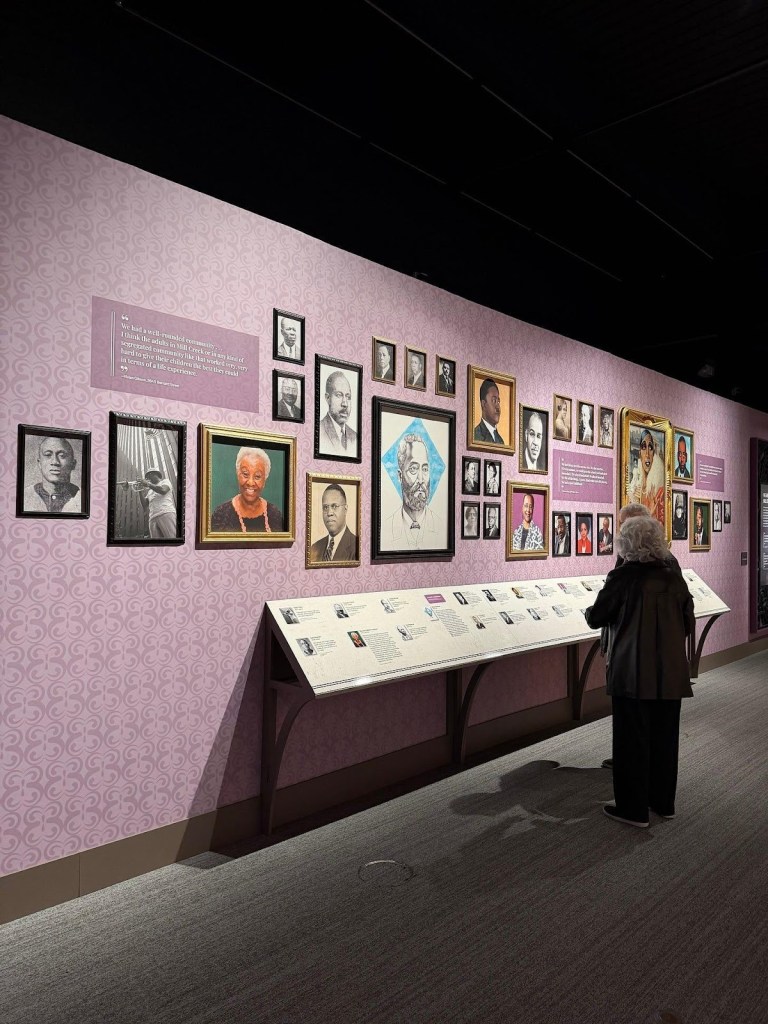
The exhibit features a veritable wall of fame which highlights the many faces, some familiar, some you are probably seeing for the first time, that called Mill Creek home. Photograph by Mark Loehrer
But the story has a somber chapter.
It tells the tale of one of the single most racist, destructive, and sloppily executed programs undertaken by then civic leaders, slum clearance. This planning policy placed Mill Creek in the crosshairs.
First came the stigmatization of Mill Creek. Then came the blue ribbon committees and the promises made for relocating residents. Then came the bulldozers.
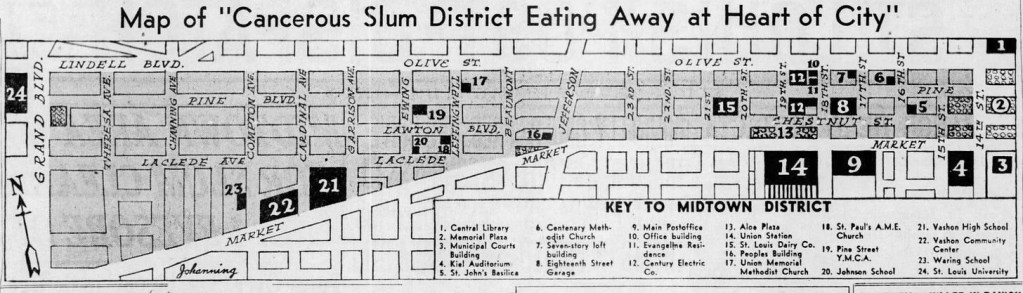
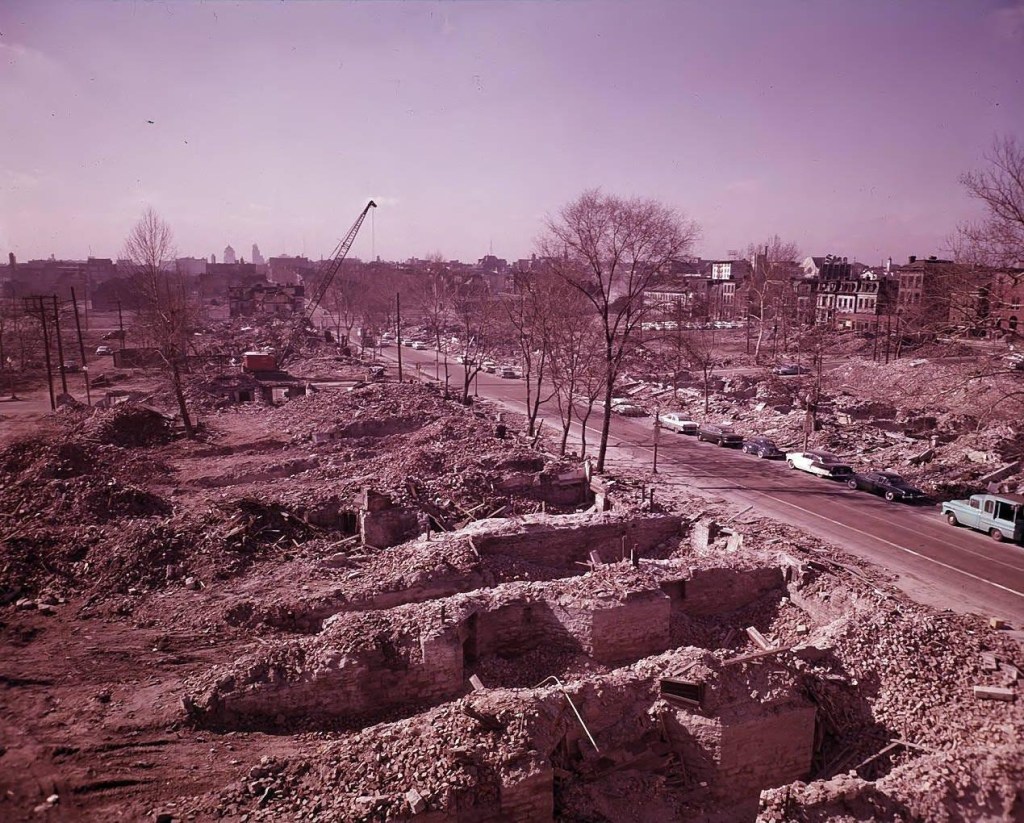
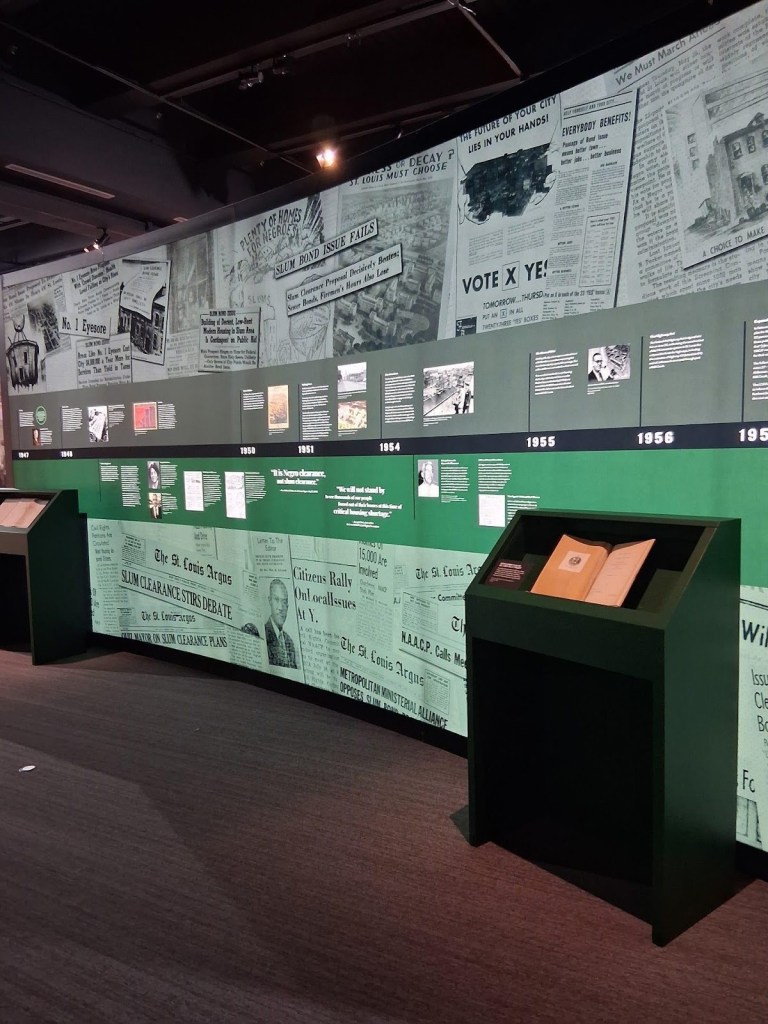
This part of the story is brilliantly told through a timeline in the exhibit, showing the city’s efforts to mischaracterize and destroy Mill Creek, while also presenting the black community’s attempt to defend itself until the bitter end, when all it could hope for was that those displaced received assistance in finding new homes.
Turning a bit towards a point of reflection, I want to pause to admire the incredible amount of work that was put into making this exhibit visually stunning.
A major credit is owed to our exhibit designer, Allison Hamburg, as well as supporting work from media specialist Nathan Wall and graphic designer Heather Speckhard. Without these three, this exhibit would simply be a really long script. The exhibit also benefited from original illustrations by local artist Candice Evers, who helped bring to life people such as educator Arsania Williams, using only a grainy1x1” newspaper photo.
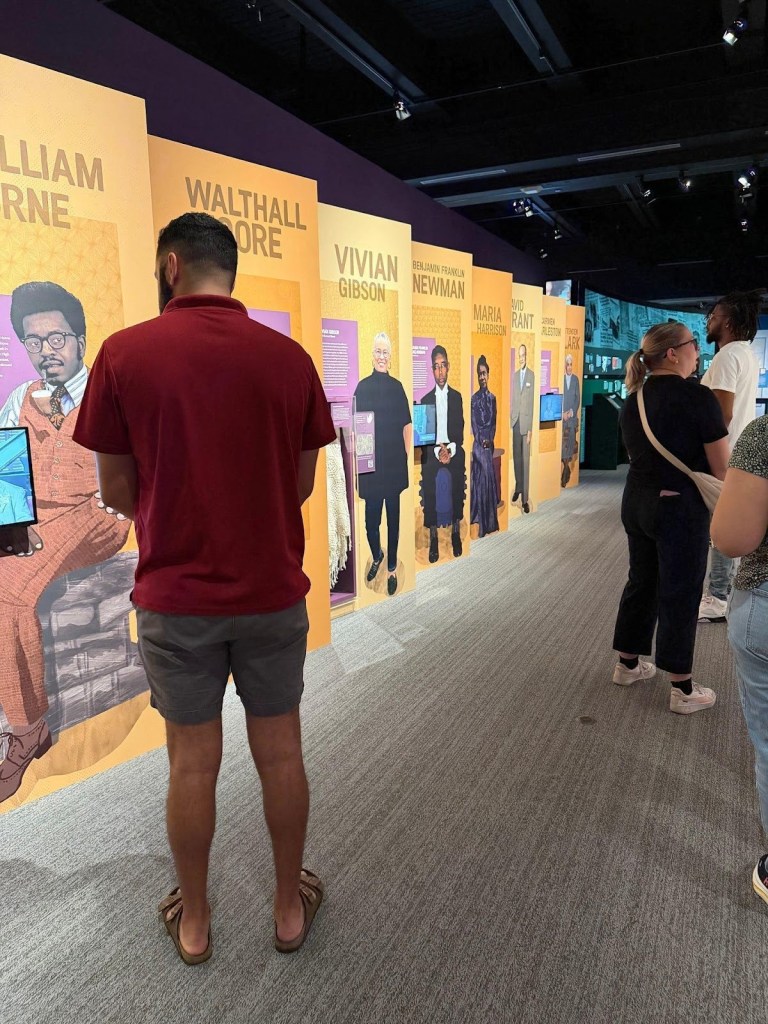
Life-size illustrations blended with collage by Candice Evers, helping bring to life familiar and new faces alike to tell the story of Mill Creek up close and personal. Photograph by Mark Loehrer
Part of the fun in creating an exhibit of this scale is finding all the elements that, when combined with a riveting script, can create an immersive and moving experience for the visitor. This exhibit pulls no punches in that respect, treating visitors to wall-sized maps, ceiling-tall screens featuring extremely rare, never-before-seen moving images. These are one-of-a-kind objects and photographs that have never been exhibited. One of my most memorable memories from putting together the exhibit was discovering photographs showing one of the city’s most happening, swanky nightlife destinations, the Glass Bar. The Glass Bar, later renamed Peacock Alley, was one of dozens of destinations for music, comedy, and revelry in Mill Creek.

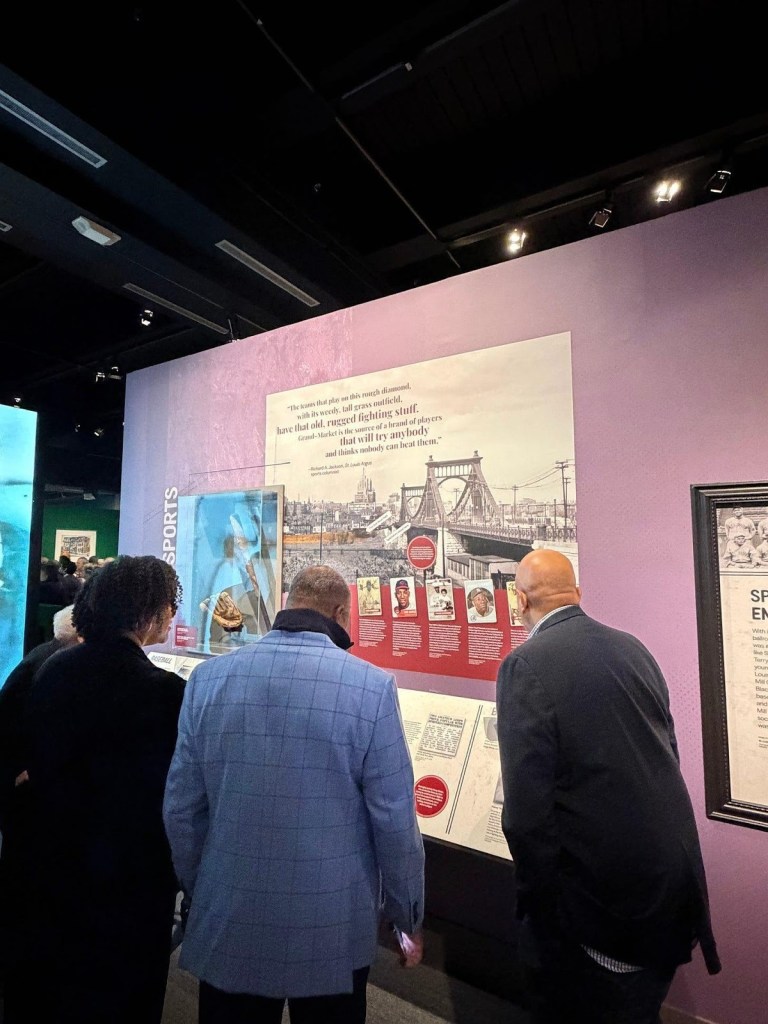
For my part, I really enjoyed researching and piecing together a story of baseball in Mill Creek that really takes the visitor into extra innings. Sure, we know Mill Creek was home to the legendary St. Louis Stars Negro League team, with Stars Park formerly standing at the corner of Compton and Market (now the site of the newly opened Wolff Jazz Institute & National Radio Hall of Fame, housed in the former Vashon Community Center).
Maybe my favorite part of the exhibit is what graphic designer Heather Speckhard did to tie the featured baseball players together, creating homemade baseball cards for Leon Anderson and Lefty “Spider” Carter cropped from team photos we sourced from Wentzville Historical Society alongside scans of real baseball cards of MLB players Elston Howard and Luke Easter, both of whom attended Vashon High School and played ball in Mill Creek.
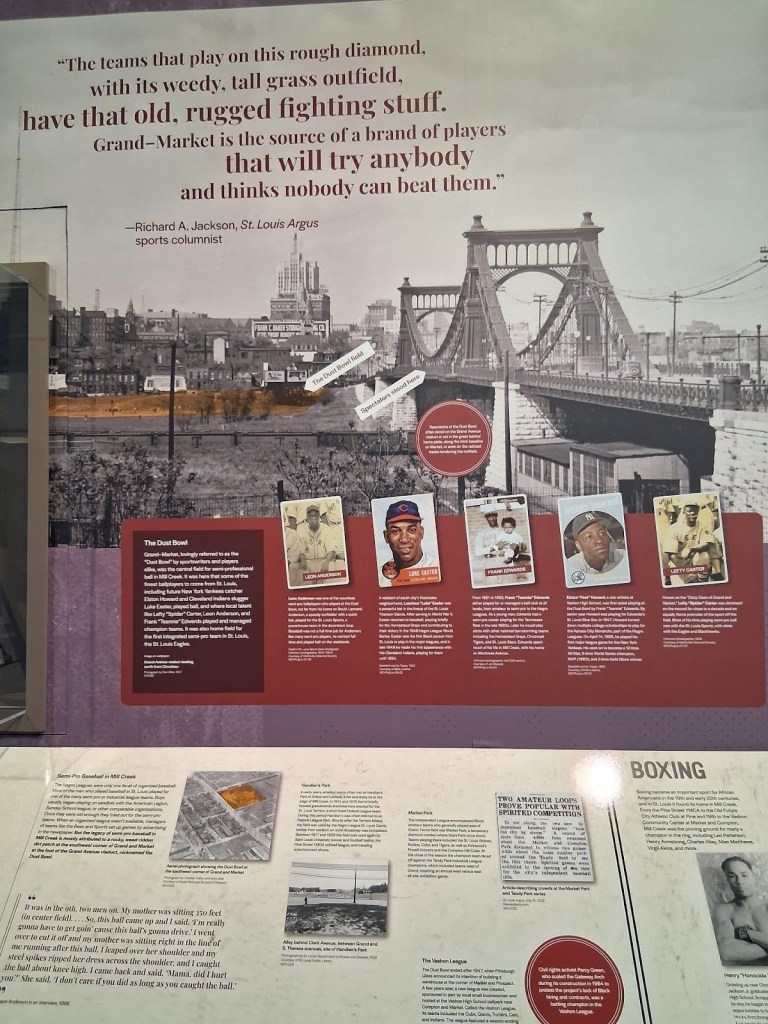

Did you know that every time you drive down Highway 40 beneath the Grand overpass, you’re passing over baseball history? At the southwest corner of Grand and Market, at the foot of the old Grand Avenue Viaduct, sat the “Dust Bowl.” It really wasn’t much to look at, but as summed up in a brilliant column from the St. Louis Argus, the Dust Bowl produced a crop of players unlike any you would find elsewhere in amateur baseball in St. Louis. They were tough. They played dirty. And they took on challengers whomever they be.
But the magic of the Dust Bowl for me wasn’t truly apparent till I received a strange message in my email.

At the time, I was really struggling with how to tie my discussion of amateur baseball together, but I knew this fellow Frank “Teannie” Edwards would have something to do with it. He was a player and manager with many highly successful teams in St. Louis, and especially throughout Mill Creek. Fate would not let me strike out, handing me a walk-off from a slow pitch down the center by the granddaughter of Frank T. Edwards! I would not have been able to tell the story of amateur baseball in Mill Creek without Joi Edwards’ help, her photographs, or her incredible research into her family’s legacy of greatness. A fine example of how the work of those in museums is richly benefited by fostering collaboration with the wider community.
I suppose I should mention why you should care about Mr. Edwards. You see, he had a part to play in forging the history of Major League Baseball.
Here’s how the story goes: While waiting for the streetcar at Grand and Market one day, he spotted what he believed to be a tall man playing baseball with a bunch of kids on the Dust Bowl. As he approached, he realized that “man” was in fact a student at Vashon High School, a multi-sport star athlete named Elston Howard. The kid could play. So well, in fact, Edwards hired Howard to play on his own team. After Howard graduated, Edwards sent word to the KC Monarchs that he had a prospect for them. A handful of years later, Elston Howard, a Vashon High School graduate, was breaking the color barrier for the New York Yankees, where he shared uniforms with fellow St. Louisan Yogi Berra.
As you see, exhibits are in many ways experiences of discovery for both the curator and the visitor!
I thoroughly believe one element that many will enjoy is the extremely rare films showing scenes in locations such as The Walnut Bar, as well as outside the historic St. Paul AME church. The footage from Walnut Bar was donated by Richmond Heights Mayor Reginald Finney, whose father owned several bars in the neighborhood, including the Walnut. Mr. Finney was also a prolific amateur videographer, and the museum received hours of content unrelated to Mill Creek.

The films will stir you. It will make you question the official narrative of Mill Creek as a cancerous slum. The people you will see do not look as if they are in need of saving. They’re well dressed, they’re laughing, kissing, and smiling brightly. It is an image of Mill Creek that those who conspired to destroy this neighborhood would rather you not see.
Hearing from former Mill Creek residents themselves will also move you.
If you appreciated the personal reflections on life growing up in Mill Creek from former residents and authors, Vivian Gibson (Last Children of Mill Creek) and Dr. Malaika Horne (Mother Wit), you’ll greatly appreciate hearing the stories of others who lived in Mill Creek, stories like those of Dr. Carmen Charleston.
As we awaited the start of the ribbon-cutting for the exhibit last November, I spoke with Dr. Charleston about her memories of going to school in Mill Creek. The excitement in her voice was radiant as she told me of her teachers from grade school on, the good ones and the not-so-nice ones. It was clear that her time spent in Mill Creek’s schoolhouses were some of the most memorable moments of her lifetime. She genuinely loved going to school (so much so that she told me she hated snow days), and she clearly loved her teachers. It makes sense that she went on to become one herself. You can hear her recall these stories in her own words and more in the exhibit.
It goes without saying that an exhibit of this size would be impossible without fostering a collaborative relationship between the general public and the museum. Chiefly, as far as exhibits are concerned, this is a relationship based on loans or donations of objects, photographs, and films you see in exhibits. This one is no different!
Take the amazing church windows, which came from the sanctuary that was built for Temple Israel, and later became one of Mill Creek’s largest congregations, Union Memorial ME.
The story behind how the window was saved and eventually made its way to the history museum is one of my favorites. According to the donor, he and a group of his fellow Animal House frat brothers of Zeta Beta Tau were exploring the area of Mill Creek around 1961, when the neighborhood was, for the most part, empty. Few buildings remained, but among them was the old Union Memorial church, which stood near Leffingwell and Pine. According to the donor, the group approached the city’s Urban Renewal authority, the LCRA (Land Clearance for Redevelopment Authority), about potentially salvaging something as a token for their frat’s house. They were rejected.
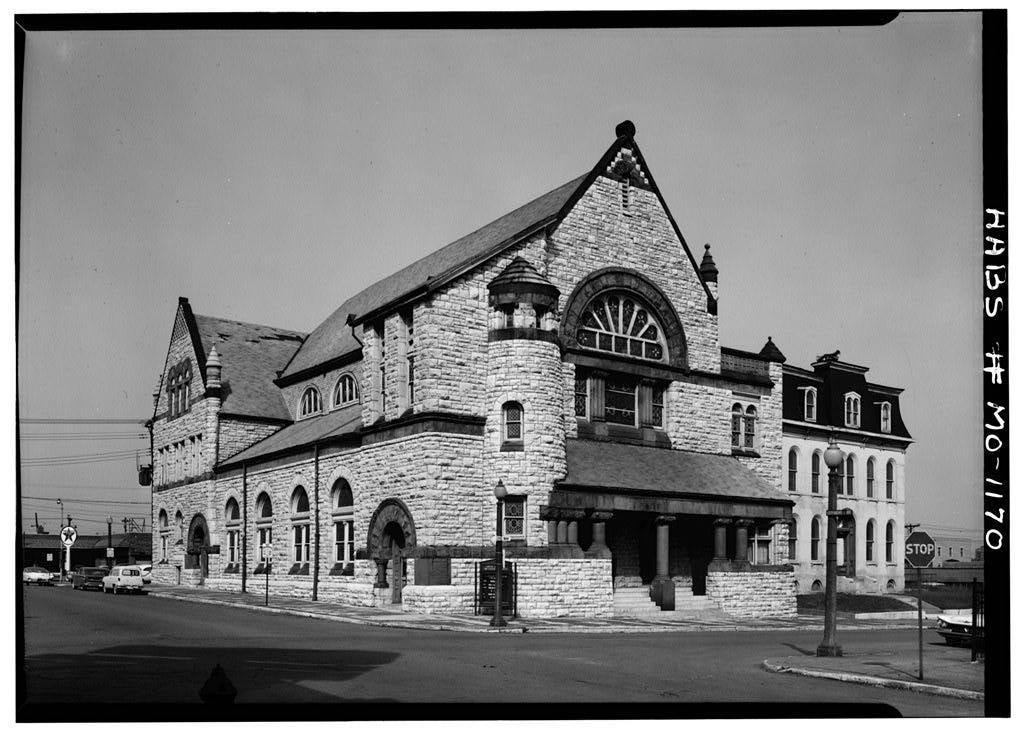

Undetermined, the group gained access to the vacant Union Memorial and seized its second-story turret window (the arched window mid turret in the above photograph). After residing in the frat house for a few years, the donor took it with him. It would reside in his residence until he approached MHS Curator Gwen Moore to inquire if the museum was interested in taking it. At the time, he did not recall the exact location from where the window was taken. However, its geometric design, typical of stained glass found in synagogues (including the former United Hebrew on Skinker that now houses the Missouri Historical Society’s research library), helped us quickly locate its origin as Union Memorial, formerly Temple Israel, in Mill Creek Valley.
Thanks to this donation, the exhibit can boast having an authentic piece of Mill Creek Valley architecture on display. A first for the Missouri Historical Society, which previously did not find Mill Creek of significant importance, meaning that there was no active collection during the period in which Mill Creek was being razed for urban renewal.
But not every collaboration needs to be material. Lending your voice, such as through an oral history, or your research, such as your genealogical research, can help a curator immensely in telling a story through exhibits.
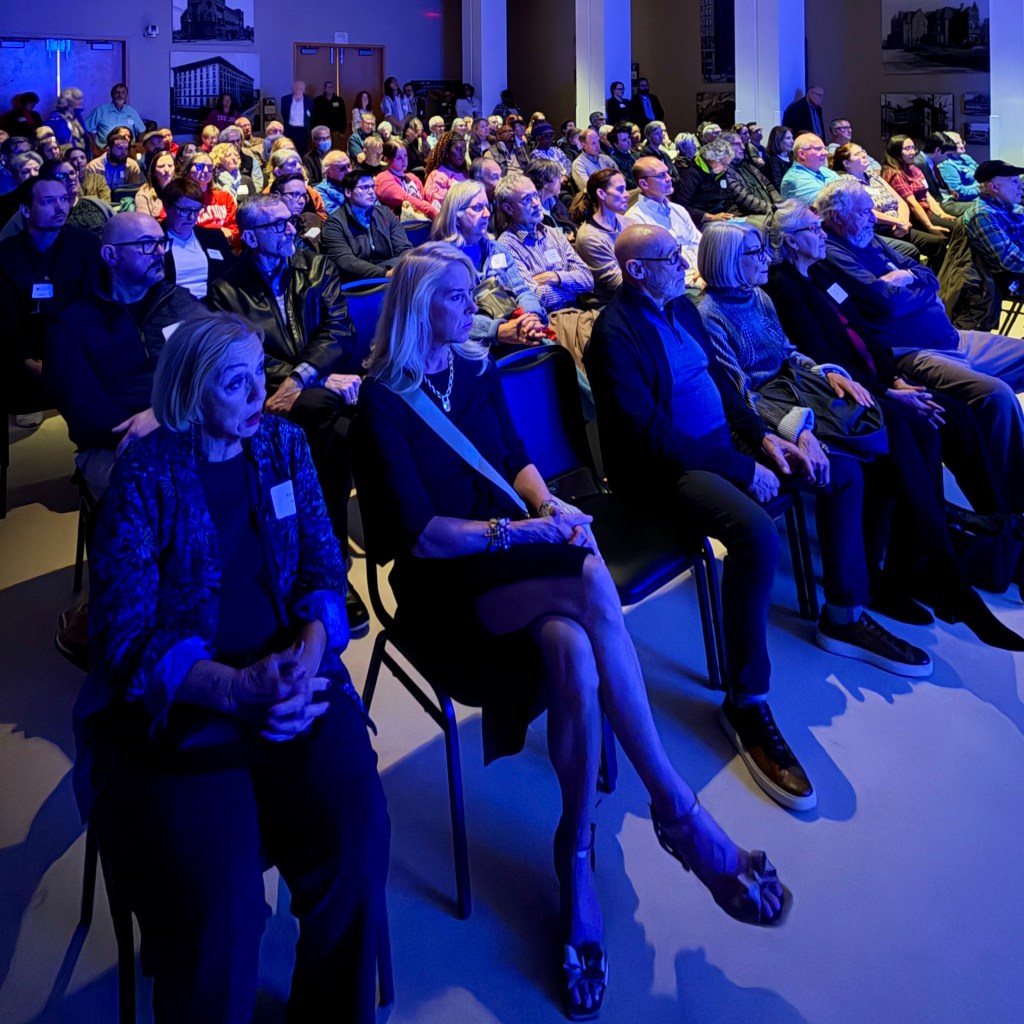
Joy Edwards Haynes and family look on at a discussion of baseball in Mill Creek Valley, which includes her great-grandfather, the long-time Mill Creek baseball manager Frank Teannie Edwards
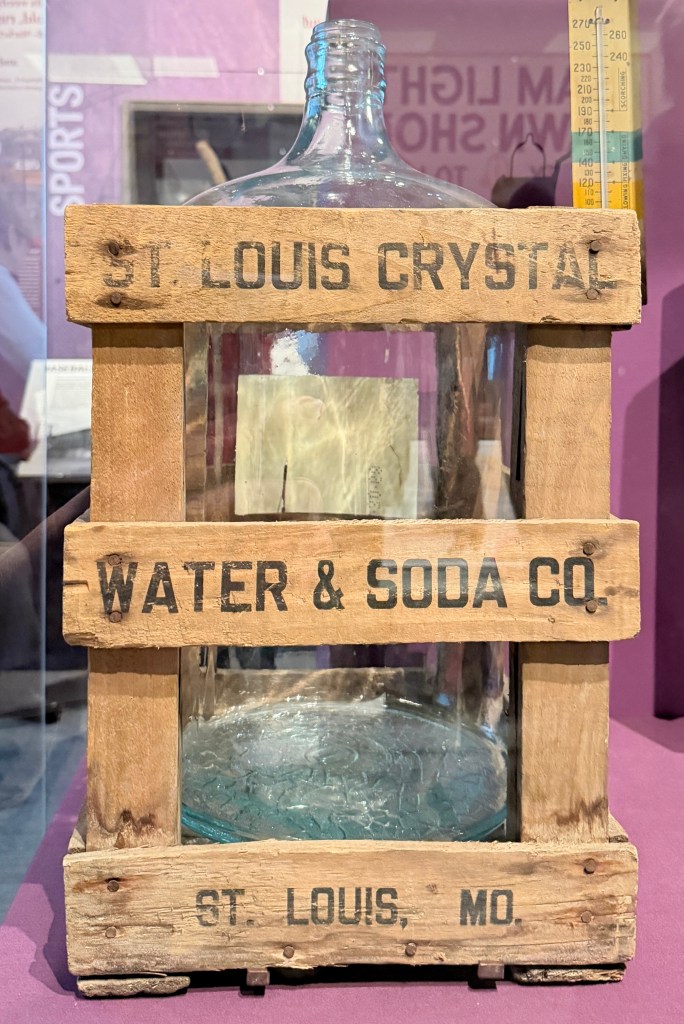
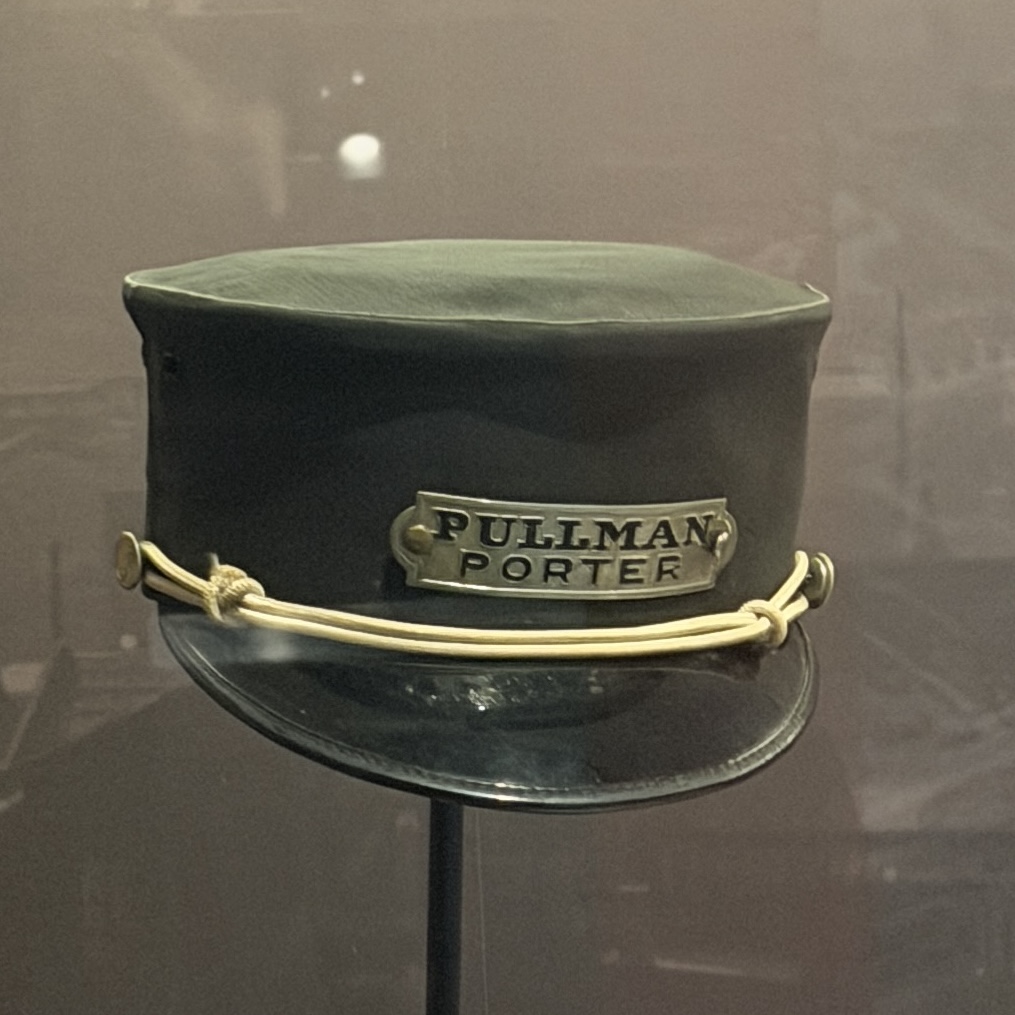
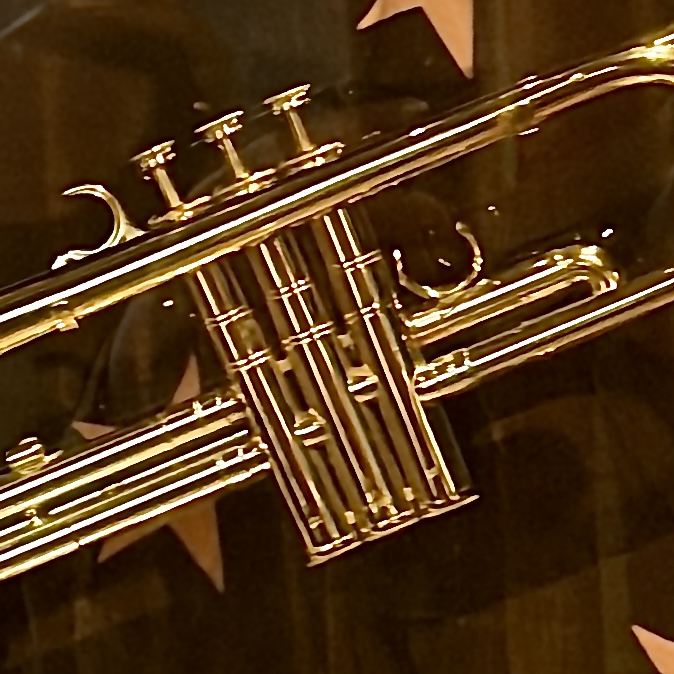
Additional objects on exhibit that will catch your eye in Mill Creek include: a flugelhorn belonging to Clark Terry and the trumpet of legendary local jazzman and orchestra leader George Hudson. A Pullman porter’s uniform, a hand mirror believed to date to the early years of Annie Malone’s Poro College business, and baseball gear belonging to Leon Anderson, who played amateur ball in Mill Creek. When taken together, the objects, photographs, films, and oral histories will show you a side of Mill Creek that is both visually stunning and relatable.
Unfortunately, that isn’t the only relatable aspect of the Mill Creek story, as the concluding section makes clear through a wall-sized map showing various urban renewal and modern redevelopment efforts. Time and time again, St. Louis has emptied Black neighborhoods and targeted them for redevelopment. In some instances, such as Tiffany in the 1980s, residents have been successful in beating back these attempts, but that instance is in a small minority, compared to the many projects that succeeded in displacing Black communities.

I hope the exhibit will remind you that neighborhoods are defined by more than their architecture, more than by how much tax revenue can be generated through property taxes. Neighborhoods are far more complex than accounting decisions. They are people, churches, schools, businesses, and corner taverns. They are people’s livelihoods. When you uproot people and cast them out, their lives are forever changed.
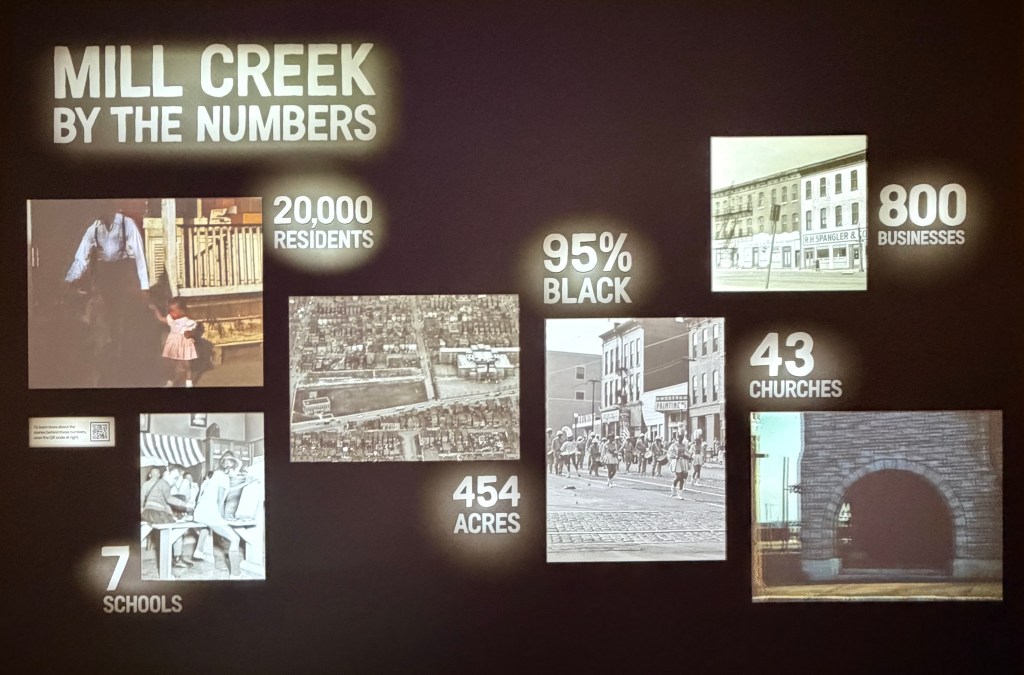
Mill Creek was a massive neighborhood. It housed nearly 20,000 people, likely more at its height, and its destruction did not deliver the resounding golden age that civic leaders and city planners had promised. In many ways, Mill Creek came at the point of no return for the city and failed to halt suburban sprawl or capital flight from downtown. For much of the decade following clearance, large swaths of the project area sat vacant. Even today, the land that had been redeveloped for residential use as Laclede Town is now occupied by athletic fields or parking for SLU or Harris Stowe students and faculty. To say nothing of the sorry state of nearby Heritage House apartments.
While discussions on how we mend this grave error range from reparations to historical markers one resounding lesson to be pulled from Mill Creek is that our neighborhoods cannot be taken for granted, black neighborhoods especially. From Meacham Park to Hadley Township in Richmond Heights, black neighborhoods have been targeted for commercial redevelopment largely for the same reasons as Mill Creek. Tax revenues.
Yet for all the bad that came from Mill Creek’s demise, we should not lose sight of the good that it produced before its destruction. From jazz musicians, singers, and dancers to lawyers, doctors, dentists, trade unionists, newspapermen, and entrepreneurs, Mill Creek was for decades the heart of black St. Louis, which places it at the heart of all St. Louis.
The exhibit runs now through July 12th of 2026.

Mark Loehrer currently lives in Tower Grove South with his two cats, Ricky and Juliette. He describes himself as an artist with a historical research fetish. Mark thoroughly enjoys helping people find what they need in a variety of historical research topics, including city planning and politics, black history, neighborhood history, and the meaning of Sanborn map abbreviations and color coding.