
Foristell Residents Express Opposition to Proposed Data Center
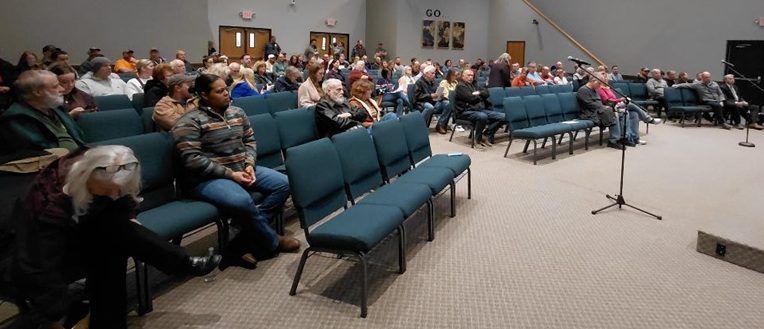
The Foristell Board of Aldermen met at the River Oaks Church on the evening of February 17 to take up a proposal to annex 216 acres of land from unincorporated Warren County into the municipality. The move would give it jurisdiction over the site that Oppidan Investment Company and its subsidiary Connect hope to utilize to build one or more data centers for an unknown client. Despite Foristell having around 900 residents, nearly 100 people attended the meeting.
Constance Palmer, both Mayor and First Ward Alderwoman, led the meeting. She assumed the role of Mayor after previous mayor Bradley Miller, who resigned suddenly in January, less than a year into his term. A resident stated that they believe the reason for Bradley’s resignation was a conflict of interest stemming from his employment at a company that sells services to data centers, while Second Ward Alderman Glenn Keevan said after the meeting that he thinks the resignation was for another reason. Ald. Keevan said that Miller stepped down because being mayor of Foristell pays very little, and his duties took up too much time.
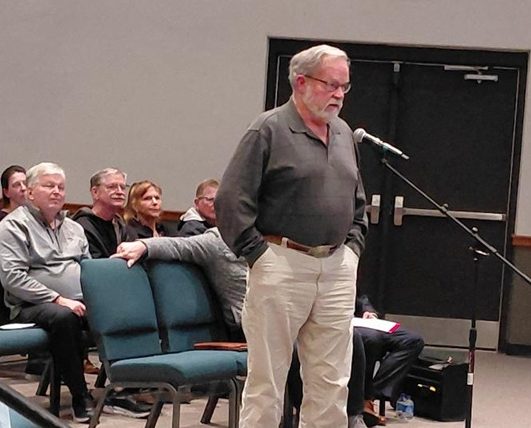
Seventeen people testified against bringing a data center to the site, while not a single person testified in support. Others in the audience, who did not officially testify, also appeared to overwhelmingly oppose the data center. Speakers against the data center also received applause from the audience.

Speakers opposed the siting of a data center in Foristell for similar reasons to opposition shown in Montgomery City and throughout the region:
- Loss of property values and damage to their way of life
- Water overuse
- Light, noise, air, and water pollution
- Increased utility rates
- Democracy and transparency
Loss of Property Values and Damage to Their Way of Life

Robin Cook said that she and her husband “recently purchased our house on December 17th.” She also said, “If we would have known this was coming, we never would have done that.” She fears that her home purchase decision was a mistake.
Longer term residents of Foristell said that the data center would damage their small town’s rural way of life. Cathy Chew said that the data center wanted to move to Foristell, but the people of Foristell don’t think it would be a good fit. Multiple residents said that the data center would change the character of their community and be detrimental to their quality of life.
An example of how it could damage the community was brought up by Fred Chew, who foresaw the possibility of the data center shutting down in a few years. He noted that this would leave the town with a very large, useless, and polluted industrial site. As an alternative, multiple residents suggested that the town leaders work to bring in more homes to the community.
Water Overuse
Several residents said that the data center could use up to 13 to 15 million gallons of water per day, and they expressed concerns about this affecting their water supply.
Wayne Stroettner said that his well has already gone dry twice, just because of the new homes that have been built around him. He asked city leaders who is going to pay for it if the data uses so much water that residents’ wells run dry?
Light, Noise, Air and Water Pollution
Multiple residents worried about increased cancer rates from air and water pollution, as well as negative effects from noise pollution. Gina Theisen said that the constant humming of low frequency noise can contribute to hypertension, heart attacks, strokes, and other ailments. She said that current noise pollution rules for the town were not made to handle the non-stop noise that data centers produce. Cook stated, “When our grandkids and kids visit, I want to have a clean environment.”
Fellow resident Ann McCutchon noted that what draws people to the area is clean water in the lakes and expressed the same concern as others: that the data center would contaminate the massive amount of water involved in the data center’s operations. Several residents referred to Coldwater Creek in north St. Louis County, pointing to it as a cautionary tale of polluted water that they wish to avoid. Residents also brought up how light pollution from a data center could negatively affect both residents and wildlife.
Raised Utility Rates
One resident who wished to remain anonymous stated that he had been told that the project would use the amount of power needed for 365,000 homes. As fellow resident Pam Zuk put it, the data center would be “an energy-sucking behemoth”. This would likely raise electricity rates from the Cuivre River Electric Cooperative, which serves the community. This was one of the more common concerns aired at the meeting.
Democracy and Transparency
Unlike in Montgomery City, the crowd mostly avoided expressing hostility towards city leadership, who has not made a firm decision on the issue.
Still, many residents felt they were taken by surprise by the data centers, and they pleaded city leaders to heed their concerns and keep them informed on any new details about the proposed development. “This was sprung on us,” said Cathy Chew. “We don’t know what we don’t know,” she continued. Fred Chew said he wanted to know exactly what was happening – who is responsible and who will be left with the problem if it fails. Resident Phyllis Wall said, “We are thinking of getting an attorney.” This is something residents of Montgomery County did when they saw their political leaders as unresponsive*. Her suggestion elicited applause from residents.

Several people expressed their displeasure with a large outside corporation having this power to extract enormous amounts of land, electricity, water, and resources from their small town. Sandy Wilson said that “nobody anywhere who has had a data center in their community is happy with them”.
Jessica Ross-Deutcher expressed the sentiments of the room with an impassioned speech where she proclaimed, “I love my country.” She then asked, “What kind of America do you want to live in? What kind of Foristell do you want to live in? Do you want an America and a Foristell where people profiting off of data centers control everything? Or do you want clean air and clean water?” She then told the officials in the front, “You were elected by us – it is your job to do what you think best serves our community”.
Several residents, including real estate analyst Edward Chesny, said that a decision regarding a data center coming to the community should go before a vote of the people. Chesny brought up his professional expertise, citing the four tests of Highest and Best Use. He said the most important test is answering the question “Is it legally permissible?”, then claimed that a data center in the location being considered would not meet this standard, because it would not be the maximum productive use of the land.

Terri Benskin had a more specific concern. She lives outside of the city limits, near where the potential data center would be sited. She worried that if the city incorporated the land, then the ordinances concerning negative effects such as light and water pollution might be projected towards her without accountability for how it affects her life. As she put it, “Before taking irreversible actions, consider how it goes inward and how it goes outward”.
After the meeting, I spoke with City Administrator, City Clerk, and City Planner Todd Streiler. He told me that if the public does not want the land annexation, Missouri statute states people can file a protest petition if signed by 5% of qualified voters in the municipality. This must happen within fourteen days after the public hearing. That is why they are waiting until March 17th, which would follow the bill’s second reading and the potential passage of the matter. Streiler said that if Foristell does annex the land, that does not mean that a data center would necessarily be built. This would just be the first step in a process of zoning and site planning, which would be done in accordance with City of Foristell codes and ordinances. There are also additional approvals that must come from the water district and the electric cooperative. When asked for his takeaway from the meeting, Streiler said, “Residents are very passionate about preserving Foristell and its small town rural atmosphere.”


