
Missouri Considers Passing Legislation to Restrict Free Speech Rights in Schools Pt. 2

One of the main organizations pushing this and similar bills throughout the country is the Combat Antisemitism Movement (CAM), which was represented at the hearing by David Soffer. It is an organization with extensive ties to the Israeli government. Kansas oil magnate and Republican megadonor Adam Beren (pictured here next to House Bill 2061 sponsor Representative George Hruza), created CAM in 2019. In Beren’s 2025 testimony before the Kansas legislature on a similar bill, he expressed his belief that banners with the words “Stop the Palestine Genocide” and “Free Gaza” are antisemitic.
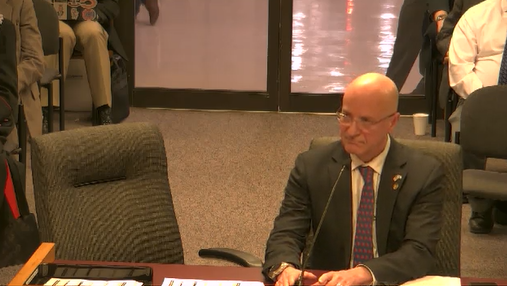
According to Influence Watch, “the Combat Hate Foundation is the nonprofit organization that operates the Combat Antisemitism Movement”. The Combat Hate Foundation is registered in Kansas as a non-profit. In tax documents, it describes its mission this way: “Combat Hate Foundation’s purpose and ultimate goal is to combat the negative trends in hate crimes by educating the public to realize hate hurts not only the victims, but the community”. Despite its stated mission as a domestically-focused non-profit, the nonprofit sent nearly $3.7 million to projects in Israel in 2023.
As reported recently in Current Affairs, “CAM is staffed heavily with former Israeli military and government communications operatives. Its CEO, Sacha Roytman-Dratwa”, seen here in blackface mocking Barack Obama, “previously served in the IDF Spokesperson’s Unit and went on to establish and command its New Media Division, where he spent four and a half years shaping the unit’s “communications strategy” and “branding the IDF on social media.””
Israeli Brig. Gen. Sima Vaknin Gill is a member of the CAM Advisory Board and a former Israeli intelligence officer, Israel’s former Chief Censor, and the former Director General of the Israeli Ministry of Strategic Affairs and Public Diplomacy. She is also a founder of a “PR commando unit” formed by the Israeli Ministry of Strategic Affairs in 2017 to improve Israel’s image abroad, especially in the United States.
CAM also has links to the Israeli government through the Institute for the Study of Global Antisemitism and Policy (ISGAP), which has been heavily funded by the Israeli Ministry of Strategic Affairs. Vaknin Gill is ISGAP’s Managing Director and Vice President of Strategy and Development. Former Deputy Prime Minister of Israel Natan Sharansky is both Chair of the CAM’s Global Advisory Board and the Chair of ISGAP. We know from 2023 tax filings that CAM had a grant agreement with ISGAP. CAM has refused requests by journalists to give a full disclosure of its funders.
Emails obtained by journalist Marianne Dhenen with a Freedom of Information Act request show that CAM’s David Soffer worked directly with Representative Hruza to draft House Bill 2061, along with Missouri Alliance Network leaders Stacey Newman and Jeffrey Abraham, Jewish Federation of St. Louis Chief of Staff and Vice President of Public Affairs Michael Lourie, veteran Republican communication specialist Keith Beardslee, and Representative Ian Mackey (D – Clayton).
CAM CEO Sacha Roytman-Dratwa once told a journalist that CAM is interested in not just reducing antisemitism, but in eliminating antisemitism. Given its conception of what constitutes antisemitism, it is not the innocent goal it might initially sound like, and it should cause us to question the claim made by Soffer that the proposed law will not restrict free speech. Let’s look at relevant sections of the bill.
“Each educational institution shall integrate the definition of antisemitism in this section into such educational institution’s student, faculty, and employee codes of conduct and shall prohibit such conduct at or by such educational institution if such conduct at or by such educational institution if such conduct creates an atmosphere or circumstance in which individuals working at, visiting, or attending the educational institution are impeded from their normal course of work, study, or access to the educational institution and the educational institution’s services and facilities either by physically impeding such activity or by creating an atmosphere of fear or intimidation.” (160.014 — Part 3, Subsection 1, Pages 1–2, lines 13–20).
Under this definition, who gets to decide what does and does not impede the “normal course of work, study, or access to the educational institution”? Furthermore, who gets to decide what is and is not “an atmosphere of fear or intimidation”?
As Representative Elizabeth Fuchs (D-St. Louis) pointed out in discussion with the bill’s supporters’ lead witness, Scott Biondo, “I think what we are talking about is subjective. If that student in that classroom felt that the environment, as stated in the bill, became threatening, just based on the conversation, then they get to make that complaint. So they’re determining what’s a threat.”
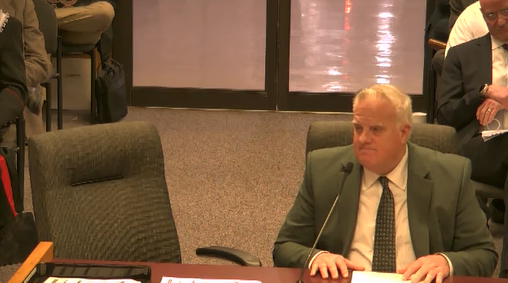
Or, as stated by Mizzou Student Arch Kimbriel in his testimony against the bill, “Would the state ever write a bill that allows another group to use their feelings to determine if discrimination has occurred? No, it wouldn’t. We know they wouldn’t, because feelings are not facts. These determinations need to be as objective as possible. This bill is not objective. The definition is not clear with this bill.”
Students and faculty will have to judge for themselves if they feel that “antisemitism” as defined by the bill creates enough of an “atmosphere of fear or intimidation” that they need to report it to their educational institution. Importantly, their school is not the only organization to which they can report. The Anti-Defamation League (ADL), a staunch supporter of the State of Israel and an organization that submitted testimony in support of House Bill 2061, is ready to hear, evaluate, and litigate all complaints of “antisemitic incidents”. They claim to have at their ready tens of thousands of lawyers from some of the top law firms in the United States. According to ADL CEO Jonathan Greenblatt, “when you enter in an incident at ADL, it instantly gets evaluated by our AI systems. Is there a litigation opportunity? And we feed it to the lawyers to evaluate and to find someone to take the case.”
None of the supporters of House Bill 2061 were able to articulate how the process by which “antisemitic incidents” would be evaluated at public schools in Missouri. Greenblatt gives us a sense of what will actually happen. Schools want to avoid litigation and avoid being branded as antisemitic. Schools will likely turn to ADL and other pro-Israel organizations out of fear of lawsuits and because of a lack of other organizations to turn to for guidance on the new rules.
The bill’s passage could lead to suspensions, expulsions, demotions, firings, loss of tenure, and other punishments. Before it gets to that point, many teachers and students will put their heads down and stop speaking about what they know and what they believe concerning Israel and Palestine. Even without a single punishment, the new guidelines will create an atmosphere to chill free speech and robust debate. That is the point of the bill – to create fear and intimidate students, faculty, and others into silence.
Another section of the bill shows how dangerous the bill is to academic freedom. It reads:
“Each educational institution shall treat harassment or discrimination against students or employees or resulting from institutional policies or programs on such educational institution’s campuses that is motivated by or including antisemitic intent in an identical manner to discrimination motivated by race.” (173.001 — Part Two, Page 5, lines 12–16)
Based on the IHRA definition of antisemitism, a professor could be branded as racist for having a curriculum containing accurate history about the founding of Israel, discussing the details of the ongoing genocide in Gaza, or studying the findings of Amnesty International about the present nature of the State of Israel. This is why scholars, including many Jewish scholars, and even the original author of the definition itself, self-described Zionist Kenneth Stern, are openly speaking out in opposition to the codification of the IHRA definition of antisemitism into any binding codes for schools. This is why American, Israeli, and Palestinian civil liberties organizations oppose attempts at codifying the IHRA definition of antisemitism into law.
House Bill 2061 is not popular, which is why far more people submitted testimony against it than submitted testimony for it. If this bill passes, the group paying the highest price will be Palestinians and Palestinian-Americans. This will restrict their ability to speak openly about their own experience. The next group most affected will likely be Arabs and Muslims, for whom speech concerning Palestine will likely receive greater scrutiny. After that, it is likely that the next group facing increased scrutiny will be Jews who support freedom and justice for Palestinians. As Jewish Kansas Citian Solomon Alpert stated in his testimony, “with this bill, it would appear that I am now in legal conflict with myself”. The people testifying in support of House Bill 2061 do not speak for all Jews – that is why Jewish Voice for Peace is involved in opposing the bill. That is why a large number of Missouri Jews testified or submitted testimony against the bill, including politicians and Rabbis.

St. Louis Jewish Voice for Peace member Aaron Nieman pointed out how dangerous the bill is for Jews by quoting an article from IHRA chief author Kenneth Stern: “There’s a debate inside the Jewish community whether being Jewish requires one to be a Zionist. I don’t know if this question can be resolved, but it should frighten all Jews that the government is essentially defining the answer for us.” We are in dangerous times, where the Trump administration is actively working to crush what should be constitutionally protected speech and actions in solidarity with the Palestinian people, as part of a broader assault on freedom of speech. House Bill 2061 is in line with this project. For the sake of free speech in Missouri, we need to make sure that this bill does not pass.


