Millennium Hotel Redevelopment: History May Not Repeat, But It Rhymes
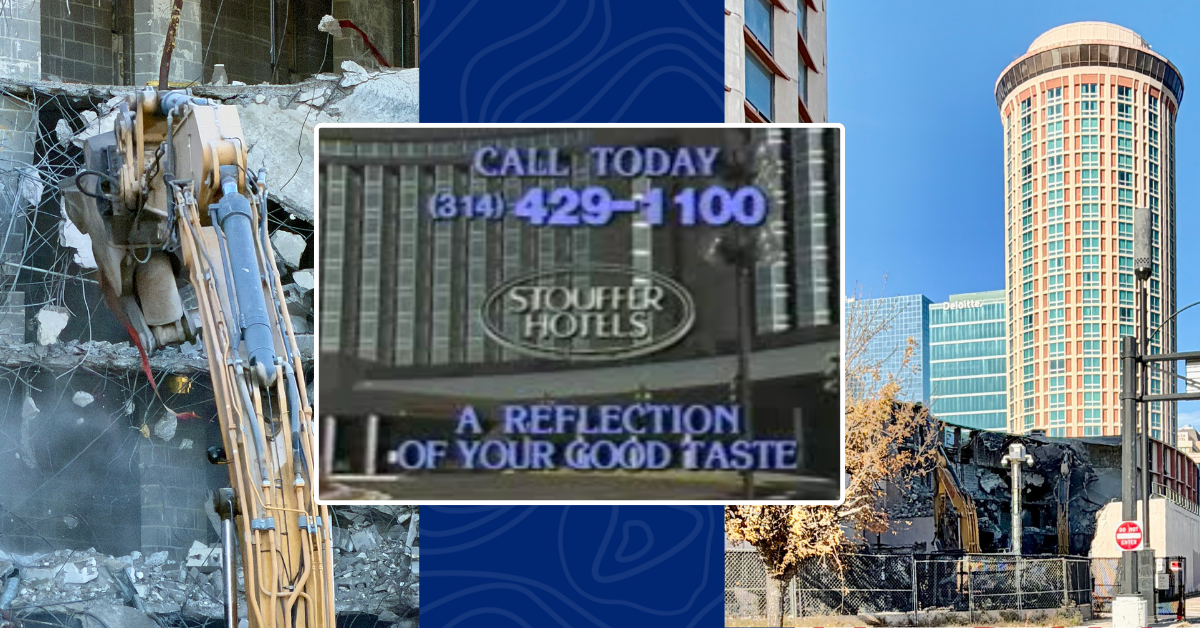
St. Louis civic leaders were eager to announce a major new high-rise facing the Gateway Arch just south of Walnut Street. The tower would accentuate the modern form of the Arch and help build a new skyline, showing that the old city was accelerating its economic progress. The undertaking was of such paramount importance that a public-private partnership was crafted to expedite possible eminent domain and clearance of the site. Political leaders and the local press eagerly anticipated the day when the view from the pinnacle of the new tower would offer a sweeping vista of the city’s baseball stadium, the mighty Mississippi River, and the Gateway Arch.
All of this really happened – in 1963. And also in 2025.
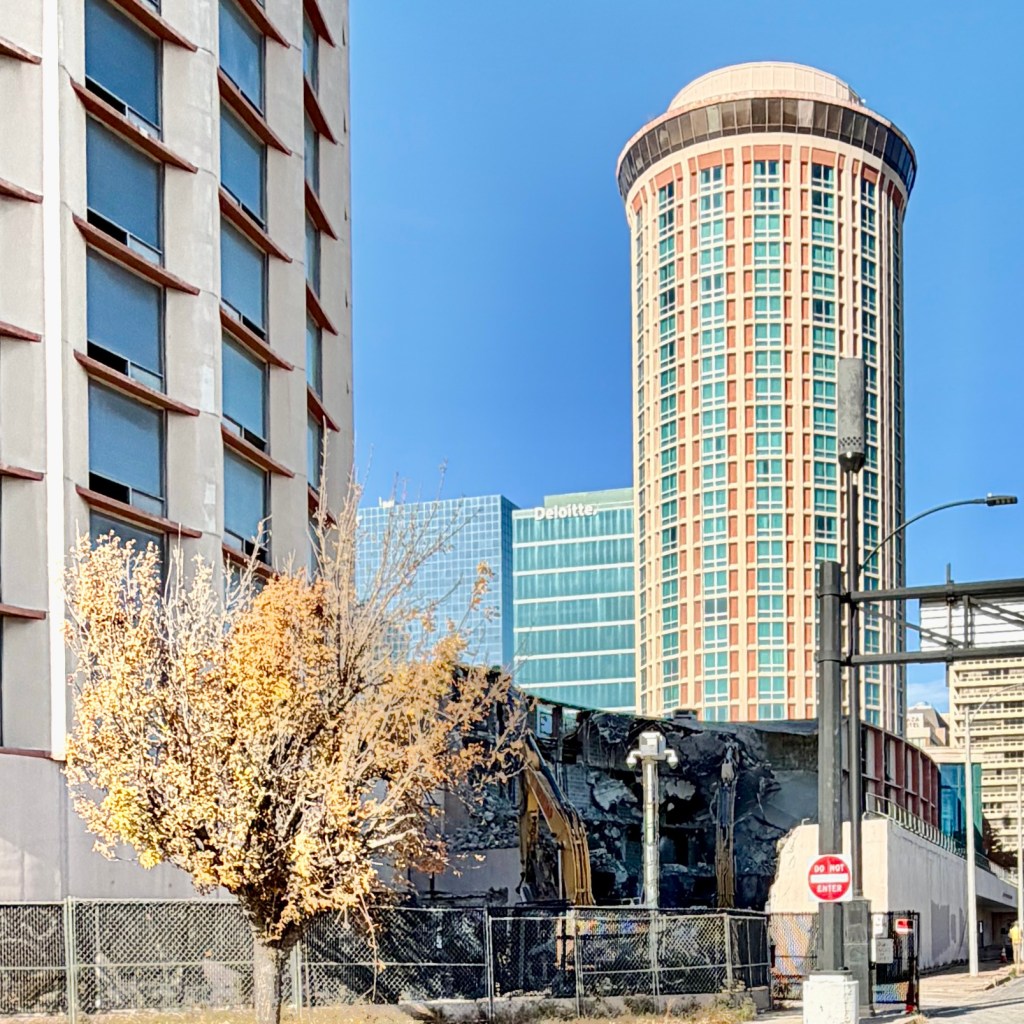
Now that demolition of the fruit of the first redevelopment of the site, the Millennium Hotel, has commenced, it is worth examining the urban renewal history of the site. The urgency to shape dramatic architecture on the site as a symbol of a resurgent St. Louis previously yielded an iconic project that nonetheless nearly never happened, and whose viability as the hub of motor tourism and local entertainment could not survive five decades.
In the spring of 1963, James P. Hickock of the Civic Center Redevelopment Corporation proudly announced that the site would be transformed with a 400-room hotel operated by downtown’s icon of reliable elegance, the Mayfair Hotel. The Civic Center Redevelopment Corporation was the public redevelopment agency chartered by the Board of Aldermen to redevelop eastern downtown around Busch Stadium and the Gateway Arch. It also coordinated projects such as the Mansion House Center and the Spanish Pavilion reconstruction (also later a hotel). The new Mayfair project would be placed near the off-ramps leading motorists to the Gateway Arch, while also providing a signature top-floor restaurant certain to draw tourists and locals alike for memorable experiences overlooking the still-under-construction Arch.
Two years later, as the Gateway Arch neared completion in October, there was no ribbon cutting on the new motel – and barely much more than demolition of older buildings and some foundation work. Hickock confessed to reporters that the initial $8 million cost of the hotel had risen to $12 million, and financing was proving difficult. This did not stop the St. Louis Post-Dispatch from running an aerial photograph of downtown gushing “Stadium, Arch, Bridge and Hotel Underway.” (The bridge was the new interstate bridge, now commonly called the Poplar Street Bridge.)
By 1967, with little construction progress evident, the hotel ownership was restructured with the addition of the Cleveland-based Associated Motor Inns to the partnership. That company brought in Ohio’s Stouffer Food, Inc. to devise a restaurant concept based on the company’s popular premade supermarket meals. By March 1968, the local press reported that the hotel’s principal architect, William B. Tabler, had dispatched his junior architect Ben Hope to oversee design and construction of a now 486-room project with a revolving restaurant at its crowning 28th floor. At 300 feet, the main circular tower would be six feet shy of the height limit that the Board of Aldermen had imposed on downtown east of Broadway to ensure that no new buildings would upstage the Arch. The tower and its low-rise wings, forming an “S” shape, would be built of poured-in-place concrete for a modern, Brutalist appearance. However, the interiors would be “Country French” to riff off of St. Louis’ colonial past and the historic site to the east.
When the hotel opened in 1969, it was called Stouffer’s Riverfront Inn, a promotional move leveraging the brand’s mass appeal. Civic leaders celebrated the project, and the press repeated the same sanguine narrative about how the hotel would “complete” the Civic Center Development Corporation’s renewal of downtown. KMOX broadcaster Jack Buck moved his weekday morning radio show recording to the rotating restaurant to celebrate the new view of the Gateway Arch. Early-year announcements of conventions, banquets, fraternal organization meetings, and live music showed the hotel to be as much a local attraction as a traveler’s haven. High demand led to a second 11-story tower being added on the property’s south end in 1974.
The hotel’s slow decline became evident by the 1990s, however, when it rebranded as the Millennium Hotel. Interiors were no longer “Country French,” but bland redecorations. Newer hotel options were available, including the large, publicly-subsidized convention center hotel at the former Statler Hotel that opened in 2002. Struck alongside the depressed interstate lanes of I-70 to the east, and set back from Fourth Street with a raised lawn – a veritable urban island — the hotel was disconnected from the grassroots, resurgent revitalization efforts rising on Laclede’s Landing and Washington Avenue. The Millennium closed in 2014, just after the 2010 announcement of the winning design for the Gateway Arch grounds’ redevelopment – including a new park connection over the interstate lanes.
At the conclusion of the Gateway Arch National Park redesign, the Gateway Arch Park Foundation began prioritizing the same east wall of downtown that had been the priority for the same reason back in the 1960s. The quest to redevelop the Millennium site again was almost always going to entail demolition, given the inflexible purpose-built design and auto-centric site plan. However the announcement in February 2025 that the Baltimore-based Cordish Companies was proposing a $670-million mixed-use site design, including a very tall residential high-rise overlooking the Arch, exceeded the scale that many anticipated.
Here, 1963 and 2025 collided again. The same Land Clearance for Redevelopment Authority (LCRA) that had led blighting and land acquisition in the 1960s designated Cordish as redeveloper in 2025. Once again, St. Louis could not generate the capital to seal the deal and an out-of-town party had to step in. In September, the Board of Aldermen approved a Chapter 99 redevelopment bill granting the LCRA eminent domain powers. The Gateway Arch Park Foundation, however, stepped in and purchased the site and began demolition, reprising the Civic Center Redevelopment Corporation’s role. Notably, the final bill passed removed Cordish’s initial request for a 20-year tax abatement of 90% of the assessed improvements of their plan – for now.
The redevelopment study prepared by PGAV for Cordish, submitted to LCRA and the Board of Aldermen, also echoes the past. PGAV’s document claims: “The redevelopment should be as much a civic endeavor as a real estate investment.” Later in the same document, PGAV proclaims that a new building on the site offers the opportunity to “redefine the city skyline.” This recalls an August 13, 1963 St. Louis Globe-Democrat spread of new Arch-facing downtown projects entitled “Changing Skyline.”
Curiously, the PGAV blighting study accompanying the redevelopment study relies on the Wall Street Journal’s controversial April 9, 2024 article, “The Real Estate Nightmare Unfolding in Downtown St. Louis, which proclaims that downtown shows signs of a “doom loop.” According to the study’s authors, the Wall Street Journal article is evidence that more redevelopment is needed to alleviate the doom loop. This writer wonders if the leaders of the Gateway Arch Park Foundation or the 13 members of the Board of Aldermen who voted for the Millennium Hotel redevelopment agreement would publicly express their agreement with the “doom loop” diagnosis, which civic leaders loudly dismissed as falsehood – despite its positive citation in a downtown redevelopment ordinance.
Perhaps there is no grand lesson in the recurrence of history at the Millennium Hotel site, and certainly no need to point out the reality that the City of St. Louis’ fortunes are worse off than they were in 1963. Both Mayor Cara Spencer and her predecessor Mayor Tishaura Jones favored Cordish’s generous tax abatement request, with each arguing the situation is a matter of civic priority. This was a rare concord around policy in this year’s acrimonious mayor race.
So after sixty years, the same argument is being made about the same site for the same reasons. St. Louis’ urban renewal past may not be repeating itself, but the past and present are quite loudly rhyming. One can only hope that the future will not.