
The Kaplan Feldman Holocaust Museum Doesn’t Oppose All Genocides

The main exhibit of the Kaplan Feldman Holocaust Museum in St. Louis County presents well-researched and compelling information to the public about Nazi Germany’s genocidal campaign of extermination against the Jews of Europe. It also does a good job of incorporating the experiences of Holocaust survivors who came to St. Louis. It also gives respectful and well-presented information about non-Jewish victims of Nazi atrocities.
The institution of the Kaplan Feldman Holocaust Museum, however, plays a dangerous role in support of genocide in the present day. It does so by:
– Scrupulously avoiding all condemnations of Israel’s genocide against the Palestinian people of Gaza, and avoiding all denunciations of genocidal language spoken by local Jewish leaders directed against the Palestinian people; and
– Advocating for policies that restrict free speech in order to protect the perpetrators, and
– Giving a forum to present pro-Israel propaganda films during the time of Israel’s genocidal campaign.
Holocaust museums teach the public about the details of the Nazi genocide with a stated goal of making sure that “never again” does anything similar occur, anywhere, to anyone. Presentations in the museum include horrifying photos of suffering Jewish prisoners and ugly racist depictions of Jews and other minorities. Teenagers from all over the St. Louis area are brought on tours to see these images. The claimed purpose is that presenting this information can spur people into action to stop a repetition of history. A recent Facebook post from the Kaplan Feldman Holocaust Museum approvingly relays this message from a museum visitor stating that the institution is “More than just a museum, it’s a call to action”.
This begs the question: action for whom and for what purpose?
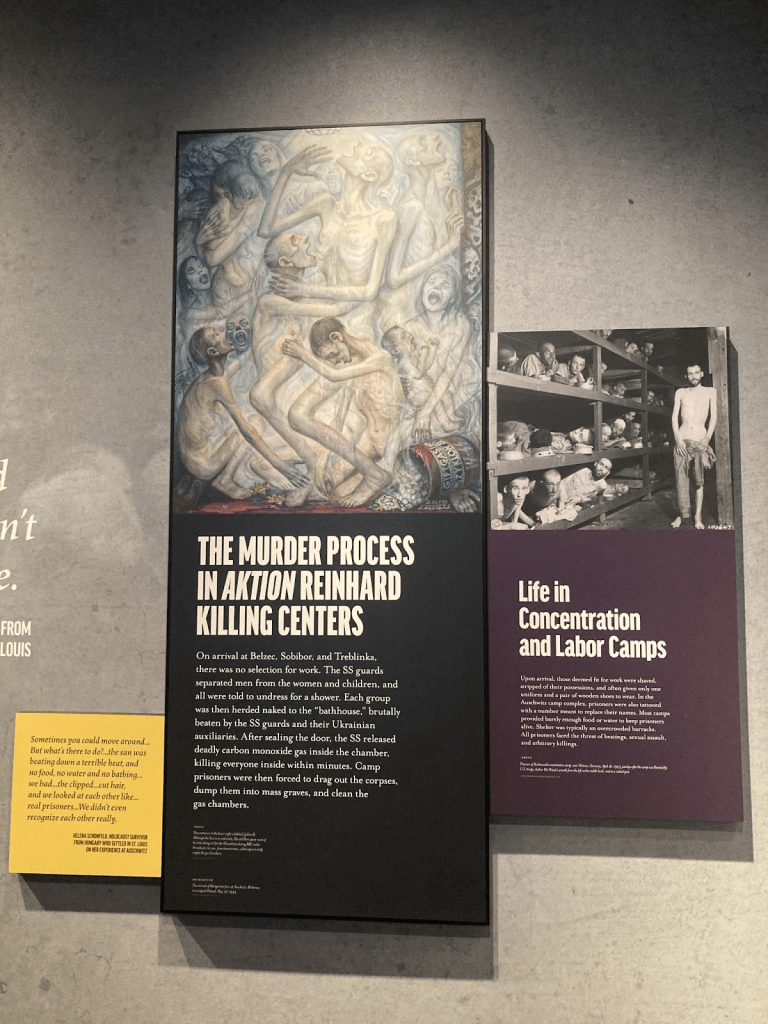
It is certainly not on behalf of Palestinians who are being starved, tortured, and murdered by the State of Israel in what is recognized as a genocide by the International Association of Genocide Scholars, al-Haq, B’Tselem, Amnesty International, Human Rights Watch, and many others. The Museum could easily find images just as shocking of Palestinians who are being intentionally starved right now, along with thousands of examples of racist depictions of Palestinians by Israelis. The Museum has a room specifically for temporary exhibits, where this could be housed.
The Kaplan Feldman Holocaust Museum has yet to make a statement condemning Israel’s actions in Gaza and beyond. It cannot claim that this is because it only has a narrow focus on the crimes of Nazi Germany. To name examples, it has made statements and facilitated events about the genocidal atrocities committed against Bosnian Muslims in the 1990s, and its Director of Education, Helen Turner, spoke at a recent anniversary commemoration of the Srebrenica massacre. The museum also hosted a forum commemorating the 30th anniversary of the 1994 Rwanda genocide.
The Museum quickly condemns some hate speech – such as spray-painted swastikas on schools – but not unambiguous genocidal language from one of the most prominent Jewish leaders in St. Louis. It has not made a single statement condemning the genocidal hate speech of B’nai Amoona chief Rabbi Jeffrey Abraham, who wrote that “there are no innocent civilians in Gaza”, “All the people of Gaza are Hamas”, and that “no matter where Palestinians live, they need to be re-educated”. Abraham agreed with and approved a statement referring to Palestinians as “Animals. Period. Full stop.”
Abraham was quoted at least 19 times in local media representing the St. Louis Jewish community between October 2023 and January 2025. The Holocaust Museum cannot claim they do not know of Abraham’s words – members of the local Chapter of Jewish Voice for Peace went to the museum and personally delivered multiple copies of a letter – one for each member of their board and top staff – that included the rabbi’s words and asked the Museum to speak out against hate within our own community. There was no response.

The Museum has failed to take a single step to publicly pressure elected officials to end the genocide of the Palestinian people. It cannot claim that the reason for this is its apolitical nature. It is not an apolitical entity. Last spring the Kaplan Feldman Holocaust Museum went on record submitting testimony in favor of a bill which would force Missouri schools to adopt the controversial International Holocaust Remembrance Alliance definition of antisemitism, including its contemporary examples.
Such a definition was not originally written to be codified into law, and its codification would represent a serious attack on the right to exercise free speech and criticize a foreign country. It also flies in the face of the Museum’s stated Mission, Vision and Values. To name just one example of why this is the case – the definition states in one of its contemporary examples that it should be considered antisemitic to “draw comparisons of contemporary Israeli policy to that of the Nazis”. According to the sponsor of the bill, stating the world expert consensus about the genocide of the Palestinian people is enough to have one branded as an antisemite. Under this standard the most respected human rights organizations in the world would all be considered antisemitic. How can you codify that it is intrinsically bigoted, now and in the future, to compare one governmental regime to another? You would think that it would be a goal of the St. Louis Holocaust Museum to give historical information so that people can draw comparisons between Nazi policy and any contemporary government so as to empower people to take action and make sure that similar crimes against humanity do not happen again.
It is important to understand that the Museum is not an impartial organization that was started to educate and oppose all genocides. It is, in reality, an initiative of the Jewish Federation of St. Louis; it was founded by the Jewish Federation, and it partners with the Jewish Federation. Until 2022, it was directly a part of the Jewish Federation. The Jewish Federation of St. Louis explicitly sees support for Israel as part of its mission, and the behavior of the Kaplan Feldman Holocaust Museum makes it clear that the Holocaust Museum also sees this as part of its mission – to the point where the museum screens pro-Israel propaganda films on its premises.

Within the last year, the museum has screened the film “October 8”, which unfairly smears pro-Palestinian campus activism and dangerously conflates opposition to the policies of Israel with antisemitism. The Museum also screened the 1960 film “Exodus”, based on Leon Uris’ 1958 novel of the same name. The film presents the founding of the State of Israel from an Israeli perspective, centering its narrative on the journey of a ship carrying Jewish refugees from Cyprus to Palestine. The film does not convey the horrors suffered by Palestinians at the hands of these same Israelis, when roughly 750,000 Palestinians were forced from their homes and never allowed back – an event known as “the Nakba” or “catastrophe”. Israel’s first Prime Minister described the novel “Exodus” this way: “As a literary work it isn’t much. But as a piece of propaganda, it’s the best thing ever written about Israel.”
Presenting these pro-Israel propaganda films during the time of Israel’s genocidal annihilation of the property and people of Gaza is beyond grotesque – it makes a mockery of the Museum’s mission “to prevent genocide”. It is probably not a surprise to learn that the Museum has not screened any of the many Palestinian films about Israeli oppression, such as this year’s Academy Award-winning documentary “No Other Land”.
While the main exhibit at the Kaplan Feldman Holocaust Museum is well presented, historically well researched, and genuinely educational, it is important that the St. Louis community not take the institution of the Kaplan Feldman Holocaust Museum at face value as an impartial anti-racist, anti-genocide educational organization. It is not. It is an institution that is partisan to a state presently committing genocide.


