
Allen: Destroying North St. Louis Has Been City Policy for Decades Pt. 1
By Michael R. Allen
With destruction brought by a 23-mile-long, 1-mile-wide EF3 tornado, St. Louis now faces the worst natural disaster in its history. Some people are calling this St. Louis’s equivalent of Hurricane Katrina, as the brunt of destruction settled in majority-Black, lower-income northern neighborhoods including Fountain Park, the Greater Ville, Kingsway East and O’Fallon, where residents are chronically underinsured and building vacancy rates are among the city’s highest. The City has estimated that 5,000 buildings were damaged, although the exact number is unknown. The City’s placing of color-coded stickers on damaged buildings – at least one of which seemingly prompted Ameren to disconnect electricity – are raising fears that mass displacement is imminent.
The apathy of a cruel right-wing federal state led by President Donald Trump mirrors the same stance that George W. Bush’s administration brought to New Orleans in 2005 – albeit with less smiling on the president’s face and no unhelpful Air Force One flyover. Trump’s inaction means that there has been no federal disaster declaration, which seems to formalize the withholding of resources that Bush more artfully disguised in his “compassionate conservative” rhetoric. Both results may be the same. People literally are on their own, as disaster austerity sets in.
The future of north St. Louis, hurling through a vacancy vortex and with an ongoing population exodus, was already tenuous before last week. In fact, conditions were so rough in the recent past that urban historian Joseph Heathcott characterized the state of St. Louis evinced by north city’s abandonment and decline as a “slow-motion Katrina” when interviewed for the 2011 film The Pruitt-Igoe Myth. Every step of the slower process of destruction – accelerated into a concentrated force by the tornado – shows withering to no assistance from the federal government, acceptance and sometimes encouragement from city officials and their consultants and only a few moments of spirited contestation. The north side is the Dorian Gray portrait of a city’s outright hostility towards its own residents, and its erasure removes the evidence needed for indictment.
Allowing the north side to disappear has been semi-official city policy since the early 1970s. The development of that stance shows the perils of progressive politics divorced from any material commitment to antiracism, the overlord status that the city government often gives elite experts, and waves of the white political establishment using the provision of city services as a weapon against Black opponents. The end result has been a physical depletion of the built environment and a spatial deconcentrating of Black residents. This has proven useful in protecting white political power against the specter of integration. North St. Louis became a political territory whose subjugation by city policy was integral to sustaining the ruling power of certain constitutions of power.
In the early 1970s, a trio of young members of the Board of Aldermen – Richard A. Gephardt (D-14th), Milton Svetanics (D-27th) and John G. Roach (D-28th) – became known as the “young Turks” for their brand of renegade progressive politics. Svetanics represented the northwest part of the city, Gephardt the area around Bevo and Roach a western area including Skinker-DeBalivere and Dogtown. The “Young Turks” would not buck the racial politics of the city, though, and both Gephardt and Roach floated various ideas of housing policies that would identify areas of high vacancy (the near north side then) for demolition as a “trade off” for stabilizing other areas (the south side, the west end).
Around the same time, the City Plan Commission, led by Norman Murdoch under Mayor John Poelker, prepared the first step toward an interim city comprehensive plan (to replace the 1947 plan). Poelker’s deputy chief of staff was Louis G. “Lou” Berra, who had also directed the Model Cities Agency on the near north side. The 1973 St. Louis Development Program report first laid out an idea of matching urban housing conservation strategies to meta-geographic areas supposedly identified by careful field study of conditions. Here was the origin of “triage” or “urban triage”: three areas of the city, with telescoping approaches of investment in maintenance, targeted investment of federal funds for stabilization and long-term cessation of intervention for “long-term” change. The three areas: Conservation, Maintenance and Improvement and Rehabilitation and Reconstruction. Rehabilitation and Reconstruction included a small bit of the south side but the entire north side between Delmar and Natural Bridge, city limits to the river.
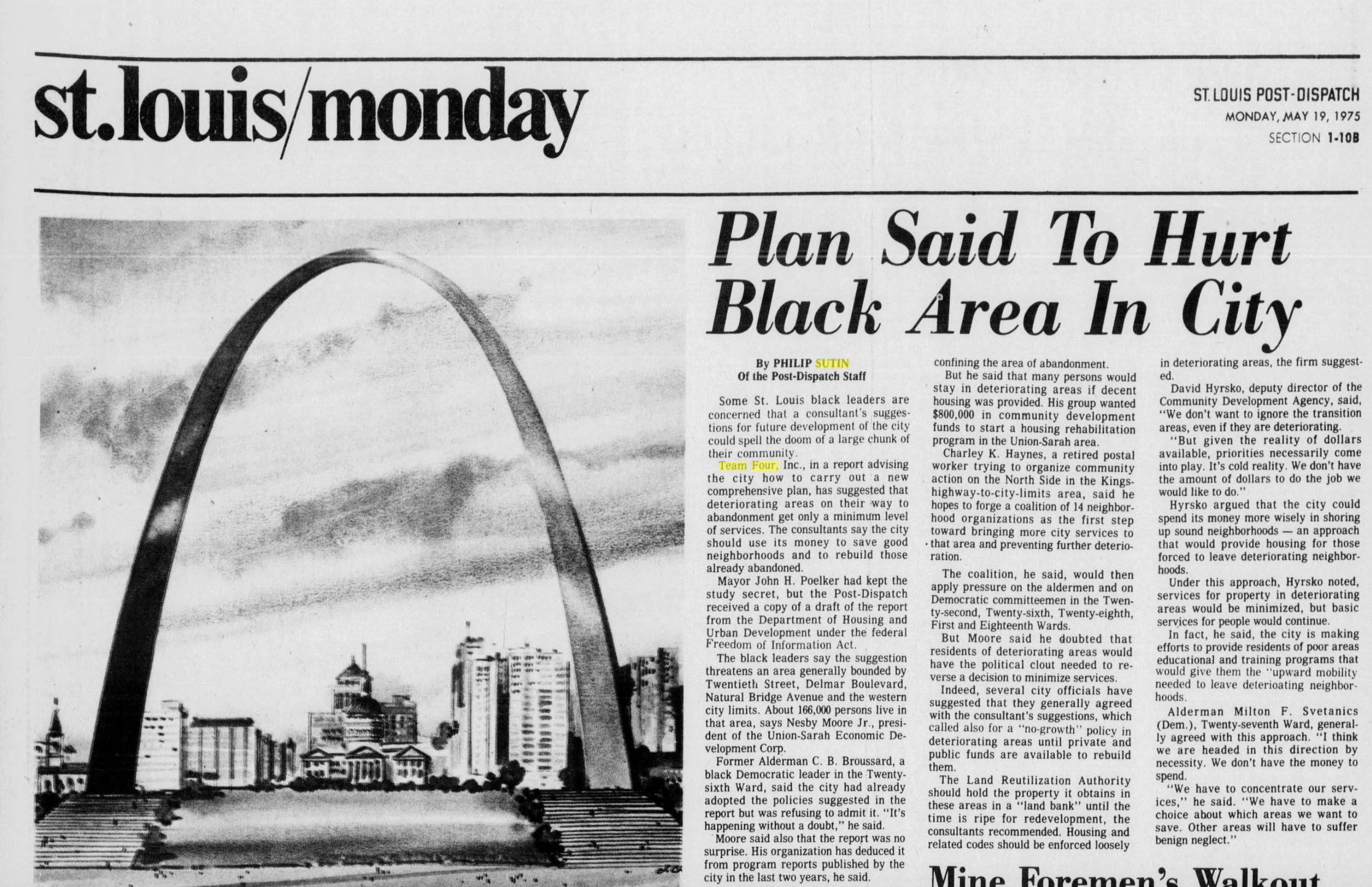
The City Plan Commission would hire Team Four, Inc. to develop a memorandum on how to implement the triage idea, which would become known derogatively as the “team Four Plan.” While St. Louis would be the first American city to try to codify a policy of deliberately neglecting urban areas, the idea was being considered in New York City Housing Commissioner Roger Starr and the RAND Corporation’s Anthony Downs around the same time. Team Four did not originate the concept, but it did stand to profit from developing its Citywide Implementation Strategies memorandum and likely the long-term implementation.
Team Four was a multidisciplinary planning and design firm headed by attorney Jerome Pratter, planner Richard Ward, architect Bill Albinson and (for a time) urban designer Brian Kent, who all met as graduate students at Washington University in St. Louis. Team Four represented the kind of enlightened, youthful, institutionally-credentialed experts that would allow Poelker, Berra and others to mask any venal political machinations with an intellectual face. The engagement would prove disastrous, although today the scapegoating falls on Team Four while many St. Louisans do not remember Poelker, Murdoch or any of the city government players.
In January 1975, St. Louis Housing Authority Director Thomas F. Costello complained that the city was already quietly implementing Team Four’s strategies before they had even been published or adopted. A meeting in the city’s Tandy neighborhood (basically The Ville and Greater Ville today) that summer led to massive pushback from Black residents on Team Four’s recommendation that code enforcement be used selectively rather than universally in order to let north side neighborhoods deteriorate faster. Public Safety Director Joseph W.B. Clark removed fire call boxes from the north side neighborhoods in June 1975 as “a matter of efficiency and economy” citing the high false alarms up north as well as the impending Team Four memorandum. A political fire storm would erupt quickly.
Mayor Poelker refused to release the second draft of Team Four’s memorandum to the Board of Aldermen or to the public. In June 1975, the Board of Aldermen voted 21-7 to keep the draft embargoed. The erstwhile progressives Roach, Gephardt and Svetanics all voted to keep the memorandum in secrecy, with Roach offering a rather stultifying justification to a reporter: reports only ever became public if actions they recommended were undertaken. The trajectory of “progressive” politics on the Board of Aldermen has remained ever so limited, with “progressive” mostly a notation of age and not of ideology or even commitment to transparency and public participation.
Meanwhile, north side political leaders, including Congressman Bill Clay, condemned the Team Four memorandum’s recommendations for suspending city service improvements and eventually basic delivery in what the firm termed “Depletion Areas.” When the fracas reached its peak, Team Four hid behind a frontispiece inside the finally-released memorandum stating that while the City Plan Commission had identified its geographies, Team Four had no specific areas of the city in mind and its protocols were only to be followed if a city planner identified “depletion” conditions in the field wherever they may be.
The memorandum was never formally adopted, and the overhaul of the comprehensive plan fell apart. Yet the innocence of Team Four’s statement was betrayed by Alderman Svetanics own words in the St. Louis Post-Dispatch (May 1975): “I think that we are headed in this direction by necessity. We don’t have the money to spend. We have to concentrate our services. We have to make a choice about which areas we want to save. Other areas will have to suffer benign neglect.” “Benign neglect” was a term that Daniel Patrick Moynihan had used in a 1971 memorandum to President Richard Nixon for how America should approach the issue of injustice against Black people. Whether Svetanics knew that precedent or not, he was candidly discussing only one part of the city: the north side.

Michael R. Allen is visiting assistant professor of history at West Virginia University, and until last year, executive director of the National Building Arts Center and a faculty member at Washington University in St. Louis.


