
Spencer Administration Goes Back To The Future
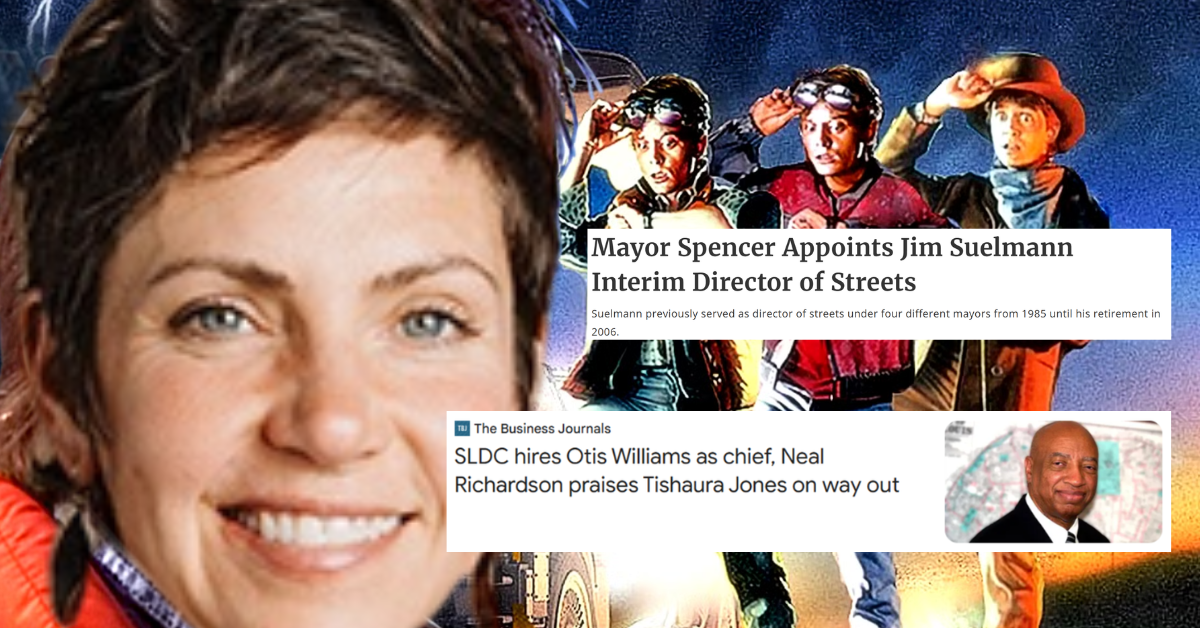
Mayor Cara Spencer’s early staffing choices show a clear preference for prior experience, as many have brought former city staffers out of retirement. Reports have highlighted the years appointees had previously served in their new, interim position. In many ways, the Spencer administration’s early moves feel like the city has gotten into Marty McFly and Doc’s famed Delorean to transport the city back to the terms of former mayors Slay and Krewson.
Reacting to these moves, dueling narratives have exploded onto local opinion pages. From the pro-Spencer camp, the story is that she’s making shrewd decisions to right the city’s ship. Bringing back veterans is a needed step in fixing operational problems that seemed to snowball over the Jones administration. This narrative squarely places the responsibility for this dysfunction on the shoulders of Jones and her appointees. Spencer supporters posit that Jones made these appointments based largely on political or other social considerations. This should all sound familiar, as it was the core argument of Mayor Spencer’s candidacy. By putting seasoned veterans back in these positions, the new mayor’s team is hoping that they can begin fixing broken systems. This will give her time to identify long-term, new leadership that can move the city forward. At least that’s how Spencer supporters would frame things. A notable outlier is the decision to hire attorney Nancy Hawes as Chief of Staff. It should be noted that she is being assisted by Emily Thenhuas, a Krewson administration veteran who was hired as Hawes’ deputy.
In other outlets, these same hires indicate that Mayor Spencer’s detractors were right in their claims that she was a candidate who would bring the city back under the control of a mostly-white old guard. Throughout the campaign, Jones supporters were vocal in their belief that a Spencer victory would take St. Louis backward in the fight for racial justice and equity. The optics of these human resource decisions fit with that narrative. While the Spencer administration has made some noteworthy Black hires, key positions in the government have reverted to being held by white staffers. At the same time, this narrative conveniently absolves the Jones appointees of any responsibility for the deterioration of city services under their leadership. If the first year of a Spencer administration brings a noticeable improvement in city services, this will become a less tenable position. Political appointees are given great responsibility, and voters are right to criticize city leadership for failures. To demand otherwise is profoundly anti-democratic. There is a limit to how much can be dismissed over claims of unfair treatment, especially considering the Jones administration came into office with broad support from both the public and the Board of Aldermen.
Notable among the returning veterans is SLDC’s Otis Williams. Williams served under Slay and Krewson. During his earlier tenure, the city awarded lavish incentive packages to developers in the city’s most desirable neighborhoods. This led to him being routinely criticized for the agency’s generous incentive packages. Interestingly, the handoff from Williams to Neal Richardson was the opposite of the drama surrounding Williams’ return. At the time of Williams’ retirement and Richardson’s appointment, Richardson was presented as a logical heir apparent. Much changed in the four years that followed. The move to restore Williams, paired with Spencer Chief of Staff Nancy Hawes’ appointment as SLDC board chair, is a clear signal to developers that the city will continue to bestow lavish incentive packages upon their projects. For her part, Hawes’ background as a lawyer who worked on real estate deals and published a guide to federal Opportunity Zone tax benefits in her previous role at Polsinelli, shows that the pro-developer sentiments held by Williams will also be held by SLDC’s board chair. Given the number of developers and real estate attorneys who donated to Spencer’s campaign and/or PAC, this is not a surprise.
Going even further back is the appointment of Jim Suelmann as streets director. Mr. Suelmann previously retired from the position in 2005. Prior to that, he served four mayors. While every city resident hopes he can right department operations and fill potholes, it is fair to ask if someone who retired almost 20 years ago is the right person for the job. While the grid is still very similar to that time, city streets have become much more complicated. These days, they are filled with speed humps, roundabouts, and other features meant to slow drivers. They simply aren’t what they used to be.
Also contributing to the Back To The Future feel of the new administration’s first days is the current tow lot scandal, which appears to be gathering steam. After a referral to federal investigators and the revelation that over $5 million in cars are missing from the lot, one can’t help but remember when a tow lot controversy brought down former SLMPD Chief Joe Mokwa. While predating her tenure, the scandal will be an early test of her pledge to make city services more responsive to residents. The tow lot is a persistent problem. If the Spencer administration can make improvements, it will show success in an area where her predecessors failed.
Right now, these dueling narratives are just that, narratives. We won’t know which is true, at least for a while. In all likelihood, we are probably destined to eventually find out that both narratives hold pieces of the truth. If city services don’t improve, then it will be clear that bringing back veteran city employees isn’t the solution. It would also show that the Spencer campaign’s core argument, which is that she would be a more competent city administrator with a greater focus on operations, was untrue. On the coin’s other side, if Spencer pulls back from investments in north city, then her detractors will be vindicated.
The truth is that many of our suffering city services began their decline long before Jones took office. Trash service began having major disruptions after the Slay administration chose to stop purchasing new trucks. Water and sewer issues were ignored for generations, leading to regular reports of broken mains and sinkholes. Is bringing back the people who oversaw the beginning of the decline a real solution? We’ll have to be patient to see how the movie plays out.
Disclosure: Author has previously worked on a political campaign for Mayor Spencer.


