
Trailnet Report Reveals Grim Reality for Pedestrians, Offers Hope
by Christian Frommelt
Full disclosure: I am a part-time Trailnet employee, though I don’t speak on behalf of Trailnet or for the authors of the report.
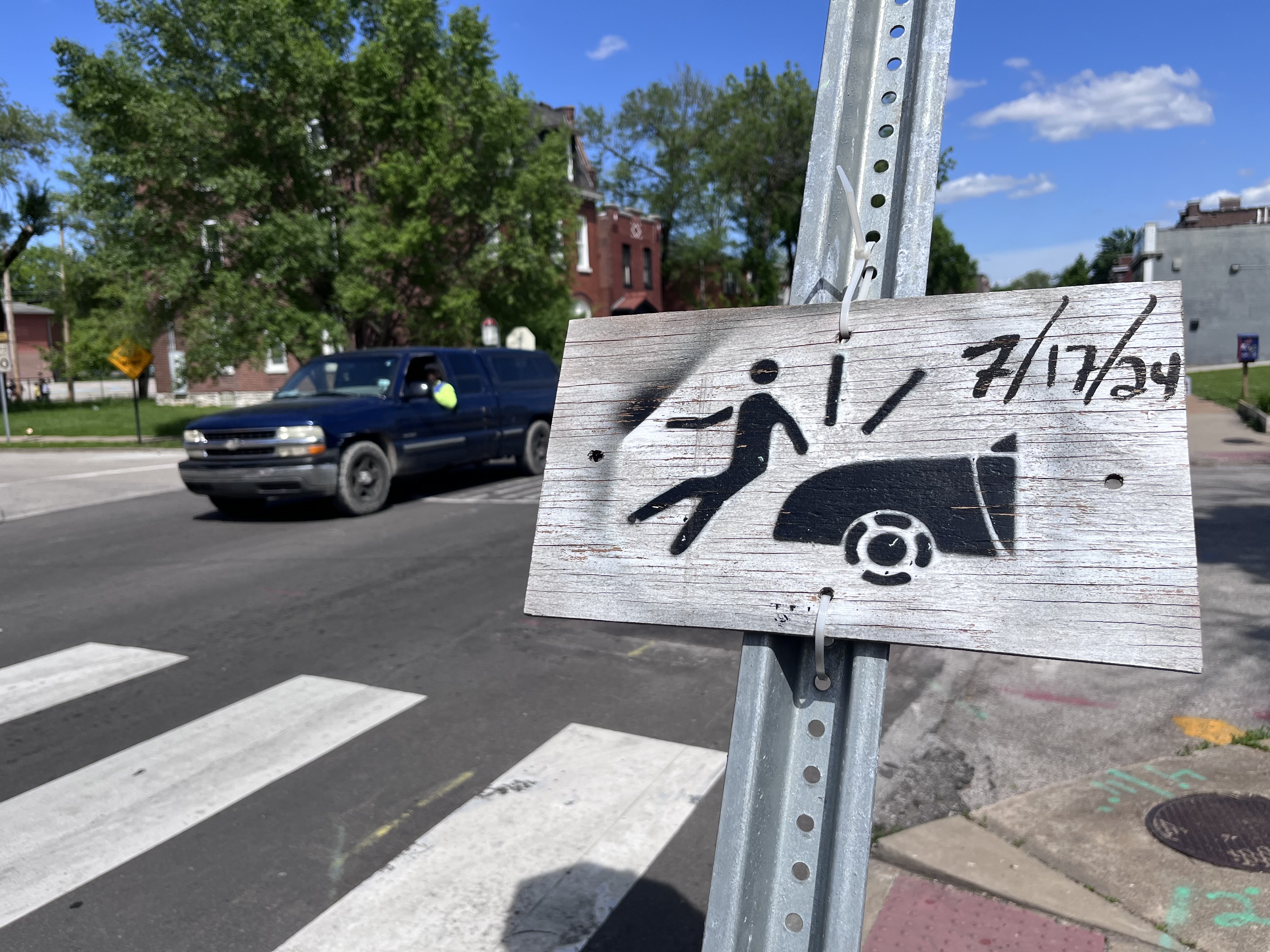
Road users in St. Louis will have noticed that an abundant crop of speed humps has popped up across city streets this spring. Trailnet’s fifth annual crash report, released last week, points to the desperate need for such infrastructure to slow cars down in the effort to save lives: As the report notes, 2024 was the most deadly year for pedestrians in both St. Louis City and County to date.
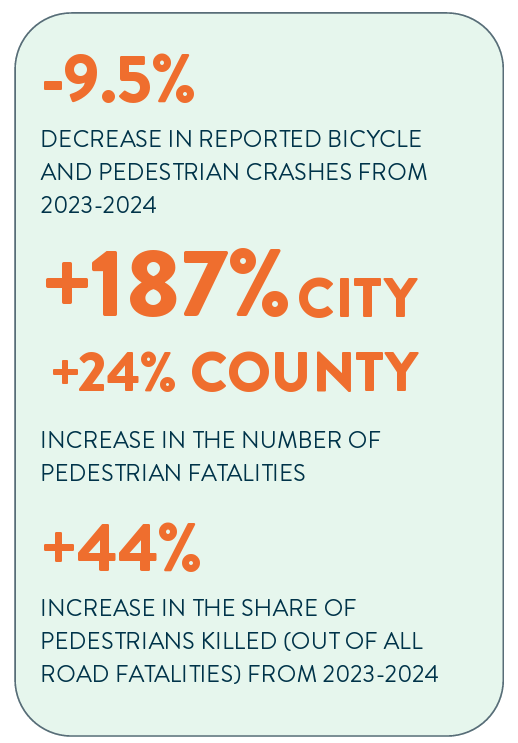
The report compiled 2024 data from Missouri’s State Highway Patrol. The data shows motorists killed a harrowing 36 pedestrians in St. Louis County, a 24% rise from the previous year. An additional 23 pedestrians were killed in St. Louis City, a staggering 187% rise. Historic disinvestment in Black communities and “urban renewal”-era demolitions created the conditions for highway expansion and street widening. Data also shows that fatal automobile crashes are more common in communities of color. Hostile infrastructure and poorly maintained sidewalks force these community members, who are more likely to walk and take public transit, into dangerous interactions with fast-moving automobiles. The conditions become yet more dire for people who also use wheelchairs, scooters, push strollers, and for children, the elderly, and individuals with visual impairments.
While the report welcomed a drop in reported crashes involving pedestrians and cyclists, police-conducted records are only one, potentially flawed, tool in assessing how many non-deadly crashes occur and whom they impact. A Washington, D.C.-based study in 2021 found that 30% of crashes impacting pedestrians, cyclists, and others went unreported. That number went up in predominately Black and brown communities, where trust in law enforcement may be lower.
Fatalities remain the primary metric for street safety, and the outlook is not much brighter for drivers. Though numbers of reported car-on-car crashes decreased from the previous year, 25 people driving cars were killed in St. Louis City in 2024 and 78 in St. Louis County. Looking over crash insights dating back to 2010, the report found that the number of people dying in cars has increased 41% since that year. Despite this notable increase, it has become increasingly more deadly to be hit as a pedestrian or cyclist. These travelers comprise nearly half (48%) of the people killed in crashes today, but in 2010 pedestrians and cyclists only made up a quarter of all automobile crash deaths.
Despite this local outlining of what Jarret Walker, author of Human Transit, calls the “ambient massacre” on our streets, Trailnet’s report signals hope for eliminating all automobile deaths in the coming years through evidence-based infrastructure improvements. The authors point to the case of Natural Bridge Road. From Marcus Avenue to Parnell Street, this major thoroughfare received “continuous, comprehensive designs for safety” in November 2020. These improvements have resulted in a 79% drop in reported crashes along this section, and zero pedestrian deaths between 2020 and 2024.
The comprehensive improvements along this section of Natural Bridge include mid-block crosswalks with rapid flashing beacons, a design element that, if applied more widely, could help stem the staggering 80% of deadly crashes that occurred mid-block across the City and County. The report also credits a distribution of medians, higher visibility traffic signals, road diets, roundabouts, and higher visibility crosswalk striping to the welcome decrease in crashes, injuries, and deaths along Natural Bridge.
Arterial roads, which have the highest non-interstate traffic volumes, accounted for the large majority of pedestrians struck by cars last year These roads saw 35% of crashes impacting pedestrians and 17% of fatal pedestrian crashes in the city. Most of these occurred on Grand, Kingshighway, Gravois, and Broadway/ 7th. The reported data exposes Lindbergh, Halls Ferry, Manchester, Highway 270, and Big Bend as responsible for 19% of all pedestrians killed by drivers in motor vehicles in the county. This was enabled by the design (often five or six lanes) and speed limits, which are hostile to movement on foot or by bike. Between both counties, 89% of pedestrian deaths occurred on roads with speed limits of 30-50 miles per hour. This affirms the mantra “speed kills,” and spurs calls for lower speed limits. Authors point out that this will not only save lives, but also money, avoiding further losses, due to property damage, health care costs, and labor productivity. That is if lower speed limits are combined with infrastructure improvements like road diets, education and engagement with communities, and equitable enforcement measures such as the automated enforcement law passed by the Board of Alderman in 2024.
The numbers reaffirm what advocates across the board have expressed for years: walking to the bus stop, biking to get groceries, pushing your kid in a stroller after an ice storm should not be death sentences. St. Louisans deserve safe and pleasurable communities.
Crash report data being analyzed and made digestible for the public is vital, but, as the report admits, we need more and better data to truly enact data-driven solutions. As I wrote last year, measuring modal share in St. Louis, as the City of Chicago does, would widen the scope and tell us how many people are choosing to walk, bike, and take public transit in a city where many people drive begrudgingly and would use the bus if it came more often or would cycle if one could do so safely. So-called “self-enforcing” infrastructure improvements like the ones on Natural Bridge are essential to curbing deadly and injurious crashes. With the additions of other tools—the expansion of frequent and dignified public transit options and car-free corridors, for example—that coax people out of cars and make St. Louis generally less dependent on cars, we can, and must, continue to fight for everyone’s right to move safely across the city and region.

Christian Frommelt is a St. Louis-based artist, organizer, and wanderer. You can read more of his work on urbanism, music, transportation, and more on his Substack, Notes from the Sprawl.


