
STLCP2 Hosts Free, Public Screening Of Join Or Die

The St. Louis Coalition to Protect Cyclists and Pedestrians (STLCP2) will screen the documentary Join or Die this coming Monday, January 27th. As noted in previous articles, Mound City Messenger considers supporting grassroots democratic organizations a key part of its mission. Join or Die explores the long-standing national tradition of voluntary associations and their decline in recent decades. The event is free and open to the public. We spoke with organizers about the screening and are pleased to share their thoughts on why they chose this film and the critical role grassroots democratic organizations play in improving our society.
MCM: What made the St. Louis Coalition to Protect Cyclist and Pedestrians decide to show Join or Die?
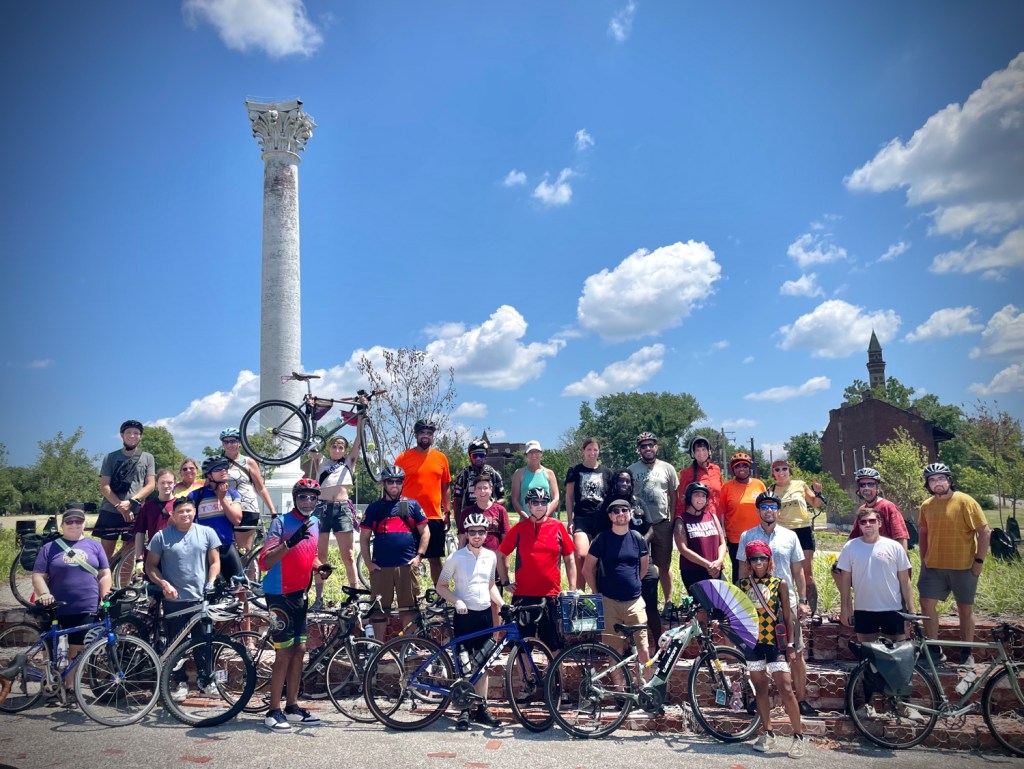
STLCP2: We heard about Join or Die by reading about it in Mound City Messenger, it resonated with something we’ve seen in our community and which has fueled our growth: the power of in-person organizations and people’s hunger for them. Many of our members know each other from regular social bike rides, and our strength lies in our shared locality and lived experiences as cyclists and pedestrians in St. Louis.
The documentary underscores the role social groups like ours play in fostering civic strength, deepening social bonds, and building social capital. Watching Join or Die reminds us of the transformative potential of coming together—not just online but in person—to tackle the challenges we face. At a time when so many events are beyond our ability to control, STLCP2 presents an opportunity to engage in something that we can personally influence, feels good, and is meaningful.
MCM: How do you think the issues talked about in the film relate to the work and advocacy of STLCP2?

STLCP2: As a cyclist and pedestrian sharing city streets with drivers, you become very aware of how decisions made by our local government – installing bike lanes, traffic calming, and enforcement, for instance – directly affects your physical safety. While residents have called long out the need for street calming and better pedestrian infrastructure, a confluence of factors has created a moment where advocacy now can make a real impact on our built environment for years to come. As STLCP2 has grown, we’ve thought a lot about how to organize ourselves and harness the energy in this community. Many of us have gotten a crash course in how local government functions and how we can influence it. It is gratifying when we can demonstrate to a younger generation the power of such effort. To that end we are very much engaged in the sort of civic engagement and processes which the film explores.
MCM: How is STLCP2 organized/run? What small-d democratic values does the coalition put into action?
STLCP2: As a young organization how decisions are made is something we’ve thought about quite a bit. Our events have generally been led by individuals who took leadership over specific actions, with no single governing structure. Our leadership and decision making authority nominally lies in the Founder’s Committee, consisting of six people who were principally responsible for our first organizing efforts. In some cases specific tasks – developing a mission and vision, for instance – are delegated to an ad hoc committee. These committees develop recommendations to be approved by popular vote at in person meetings and online.
We’re looking to evolve this temporary structure to incorporate new leadership, and have established a governance committee to think about different models of running ourselves. Topics we’re discussing include thinking about issues like how to deal with internal disagreement, striking a balance between consensus building and the need to make decisions, how to move beyond the Founders’ Committee, and how to avoid member and leadership burnout.
A lot of our communication takes place on Discord, both on our own STLCP2 server (currently on hiatus for the winter) and on affiliated groups like Bici and the Urbanists. There are many positives in maintaining an online community, but it is also time intensive, both for active participants and moderators. We are striving to find a balance between online discourse and in-person meetings.
MCM: Do you think the fraying social fabric has made drivers more callous and less willing to share the roads?
It has never felt more perilous to ride a bike in St. Louis, with record traffic violence and scary drivers everywhere. A significant reason is the physical infrastructure of the city, which has largely been built around the needs of the automobile. Wide, fast streets are convenient and empowering for drivers, and many of them view pedestrians or bicycles as just a hazard or an inconvenience. Our city is engineered to maximize the flow of traffic, and many aspects of the built environment encourage callousness towards and dehumanization of nondrivers.
Also, the pandemic has erased some social norms in ways that have yet to recover. A culture of dangerous driving seems to have developed, encouraged by wide streets and lack of enforcement. Drivers speed, run red lights and stop signs, endangering other road users with no apparent accountability, sometimes with catastrophic consequences.
MCM: Besides movie nights, what should St. Louisans expect from becoming active in STLCP2?
STLCP2: Over the past year CP2 has organized rides and walks along major roads to evaluate city traffic calming proposals for them. We expect to do more such events as opportunities arise.
We also organize a “bike bus” to City Hall, where we ride as a group on two wheels or on an actual bus, to raise awareness of specific issues related to cyclist and pedestrian safely. These happen on every third Friday of the month. We also do fun bike rides, including a ride to the St. Louis Symphony Orchestra concert in Forest Park in September. More information can be found on our instagram at @stlcp2.
We are co-hosting a Mayoral Forum on transportation issues with Trailnet, the St. Louis Urbanists, Paraquad, and Transform 314. The forum will be Feb 10th from 6-7:30pm at Paraquad’s office, 5240 Oakland Avenue. We welcome the public to join us in asking the candidates questions regarding their plans to increase safety and infrastructure for pedestrians and cyclists.
Additionally, we have a small fund from a donor to help cyclists in financial need get free bike safety gear, like helmets, lights, and locks. Interested individuals can apply here: https://forms.gle/h2CmZhZAHiebUAAJ7
Finally, we host an in-person general coalition meeting every other month on the second Monday of the month. We use these meetings to coordinate upcoming events, strategize campaigns, and build community. We also have an active online community, with informative discussions on the Urbanist, Bici, and our own STLCP2 Discord servers.
MCM: Are there particular policy changes that the coalition is currently pursuing in the city/state?
STLCP2: There has been a wave of activity in the city regarding cycling and pedestrian infrastructure, with millions of dollars in ARPA funding being allocated to projects in the past year, the passage of a Department of Transportation, the creation of a Transportation and Mobility Plan, and the SLUP plan being finalized. While these plans are all promising, it’s our role to advocate for bicyclists, pedestrians, and other vulnerable road users as the plans are realized. The mayoral election also opens a window for change in policy – we are eager to work with the next administration to push for ways to prioritize people over cars.
MCM: Is there anything else that you would want people to know, prior to attending the event?
STLCP2: We invite you to join us for the documentary screening even if you have never been to an STLCP2 event before. You’re also welcome to bring food or drinks to share with the group. After the screening, we’ll have a discussion about the movie and talk about ways that STLCP2 can build community and effect change on our streets. We hope to see you there!
MCM: Finally, are any of you members of other small-scale organizations/clubs? If so, how do they enrich your lives?
Matt Wyczalkowski is a founder and past executive director of The BALSA Foundation, an all-volunteer nonprofit whose mission is to help first time entrepreneurs through small cash grants, mentorship, and community building. We recently celebrated our 10 year anniversary and were recognized with the 2024 What’s Right With the Region Award in the Improving Equity and Inclusion category. Serving on a small all-volunteer nonprofit for a decade has allowed me to grow as a citizen and a leader, and has provided me with tools to more effectively pursue other passions like CP2.
SLTCP2 showing of Join or Die will be held from 6pm-9pm on Monday, January 27th at Matovu STL (4200 Blaine Ave). Click here to RSVP.


