
City Real Estate Trends: The Ups And Downs

The larger regional picture
In the past few years, real estate markets in some neighborhoods have remained stable or continued an upward trajectory. Other neighborhoods have not had such success. To get a clearer idea on changes in the city’s submarkets, we are using Redfin’s publicly available data to take a look at changes in neighborhood real estate sales prices. Due to it being unfeasible to look at every neighborhood’s real estate market in a modestly-long post, we have chosen some baskets of neighborhoods, broken down to groupings of central, northern, and southern neighborhoods. Before we get into the details of neighborhood vs. neighborhood price changes, let’s take a look at how St. Louis City’s sales prices are performing, compared to suburban neighbors in St. Louis and St. Charles counties. I’ve also included national prices to show how the three counties are performing, compared to overall national pricing trends.
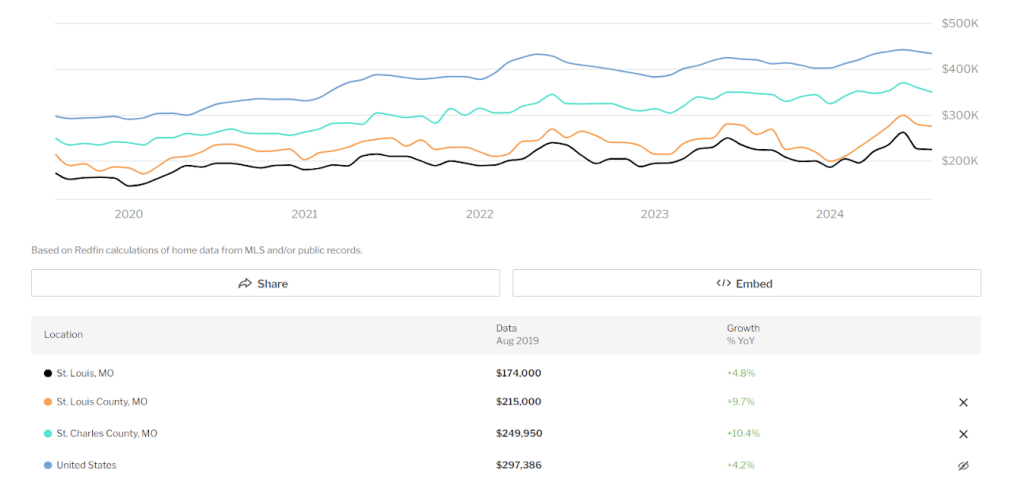
Price growth in the city has been moderating. In fact, median sales prices in the city have been falling for much of the last year. For a while, a similar moderation trend was also taking place in St. Louis County. The county’s price premium has returned, after a brief period where prices almost fell even with the City’s. Recent sales data shows that St. Louis County is actually posting the highest year-over-year (YoY) returns ever. City real estate prices are essentially flat, YoY. Meanwhile, St. Louis County’s median sales annual price gains of 7% is more than double that national median housing price gains. Across the Missouri River, St. Charles County’s market performance had been matching or exceeding national price appreciation, though YoY gains have recently fallen below the national trend.
Not everyone is seeing this trend, though. Katie Berry of RedKey Realty Leaders is more optimistic of trends in the city. “What I see is a normalization of the housing market across all neighborhoods. When looking at pre-COVID numbers against today, every neighborhood has seen a value gain. Immediately following COVID, we saw an influx of buyers driven by extra savings from COVID relief and increased savings as well as low interest rates. I think what you’re starting to see is less of a decline and more of a normalization of the market,” said Berry. She added “Personally, I’m bullish on the city- crime is down and investment and educational opportunities are up, we just need to get the word out.”
Basket of “up and coming” city neighborhoods
Before we look at neighborhoods in the usual north/central/south frame, let’s focus on some neighborhoods with increased investment that have been touted as “up and coming” neighborhoods, plotted in the graph below.
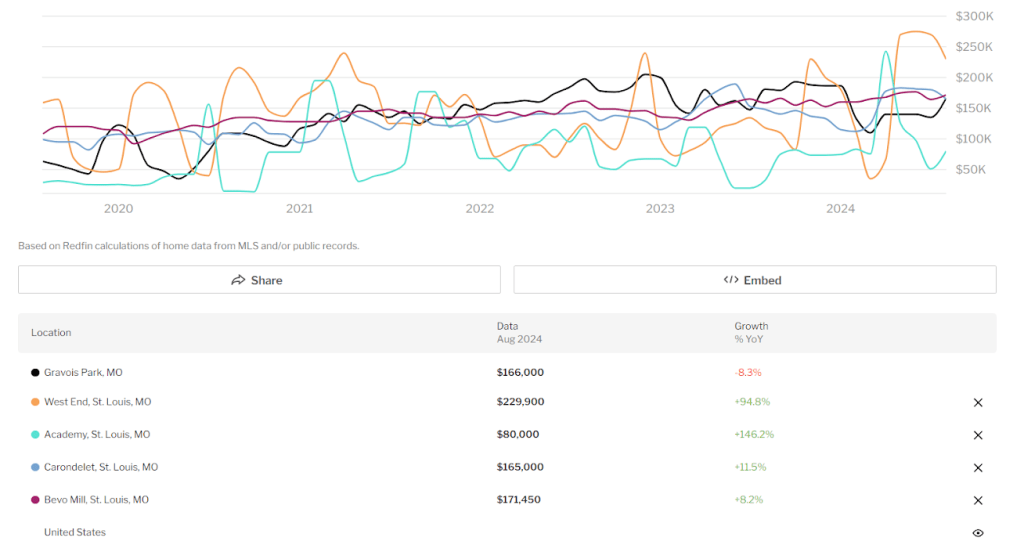
Notice the “spikey-ness” of the numbers from Academy and West End? The sales price behavior in these near northside neighborhoods is experiencing a common phenomenon during the initial years of gentrification. During these periods, you will often see lower prices with intermittent, large jumps. This is usually indicative of a slower market where new rehabs are selling. In these markets, you have still-depressed housing values driving sales prices for much of the neighborhood. Meanwhile, blocks closer to wealthier neighborhoods have rehabbing activity, which generates occasional sales prices far in excess of the pricing for non-rehabbed homes in the neighborhood. Due to overall low sales volume, these sales can create the kind of dramatic swings you see in the data for West End and Academy. Such sales can also produce seemingly dramatic YoY increases in median sales prices. In reality, most homes in Academy have not seen a 146% increase in value.
The three southern neighborhoods (Gravois Park, Bevo, and Carondelet) show less dramatic leaps and falls, as they have active real estate markets that generate enough transactions to smooth out the occasional low or high sale. Until recently, Gravois Park’s data often exhibited the kind of spikes visible in the near northside neighborhoods. In recent years, the neighborhood has seen significant investment and interest. Having Cherokee as its northern border gave it a growing commercial district that drew attention and capital to the neighborhood. This was aided by the city investing significant money in rehabbing buildings in the area via the nonprofit developer Lutheran Development Group. This is a strategy that has worked well for the city in nearby neighborhoods such as Tower Grove East.
As the graph shows, the Bevo neighborhood continues to see strong price growth and Carondelet has joined them in a solid trend toward higher prices. Meanwhile, Gravois Park has fallen behind the city’s overall rate of price growth. Notably, Gravois Park was actually showing declining prices, though recent months have shown a recovery. The past year’s sales price history points toward a broken trend upward. That said, it is entirely possible that a return of lower interest rates will bring more rehabbing into the neighborhood, reviving sales prices. In fact, median sales prices in all of these southern neighborhoods have essentially converged in recent months. Whether sales prices in Gravois Park regain the premium that they enjoyed over homes in Bevo Mill and Carondelet is an open question.
Established neighborhoods holding value
Next, we’ll turn our attention to a group of city neighborhoods that are largely considered stabilized, middle/upper-middle class neighborhoods. In recent months, the price performance in many of these neighborhoods has faltered somewhat. Looking back a year from August, all of them lost value. That said, these neighborhoods continue to hold strong prices, though they do show YoY weakness, especially in comparison to the increasing prices in the suburbs. Has luxury living in the city lost a bit of its luster? We will need to watch what happens during next year’s spring buying season. If they are unable to reestablish steady price growth, this could be seen as a warning sign for the city’s overall real estate market. Even so, there is no reason to believe that recent weakness is necessarily the end of the upward trend that has generally benefited these neighborhoods.

A look at northern neighborhoods
To the north, we see YoY price increases in some neighborhoods, but the data mainly shows a recovery back to already depressed values. Because prices in these neighborhoods are highly depressed, and the increases often only represent a change in price of a few thousand dollars, even when YoY percentage changes are high. rice growth does appear to be somewhat widespread. Current data shows Penrose, Walnut Park, and Baden all posting gains. Penrose seems to be somewhat pulling away from the others, but these areas have so few sales that it is hard to identify a trend with much confidence.

Overall, these neighborhoods sport sales prices at a fraction of the up-and-coming neighborhoods, while some neighborhoods’ average sales prices are roughly a tenth of those in higher-cost neighborhoods like Shaw, CWE, etc. While there are occasional higher priced sales, most recorded sales in these areas fall between $25k and $50k.
Turning our attention to the Central Corridor
In recent years, the city’s Central Corridor neighborhoods have led the city’s building and construction scene. With new towers rising in the city’s center, it is obvious that significant capital has been attracted to the area. Major commercial additions and the new soccer stadium in Downtown West have also drawn attention and capital to parts of town that had seen less growth in the last decade. Let’s see how this has impacted recent sales prices in the area.
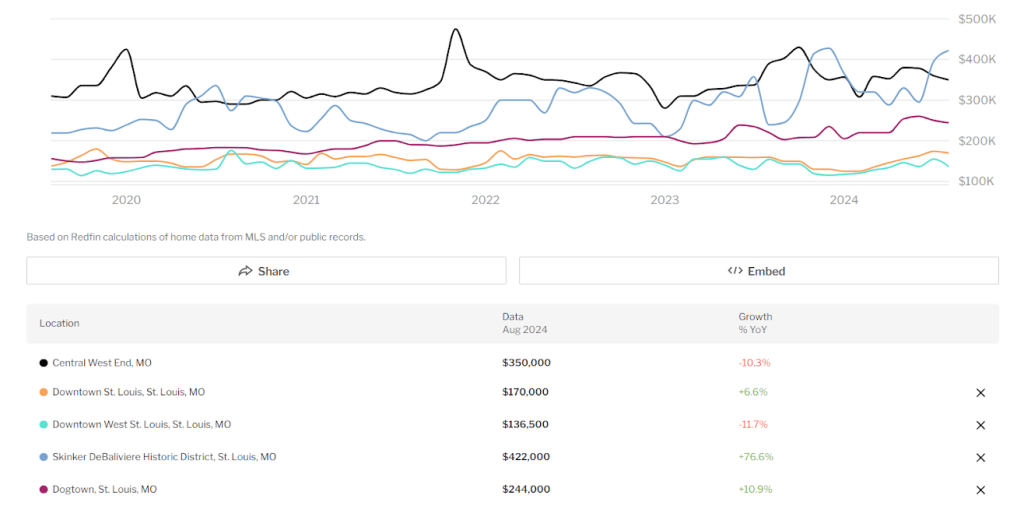
As you can see, the Central West End prices have remained fairly stagnant over the past few years. Meanwhile, Dogtown has shown a steady trend towards higher prices. Skinker-Debaliviere, which has enjoyed significant new investment, also seems to be on a trend higher, while prices in Downtown and Downtown West have stagnated in recent years. This flies in the face of the local media and political class’ mantra that weakness in Downtown’s central business district is offset by growth in Downtown West. In fact, Downtown sales prices have gained a premium over Downtown West. While there is definitely commercial growth in the blocks around the soccer stadium, home sale price data indicates that this has not translated into higher prices for condos, etc. in the Downtown West Neighborhood.
Southern neighborhoods show both weakness and strength
Neighborhoods to the south area bit of a mixed bag, though upward trends are generally taking hold. Dutchtown prices remain depressed, as much of the neighborhood remains without recent investment. This is changing, though. In recent years, Dutchtown’s median sales prices have essentially doubled. South Hampton and St. Louis Hills are both established neighborhoods, and their prices continue to appreciate. In fact, St. Louis Hills’ median sales prices have been exceeding those of the Central West End and even Shaw.

“I’ve seen quite a bit of investment purchasing for rentals in Dutchtown, Carondelet, Tower Grove South, Bevo, and Marine Villa… in particular the $100,000-$225,000 range which has hurt the first-time homeowner’s chances of purchasing. It has also forced rent up significantly, especially along the southern/eastern areas of south city,” noted Realtor Kyla Oudshoorn of Platinum Realty. Additionally, Oudshoorn noted that “Cash purchases have significantly increased, removing the appraisal contingency.”
Overall, southern neighborhoods’ pricing shows that many of their values are making broad gains, although they are not evenly distributed. While northern neighborhoods continue to exhibit the signs of moribund real estate markets, these southern neighborhoods show a pattern of general price appreciation.
A mixed bag
It shouldn’t really surprise anybody who has lived in the city for some time, but our real estate values continue to range from very, very low to quite high. Much of this is related to the racial makeup of the neighborhoods and our nation’s longstanding practice of undervaluing property in non-majority-white communities. There are also what appear to be shifts in investment patterns. While the last decade saw lots of effort and money being expended to redevelop the southern “state street” neighborhoods, including both Gravois Park and Dutchtown, some of these neighborhoods have recently seen declines in sales prices. Meanwhile, there is a lot of energy and money directed to the near northside neighborhoods that border the Central West End and Skinker-Debaliviere, with the “Maker District” regularly announcing new retail and dining additions. While it is too early to tell, this could indicate that investment is shifting away from the state streets and into the near northside. If pricing and investment in the state street neighborhoods doesn’t rebound, it could mean that these neighborhoods’ real estate markets weren’t as stabilized as many thought. While Dutchtown seems to be doing well, Gravois Park real estate has trended below recent years’ median prices. We will have to wait and see if this turns into a longer term trend.
The Central Corridor shows both strength to the west and weakness to the east, while prices in many northern neighborhoods have seen stability with some signs of increasing prices. In general, though, most northern neighborhoods still do not have very functional real estate markets, and buyers have a very hard time getting financing in these neighborhoods. This lack of access to financing works to keep values depressed, exacerbating the problem. While West End and Academy are seeing prices rise significantly, this trend does not seem to stretch farther north, where most neighborhoods are having a hard time breaking the $50k mark with any consistency.
While some see the city’s housing values broadly rising, Redfin data continues to show that sales prices remain hyper-localized. Values are rising in some areas north of Delmar, though many northern neighborhoods continue to face disinvestment and lack of access to financing. Due to moribund investment activity, these northern neighborhoods continue to see median sales prices that are roughly the same as that of a new mid-grade SUV. To the south, some neighborhoods continue to command high prices, while others have seen redevelopment slow down. In the city’s central neighborhoods, Downtown is struggling after having been a bright spot for many years. Heading west from downtown, neighborhoods like Dogtown and Skinker-Debaliviere are showing continued price growth. Overall, data shows that the city’s real estate market remains quite variegated.


