
BJC Health Announces First Round of Pay Cuts, Increasing AI Integration

(Editor’s Note: Mound City Messenger avoids the usage of anonymity in most cases. Given the fact that BJC employees could be sanctioned for discussing and sharing information related to this story, none of the employees interviewed for this story will be identified. This concern is further evidenced by the fact that BJC staff posting in social media groups have largely done so anonymously.)
Missouri’s Largest Private Employer Announces Wage Cuts
Over the past few weeks, local nurses have been taking to social media groups to express their alarm at recent changes announced by BJC Health. In these conversations, employees of Missouri’s largest private employer discuss changes that they believe will amount to pay cuts for many staff. This process has been discussed with BJC staff in terms of being part of a process of aligning policies with those of St. Luke’s, a Kansas City-based hospital system that merged with BJC in 2025. According to BJC internal communications that were shown to this publication, the process included a market evaluation, which employees have been told helped determine the newly announced wage structure. This new wage structure will take effect on May 3rd, 2026. Conversations with BJC staff in St. Louis surfaced doubts that the changes are genuinely being driven by the merger. Many believe that this “alignment” is simply a convenient excuse for wage cuts. Many complained that they didn’t have a say in merger decisions, and they feel that it is unfair that they are now being expected to take pay cuts.
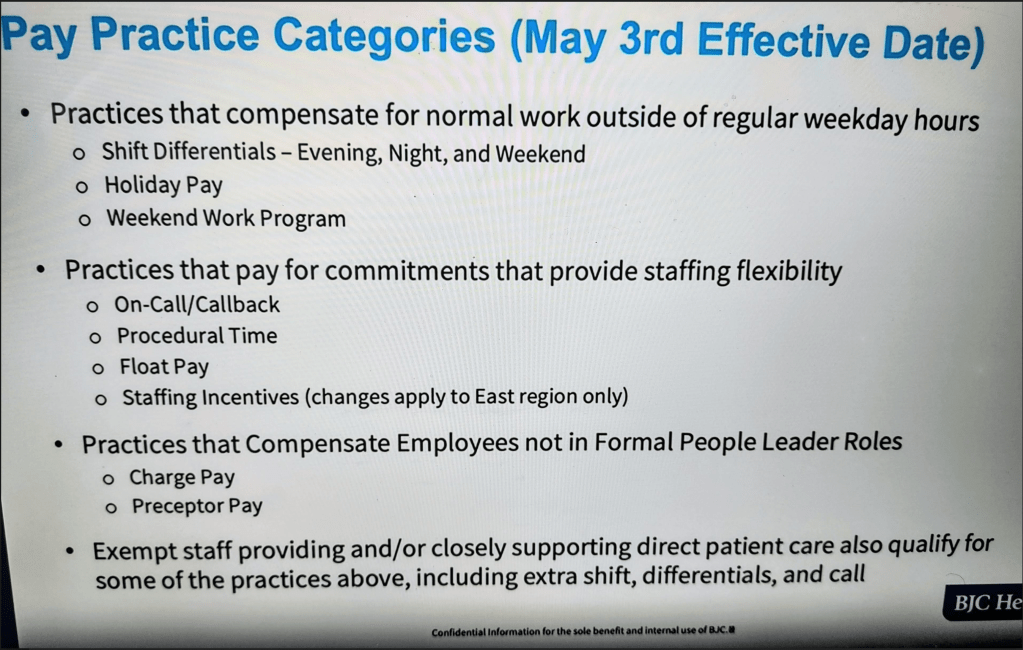
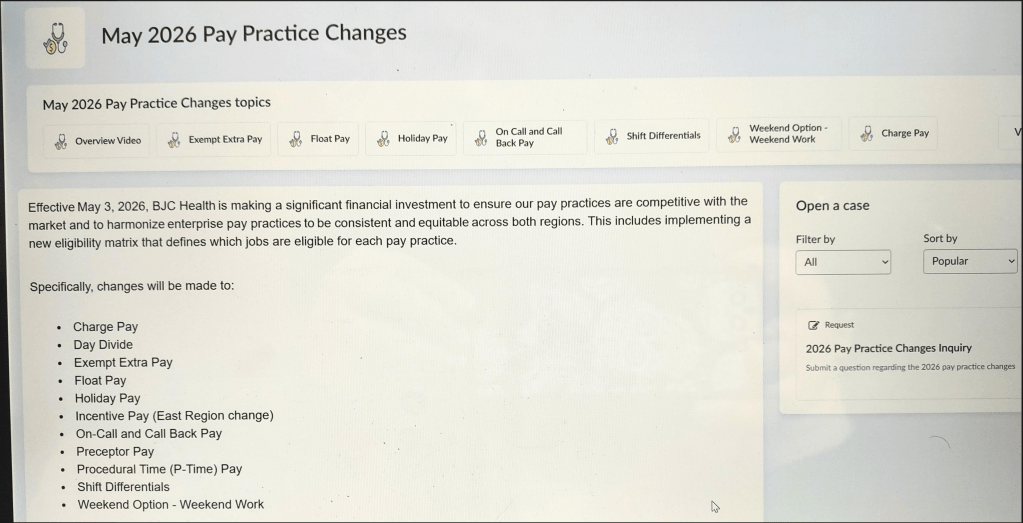
Internal information distributed to staff indicates that most base wages would remain the same or slightly increase. At the same time, workers will face cuts to differential pay rates. Differential pay is in addition to base wage rates and increases compensation for things such as specialties, working different shifts, specific work duties, and other considerations. For example, Charge Nurses are expecting the differential they receive for leading their shifts to be reduced from $3/hr to $2.50/hr. As many differential rates are changing, the impact on BJC employees’ total compensation will be cumulative. The sum of this means that even workers with rising base wages will likely see their total hourly wages decrease. One BJC employee interviewed for this story said that they believed the changes would mean a roughly $10,000 reduction in annual income. It is worth noting that internal BJC documents indicate changes to differential pay are not limited to nursing staff. Clerical, professional, and technical positions are all seeing their differential pay structures altered.
Some staff are also being instructed that they will be required to attain additional certifications. Documents shown to this publication indicate that BJC employees will be expected to pay for these certifications. Information given to employees states that these new requirements won’t be immediate, giving staff time for “budgeting and licensure acquisition”. Some staff have mentioned additional changes in policy that will stop them from being able to pick up overtime shifts that they were previously allowed to work. Other employees report changes to how overtime on weekends is calculated, which they say will lead to lower wages for those shifts. The changes in overtime policy apparently predate the newly announced changes to BJC’s wage structure.
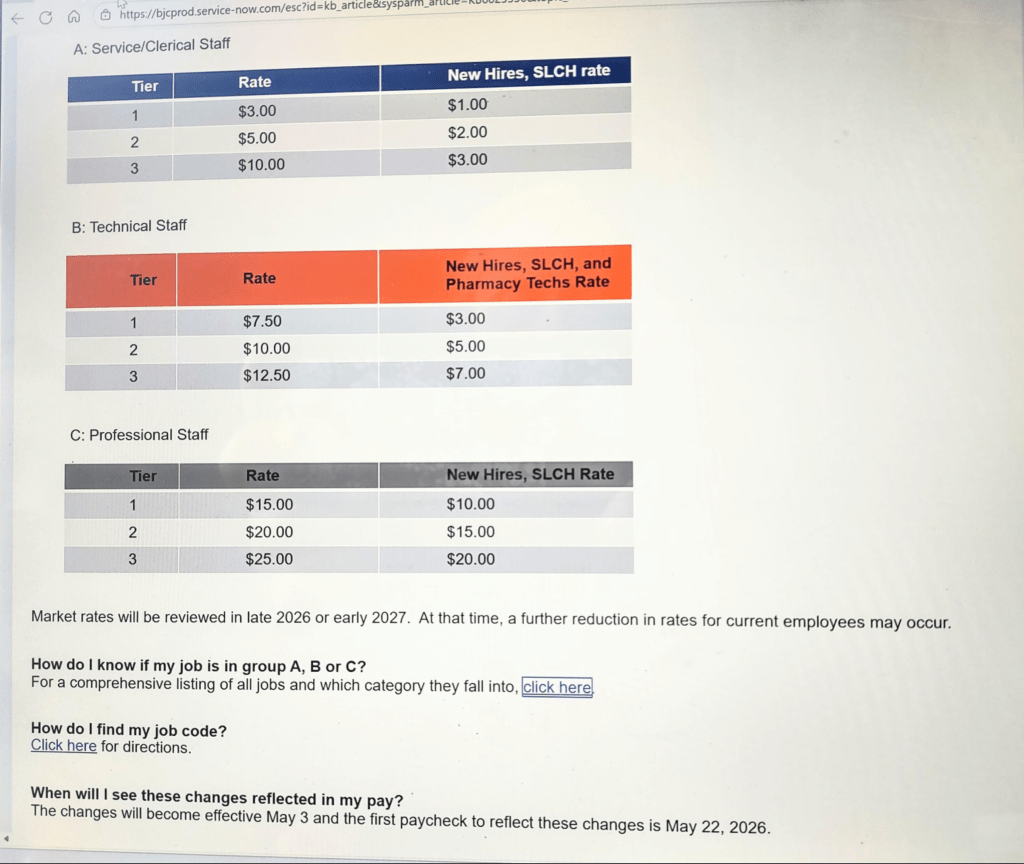
One of the larger changes will be to pay policies regarding new hires to BJC’s “float pool”. These are employees who don’t work at a fixed location. Rather, they are dispatched to work at various BJC locations, depending on staffing needs. New nurses hired into the float pool will see differential pay that is roughly a third less than that of current BJC nurses. This has been likened to the tiered wage system that automakers adopted after government bailouts in 2008-2009. Other areas will see even more drastic changes to new hires’ differential pay, with clerical staff seeing cuts of close to 2/3rds, and technical staff will see cuts of closer to 50%. Staff members fear that cuts to new hires’ pay will make it hard to recruit new employees. They point to this as a clear example of the proposed changes to the company’s wage structure actually making BJC less, not more, competitive in the labor market.



A video has been provided to staff explaining the changes. In the video, senior BJC leaders talk about the change as an important step forward in modernizing BJC’s corporate structures in the post-merger era. In the video, senior leadership says that an important aspect of the restructuring is that it will make the organization more flexible and adaptive. It also states that these pay changes are to make BJC more competitive in local hiring markets, though employees interviewed pointed out that they are announcing significant cuts to the pay of new float pool employees. As these would be some of the most flexible positions in the organization, many have pointed to wage changes that will make it harder to hire new float pool staff as an inconsistency between leadership’s words and actions.
Changes Made Possible by AI?
A point that the video spends time on and seems to be a key part in this shift is BJC’s adoption of Oracle’s Cloud Fusion system. This product, also known as Oracle Fusion, is an AI-forward tool that can do many things. In the video, BJC’s East Region President Bob Cannon refers to the software as an “enterprise resource planning tool”. Oracle’s website describes the tool thusly, “Oracle provides comprehensive AI services and state-of-the-art generative AI innovations in our data platform and cloud applications—all on our leading AI infrastructure. Oracle’s AI offerings span the entire technology stack and are powered by industry-leading large language models (LLMs) and Oracle Cloud Infrastructure. OCI is designed to excel in the demanding scenarios of generative AI due to its high performance, low-cost GPU cluster technology and high-bandwidth RDMA network.”
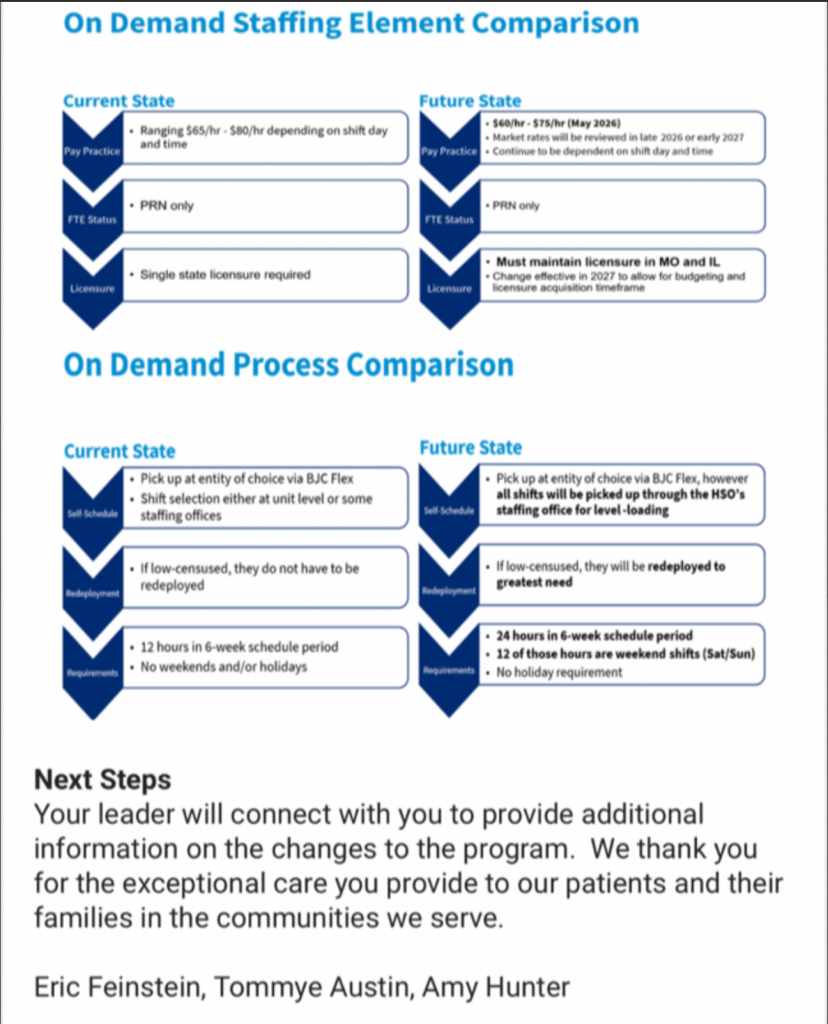
It is unknown in what ways this new software is leveraging AI to change how things are being done at BJC. One way that has been speculated is related to a change announced to “On-Demand” nurses. These nurses often work only a few shifts per month. Many of them describe having child or elder care commitments that limit their work availability. Employees we spoke with described a previous system where they could choose dates and locations for upcoming shifts. In the event they were not needed on the day of their shifts, they would be notified that they did not need to come in. Under the new system, they will be reassigned to another hospital with staffing shortages. Nurses noted that the size of BJC’s system means that these hospitals could be much further from home, compared to the location they had signed up to work. Many express concern that they will not be able to handle the additional, unplanned commute time, while still meeting household commitments. On-Demand staff have also been informed that their hourly wage will be reduced by $5. BJC has acknowledged that this is despite a February 17th communication saying otherwise.

Oracle Fusion features “smart search and matching” capabilities, which it says can match staff with needs created by absences. Some have wondered if this new AI capability is related to the new reassignment system being instituted. The program also promises organizations that it will be able to better organize employees by department, line of business, and more. This is supposed to result in faster staffing and better skills matching between employees and roles. Oracle says that it has rolled out over fifty AI agents across the suite and that it is adding more quarterly.
Additional Cuts Expected, BJC’s Market Power Could Shift Regional Pay Trends
BJC’s internal staff website also notes that employees should expect additional differential wage reductions in late 2026 or early 2027. This has led to growing concerns that BJC is beginning to systematically ratchet down wages. Some BJC staff have noted that this follows an end to certain funding tied to the COVID-19 pandemic. Staff interviewed point to falling premiums being paid to travel nurses as evidence that the healthcare industry has begun reducing compensation to hospital staff. Others point to the change in new hires’ differential pay, which demarcates a time between the old wage hierarchy and the new regime. Given BJC’s size and market share, it could begin a trend of falling hospital wages at other local hospitals. Given the importance of healthcare to the St. Louis economy, a future of reduced healthcare wages in the region would have impacts that reverberate far beyond BJC.
BJC Health Responds
In response to questions submitted for this story, a BJC Heath representative sent the following statement:
BJC Health annually evaluates benefits and compensation offerings across the Midwest and in its Kansas City- and St. Louis-based regions. This process includes a comprehensive market analysis to ensure our benefits and compensation package remains highly competitive with peer organizations within the health care industry and across the region.
Like any organization following an integration, BJC is creating a single set of policies and practices for consistency. This standardization can lead to more pay opportunities, career growth, and the ability to move within the organization. These changes are meant to align pay and benefits while keeping total compensation competitive in the Kansas City and St. Louis areas.
Starting on March 8, more than 8,000 BJC nurses will receive the benefit of an investment of $70 million in base pay and benefits, each year. This, along with aligning pay practices beginning May 3, ultimately maintains or increases pay for 72% of employees (7% maintaining and 65% receiving increases).
BJC understands the important role benefits and compensation play in supporting our team members and is proud to be recognized as one of the Forbes Best Large Employers and Newsweek’s America’s Greatest Workplaces.
These pay practice changes promote enterprise-wide consistency and market competitiveness to help BJC Health remain an employer-of-choice in the Midwest.


