
Transit Riders Call for Better Snow Removal Policy

Four days after a winter storm dumped up to a foot of snow across St. Louis in sub-freezing temperatures, Ghiavonna Jamerson steps off the #8 Metrobus with her three-year-old daughter in her arms. She trudges through a strip of snow and into the neon light of the bustling Phillips 66 gas station at the intersection of South Jefferson and Chippewa. Rush hour traffic zips by. After working in the Shaw neighborhood, she picks up her daughter from daycare and re-boards the #8. On the other side of the gas station, she transfers to the #11 to get home near Chippewa and Hampton Avenue.
She lost her car in a crash a few months ago. Her 15-minute commute is now 55 minutes at best. “I’m adjusting to having to get on the bus and waiting. I think there are some things that could be better,” says Jamerson. She mentions having to step into a pile of snow while holding her daughter, but she’s unsure whose responsibility it is to address the slush and ice.
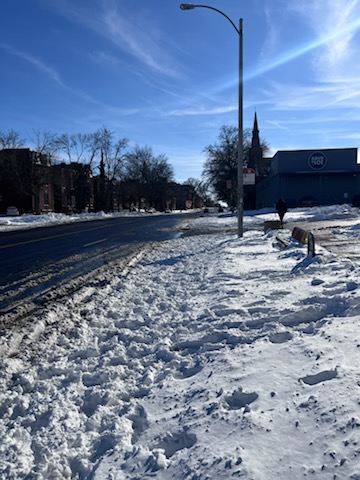
Another traveler, Jada, walks to a stop for the #11 Metrobus. She has gathered her kids, aged two years and eight months, from daycare. Exposed sidewalk is rarefied on this stretch of Chippewa dividing Gravois Park and Dutchtown, a line of businesses, rental properties, homes, and vacancies. She crosses at an intersection where trickling water has pooled around curb cuts, freezing into an impassable sheet. Pausing intermittently between parked cars to let motorists pass, Jada walks her stroller in the lanes of this legacy highway. “It’s been bad, because I have a stroller and two kids, and they ain’t trying to do nothing to fix it,” she says. “They need to fix the snow, that’s all they need to do.”
City response to snow removal was a pivotal issue during the 2025 mayoral race, and then-candidate Cara Spencer slammed then-mayor Tishaura Jones’ administration not only for a failure to clear residential side streets for drivers, but also for how snow and ice vexed pedestrians. One Black mother paid the highest cost. On January 20, 2025, 39-year-old Shirley Howard was pushing her 2-year-old son in a stroller. Iced-over sidewalks caused them to travel in the unprotected bike lane on West Florissant Avenue, where an elderly driver hit them, killing Howard and sending her son flying. He suffered severe injuries.
Kea Wilson’s reporting on the tragedy highlights the way that insufficient pedestrian infrastructure impacts parents and caregivers, who are more likely to be women. Furthermore, “Black and low-income people both disproportionately suffer the burdens of traffic violence, and are also over-represented among both paid and unpaid caregivers that struggle to push strollers or wheelchairs when roads are too icy to do it safely,” Wilson writes. In Howard’s case, an epilepsy diagnosis kept her from being able to drive. For others, like Jamerson, the months of saving to replace a car are spent using public transit—and sidewalks.
The mayor’s office celebrates its painstaking effort to clear snow from residential side streets in addition to arterial roads, but some public transit riders are speaking up after feeling ignored.
“This last snowstorm made it clear how difficult public transit can be for riders, especially those with disabilities,” says Justin Wallen on behalf of RAISE Transit, an advocacy group that meets weekly to promote inclusive, safe, and equitable public transit in greater St. Louis. He says nearly all of the neighborhood transit stops he visited were blocked by snow piles, creating gaps in accessibility. “While I was able to navigate them, my parents are both legally blind and would struggle, risking unsafe conditions in the street.”
In a social media post, RAISE claims that they had sent a letter to Mayor Spencer’s office in November, pointing out that a recent snow removal plan update failed to address pedestrian facilities or transit stops, and did not receive a response. The letter requested a Winter Accessibility Plan that identifies who is responsible for clearing snow in these spaces and sets expectations for removal timelines. It also called for the prevention of snow plowed onto curb ramps or transit stops, and a clear follow-up process when blockages are reported by dialing 311. “Sidewalks and transit stops are part of the transportation system. If they are not cleared, transportation access does not exist,” the letter reads.
At the time of writing, Wallen says RAISE is still waiting for an official response. I reached out to Rasmus Jorgenson, a press secretary in the mayor’s office, to inquire if pedestrian crossings, bus loading zones, and sidewalks were addressed in existing snow removal policy. Following an after-action review meeting this week, Jorgenson writes, “Improving access to public transit stops after snow events, especially for people with disabilities, is an area where we see room for improvement and which was discussed. We are grateful to Metro for their existing efforts and partnership in this area.”
After speaking with riders around the intersection of South Jefferson and Chippewa, I make my way west along Chippewa, where Jamerson still waits. “Another thing for your story—the bus is late,” she quips. Jamerson picks up her daughter again, who is now crying. The cold has set in—it’s around 19 degrees. As she said during our initial interaction, “The waiting part is the worst.

Christian Frommelt is a St. Louis-based artist, organizer, and wanderer. You can read more of his work on urbanism, music, transportation, and more on his Substack, Notes from the Sprawl.


