
Unlike KC Counterparts, SLDC Board Members Don’t File Financial Disclosures

Despite promises of renewed transparency at St. Louis Development Corporation (SLDC), the city agency that makes recommendations on granting numerous real estate development tax incentives, board members are still allowed to serve without filing personal financial disclosure paperwork with the development agency. Questions of unethical behavior at the agency were a major part of the recent mayoral campaign. The agency faced numerous negative media reports, many of which centered on a troubled small business and nonprofit grant program’s administration and selection process.
The lack of conflict of interest paperwork was confirmed while seeking these documents for SLDC board chair Nancy Hawes. Hawes also serves as Chief of Staff for Mayor Cara Spencer. Hawes’ hiring and appointment as the new SLDC board chair were two of Mayor Spencer’s earliest moves. Once on SLDC’s board, Ms. Hawes and the majority quickly moved to remove former SLDC Executive Director Neal Richardson. Instead of fighting his removal, Mr. Richardson offered his resignation. This personnel change was supposed to be a sign that SLDC would be more transparent under Mayor Spencer.
On June 11th, Mound City Messenger submitted a request for copies of emails from Ms. Hawes to SLDC in the years prior to her appointment to its board. The same request included an ask for Ms. Hawes conflict of interest paperwork. Initially, SLDC denied the request for emails, stating that we would need Ms. Hawes’ old work email addresses to process the request. SLDC’s Public Information Officer ignored the portion requesting a copy of Ms. Hawes’ conflict-of-interest paperwork.
Follow-up conversations with Sunshine Law experts indicated that SLDC should not have denied the request for emails from Ms. Hawes, as they have the capability to search by name, which would pull up emails with her signature line. They also indicated that SLDC should not have ignored the request for paperwork about professional conflicts.
Upon follow-up and a reiteration of the request for Nancy Hawes’ conflict of interest paperwork, SLDC produced a conflict of interest form from Ms. Hawes. It was dated June 23rd, almost two weeks after the date it was requested and long after her appointment to the board. In further communications with SLDC, agency spokesperson Deion Braxton said, “SLDC is a not for profit corporation and all Directors are bound by the conflict of interest provisions of SLDC’s Bylaws upon assuming their seat on the Board. Ms. Hawes is required under those Bylaws to disclose any conflict with a matter pending before the Board.” When asked to clarify if it is standard practice that SLDC doesn’t have board members sign conflict of interest forms indicating business relationships that could have business come before the board, Mr. Braxton repeated the above statement about SLDC board members being expected to disclose relationships as individual pieces of businesses arise.
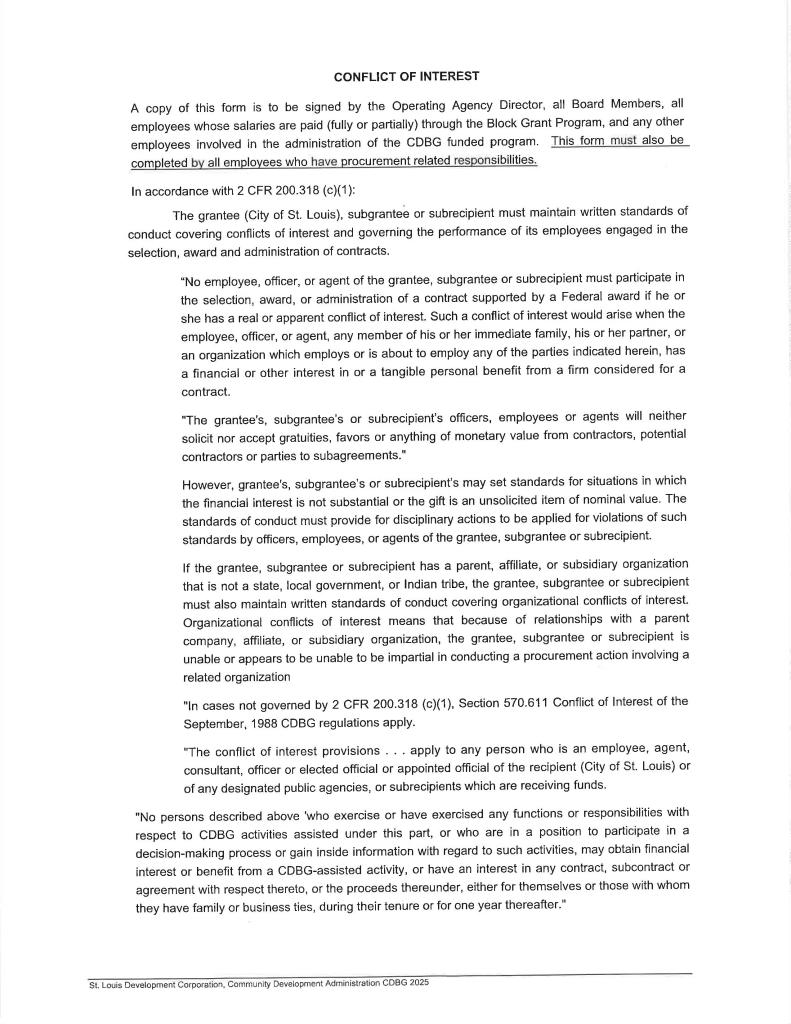
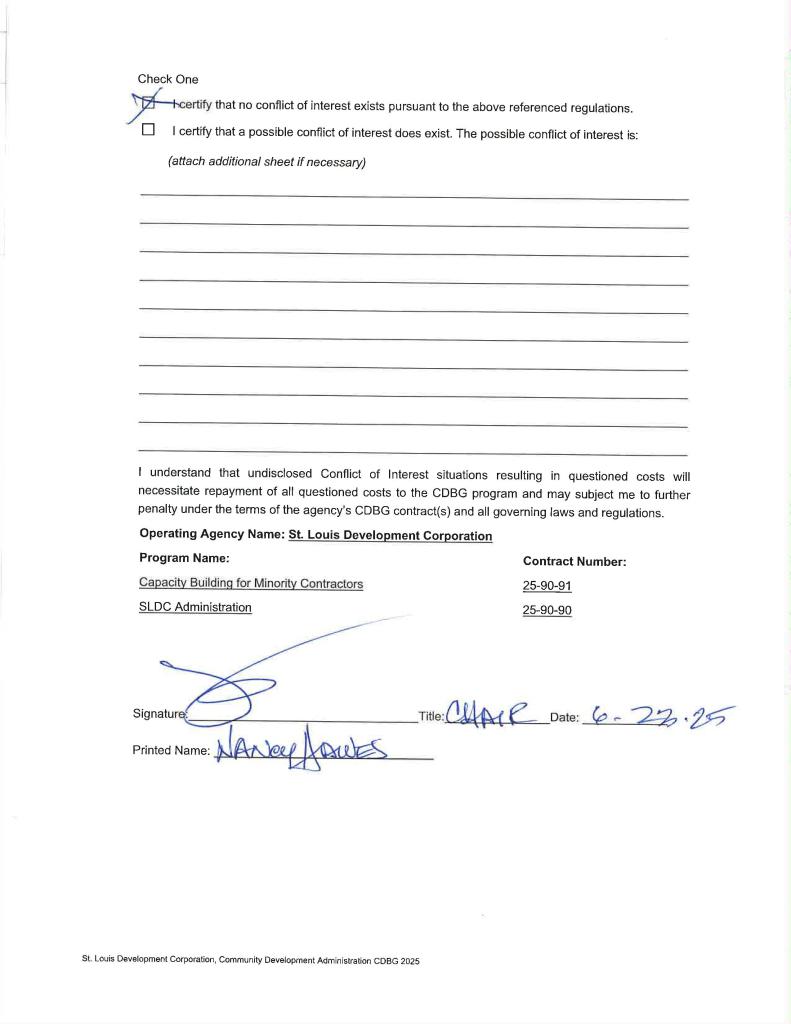
Without board members disclosing business relationships, it is almost impossible to track if contracts, TIFs, tax abatements, or grants are being given to firms with ties to board members. When asked how the public could be expected to track whether board members were acting ethically, given that the board members don’t produce any documentation that would allow the public to verify their actions aren’t personally beneficial, Mr. Braxton repeated the above statement about SLDC’s bylaws. He also added “There are several instances of Directors publicly recusing themselves from matters in recorded public meetings.”
In an effort to understand if this lack of transparency was common for economic development boards, we reached out to the Economic Development Corporation of Kansas City (EDCKC). EDCKC is SLDC’s sister entity in Kansas City, MO. When asked about their disclosure policy, EDCKC’s Marketing and Communications Coordinator Brian Escobar responded “At EDCKC, our board members, as well as the members of the agencies we staff, are required to file annual conflict of interest disclosure statements with the City Clerk. This is outlined in Section 2-723 of the Kansas City Code of Ordinances, which sets standing rules for boards, commissions, and task forces.”
The ordinance referenced by Mr. Escobar states “members of all boards, commissions, task forces and other entities of the city or who receive funding from the city or which make recommendations on the expenditure of public funds, except members and contractors who are required to file a personal financial disclosure statement, shall file an annual conflict of interest disclosure report on the form provided by the city clerk or equivalent form provided by the state ethics commission which shall provide the following information, before May 1 of each year.”
Given that Kansas City’s development corporation requires regular disclosure, SLDC’s lack of transparency puts the agency behind their cross-state counterparts in Kansas City. It would also indicate that this is something that could be changed by the passage of a city ordinance requiring SLDC board members to file annual personal financial disclosures.
While the city updated its conflict of interest rules for members and employees of the Board of Aldermen in 2022, the rules left appointed commissioners without a responsibility to declare potential conflicts. Those new rules were the subject of a longrunning legal challenge that slowed their implementation. That court case was resolved at the end of June. The city has not yet moved to implement the new disclosure requirements.
Mayor Spencer’s office did not respond to numerous requests for comment on this story.


