
Intimate and Compelling, RENT Remains a Powerful Contemporary Musical

Although it’s now 30 years old and a few of its references are a bit outdated – does anyone use an answering machine anymore? – the struggles, ideals, and hopes of the characters in Jonathan Larson’s seminal musical Rent feel just as relevant and important today as in the mid-1990s. And those ideals felt just as relevant when the musical first premiered as they did in the 1890s, when Puccini’s opera La Bohéme, which Rent reinvents, first introduced audiences to a community of artists and entertainers finding joy, inspiration, and love while fighting to survive. New Line Theatre’s production embraces these universal themes in an intimate production that captures the musical’s conflicting emotions with raw honesty.
Mark, an aspiring filmmaker, and Roger, a songwriter and musician, live in a near-vacant building owned by their friend in a rundown New York neighborhood that’s ripe for gentrification. Neither of them is working steadily, and this Christmas Eve they’re struggling to heat their apartment and find enough to eat. The mood improves when their friend shows up with supplies and even the arrival of Benny, owner of the building and a former roommate who’s now pushing the gentrification effort, can’t dim their spirits. The two face a year of growth and change, heightened by loss and uncertainty, made bearable by friends and community, and chronicled in song.
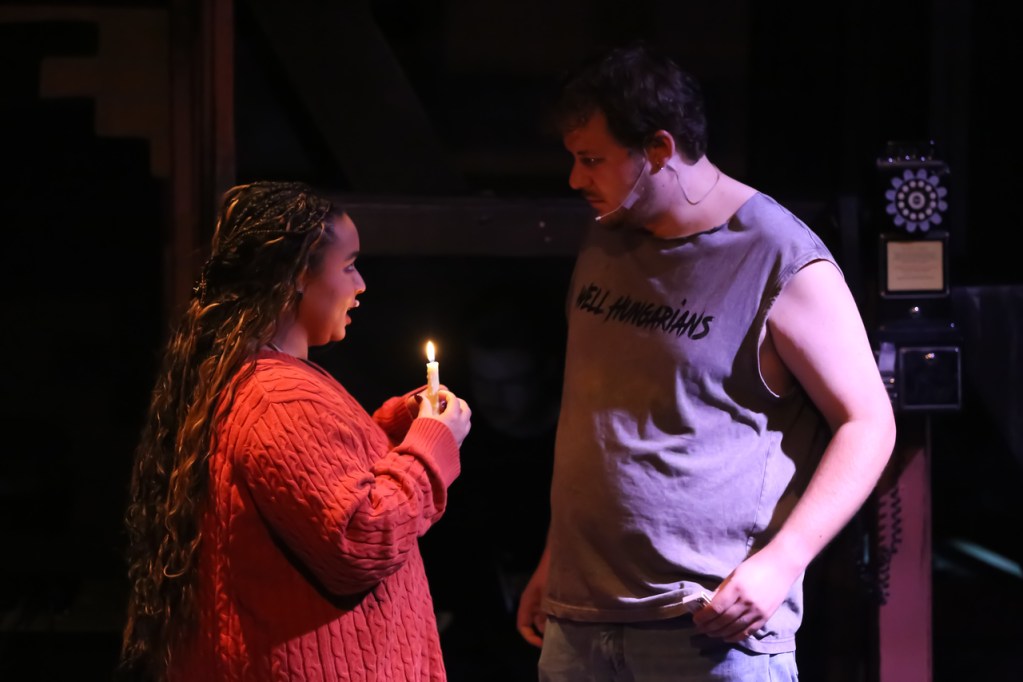



And, oh, how those songs linger and replay in our minds. “Rent” strikes the right tone of defiance and despair. “Light My Candle,” “Tango: Maureen,” “Sante Fe,” “I’ll Cover You,” “Take Me or Leave Me” and “Halloween” capture the excitement, frustration, and possibilities of love and aspiration. And “Christmas Bells,” “La Vie Boheme”/“I Should Tell You,” and “Seasons of Love” are emotionally layered ensemble pieces that elicit a flood of emotions, each song reflecting aspects of our humanity. Revealing more than just the scene and experiences of the characters, the songs reach out and touch something at the core of the audience. Directors Scott Miller and Chris Moore ensure each nuance and emotion is effectively conveyed, and the New Line Band, with musical direction from conductor and keyboardist Randon Lane, provides reliably outstanding accompaniment that compliments and enhances the evocative score.
J. David Brooks is immediately sympathetic and likable as Mark Cohen, who guides us through the story, his camera always in hand to capture the moment. Even though he’s part of the story, he’s often holding back, observing and recording, rather than participating in his own life, and Brooks perfectly captures the insecurity and hesitation while still conveying how deeply caring and affected Mark really is. Nathen Mecey embodies Roger’s quiet, inner turmoil and his longing for something bigger than himself with understated conviction. Brooks captures Roger’s fear and uncertain future with small gestures and a plaintive voice that longs for a more meaningful life. Aarin Kamphoefner is captivating as the always compassionate and nurturing community organizer Angel Dumott Schunard and is nicely paired with Chris Moore’s warmth and generous spirit as Tom Collins. Corrinna Redford is heartbreaking and compelling as Mimi, Sarah Lueken is vibrant, impetuous and impassioned as Maureen, and nicely complimented by Jazmine Kendela Wade as the determined, resourceful Joanne, and Aaron Tucker finds moments of likeability in the ambitious Benny. The supporting ensemble is strong and features solid performances from Rafael DaCosta, Gabriel Scott Lawrence, Sofia McGrath, Tawaine Noah, and Rachel Parker, with standout moments from Chelsie Johnson, Brittany Kohl, and Lauren Tenenbaum in particular.
The production is intimate and captivating, but it isn’t perfect. The edges are left a bit unpolished, and the voices sometimes miss a note, crack, or slide into harmony rather than maintaining perfect balance. The set is nondescript, and some set pieces look like they could have been salvaged from a dumpster. But these slight imperfections fit the score and emphasize the humanity of the characters, and honestly, that’s where one finds the beauty in Rent. New Line Theatre’s production is also the company’s 100th show, a milestone representing countless hours of rehearsal and stage craft – with relevant themes and truly unforgettable songs, Rent is a sometimes messy, always compelling must-see show that’s a fitting celebration of the company’s legacy.


