Hopeful Utopian’s Upbeat Compositions Showcase Her Unique Songwriting Process
Is there a difference between a songwriter and a composer? I believe so. I think most people do, too. I think if you were to ask folks who call themselves “songwriters,” most of them probably wouldn’t feel that that’s interchangeable with “composer.” That term seems to imply a level of sophistication that goes beyond popular styles of music. There seems to be a prerequisite knowledge from formal study that is employed by a composer. There seems to be an attitude of meticulousness attendant to the role of “composer”.
There are, of course, people in popular music – that is to say rock, hip-hop, country; etc. – that approach their craft as meticulously as any contemporary composer would. I think about people like Ludwig Goransson, who has true composer bona fides; Omar Rodriguez-Lopez of Mars Volta; King Crimson and any number of prog-rockers; never mind the arrangements that go into so much soul, and hip-hop instrumentation. Many probably would argue that even the most facile of pop songs require a process and attention to detail that rise to the level of “composition.” The debate is an important one, but many would agree that there is something to a single individual putting literal or figurative pen to paper and very particularly selecting the precise notes.
Most of the bands and in fact, musicians I know utilize a process driven largely by, well, mistake. Messing around and “jamming” and improvising until something gels and sticks. Dynamic features (loud and quiet, fast and slow) are largely felt out and then agreed upon as they reveal themselves. There’s nothing wrong with this, the approach has several advantages, but precision is rarely one of them.
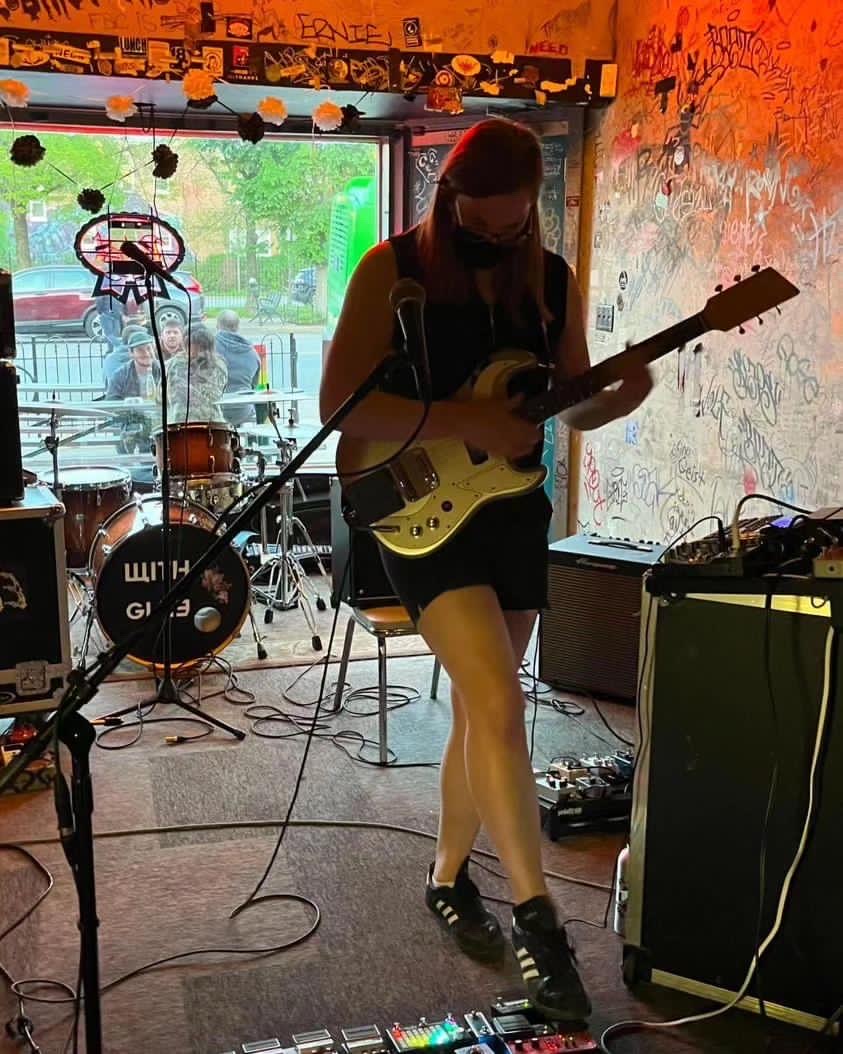
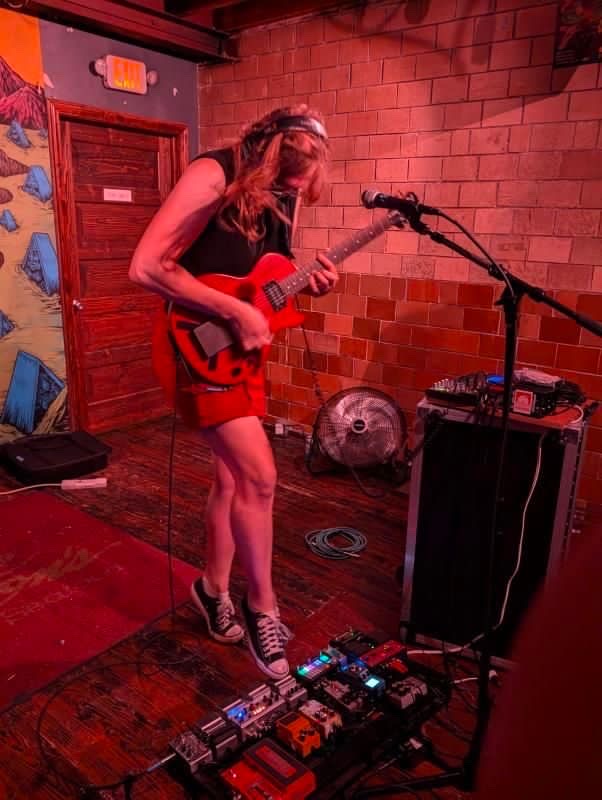
May Meckes, otherwise known by the stage name, Hopeful Utopian, does not do it this way. She is a composer. She calls herself a composer. To the casual observer, she likely comes across as a more sophisticated artist of the one-person-band variety (it’s time to retire the “one-MAN- band” phrase). She stands on stage amidst a small ensemble of noise-making devices, guitar hanging off her. It is hard not to notice the amount of physical activity she employs during a performance. “For me performing is an exercise of how much stress I can put myself under and still make it sound good.” She moves constantly. There’s none of the slow process of playing a pattern just so to achieve the perfect loop. Her songs are not merely the addition of sounds building upon each other and then the subsequent subtraction. Her songs have a much more urgent and kinetic quality, the result of deliberate and meticulous arrangement.
“I often start with a concept or musical idea and then ask, ‘how can I make this interesting and positive to listen to?’” As much as she claims that her songs are just “really complicated children’s songs,” she also uses and understands terms like “diatonic”and “polyrhythms.” What this seems to yield is a unique mix of the “songwriter” happy accident from experimentation focused through the lens of intentional composition. In fact, May’s experimentation even seems to have a deliberate process to it.
Many of her compositions stem from a musical concept or idea. “I discovered Paul Hindemith… who had this classification of interval dissonance [that] has really stuck with me and I still use as how I’m approaching music.”
May started her musical journey playing in fifth grade with the gifting of a Casio keyboard. She was “super drawn to a lot of video game soundtrack stuff” and she would find sounds on her keyboard that were reminiscent of the sounds she heard in her favorite Final Fantasy games. From there she moved on to brass, eventually settling on tuba. “It really got me in some really cool places.” She earned a scholarship to a school in Chicago, where she also picked up bass, and between the two played a mix of jazz, bluegrass, dixieland…
“This is something I can revolve my identity around”

This is a common theme amongst creatives – the discovery of a thing,, a tool or an idea that becomes not just a thing they “do” but a part of who they are. Most people probably wouldn’t say that their vocation defines who they are as a person. It may be a piece of their identity, but not a primary feature. For artists, musicians, designers, this is the first part of their identity. Certainly not only creatives feel this way, but all creatives do.
To say that May’s music defies convenient categorization is an understatement to an obscene degree. It really must been seen to be believed. There are a lot of prog rock elements at play, but without the attendant self-seriousness that seems to plague the genre. Her compositions tend to be a bit shorter, and there’s a whimsy to the music that promotes joy. The four-song E.P., The Best Ones, which is available to stream on Bandcamp (https://hopefulutopian.bandcamp.com/album/the-best-ones), released this past May, serves as a good example of the generally positive mood of Hopeful Utopian, but still has some moments that just, well… rock.
Do something for your emotional well-being and catch Hopeful Utopian November 9th at CBGB and December 5th at Sinkhole. Follow her on her website (hopefulutopian.com), Instagram (instagram.com/hopefulutopian), and Facebook (https://m.facebook.com/hopefulutopian).