
Michael Allen: The #STL Exit Interview
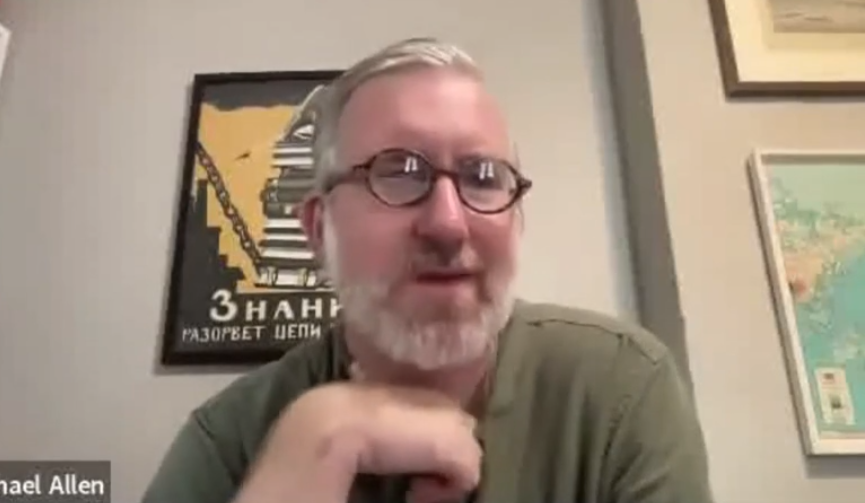
For the past two decades, Michael Allen was synonymous with historical preservation in our city. Beyond his professional notoriety among urbanists, he was also well known in local political circles. For many St. Louisans, Michael entered their consciousness with his online reporting about a mysterious company called “Blairmont” that was buying up lots of property in St. Louis Place and Old North St. Louis. The research behind his writing on Blairmont eventually led to the uncovering of Paul McKee’s plot to establish what we now know as Northside Regeneration, which is currently embroiled in seemingly endless legal battles with the city. In the years since his 2005 article on the mystery of Blairmont, Mr. Allen continued to advocate for neighbors and neighborhoods on the near northside, long after he had moved elsewhere. He also remained a fixture in local politics and was often asked to participate in hosting debates between candidates for various city offices.
In recent years, Michael had moved to the Dutchtown neighborhood. He was also continuing and expanding his historical preservation work. Not only had he taken the helm as Executive Director of the National Building Arts Center, Michael had also been teaching a new generation of students in his classes at Washington University in St. Louis. These turned out to be short-lived positions, as controversy at his teaching position and the desire to advance his academic career made it clear that it was time for him to pursue work outside of our metropolitan region. This past summer, Michael said goodbye to St. Louis and made his way to West Virginia. There, he has taken up a new teaching position and shifted his focus more towards advancing his academic career. Thankfully, Michael agreed to do an “exit interview” with the Mound City Messenger. The full interview lasted well over an hour and covered topics ranging from the city’s population losses, to his unfinished projects in St. Louis and the future of the area around the soon-to-be completed NGA facility. Due to the length of the discussion, we have excerpted clips that we think readers will be most interested in listening to and about topics closest to his heart. We’ve also included portions about what he thinks of his newfound home and how it compares to St. Louis.
While Michael’s life has now taken him eastward, he is not writing off the potential of a St. Louis return at some point in the future. As is apparent in the videos, Michael still has many connections to the St. Louis region and projects that will keep him connected to us. In fact, we hope to publish articles from Michael in the future! We hope those who have long followed Michael’s work in St. Louis enjoy this open and frank discussion about living in, and then deciding to leave St. Louis.
—
In this first clip we discuss Michael’s unfinished work here in the St. Louis region. These include following up the National Building Arts Center’s successful exhibit at the Pulitzer Museum with the installation of a permanent exhibit at the Sauget, IL institution and the potential for a book on the past and future of St. Louis’ built environment.
From there, we turned to a discussion about his proudest achievements in local historical preservation and the architectural losses that he found to be the hardest. We discuss the specific buildings he is most proud of having helped save, as well as the loss that hurt the most.
Speaking of architectural losses, we discussed which St. Louis neighborhoods he sees as having the greatest amount of recent demolitions and how that relates to the recent increases in the rate of Black St. Louisans leaving the city. Michael also touches on what he sees as the community development field’s changing attitude toward demolition as a development tool.
With the NGA on the verge of completion, we discuss what Michael sees as the probable future for the area around the large federal installation that stands where homes did only a decade ago. Will there be new housing? Retail? Michael shares his thoughts on the kinds of developments that he views as most likely to sprout in the surrounding blocks.
In this clip, we discuss the city government’s generalized dysfunction and how regional Black political power has been shifting for the past 20 years.
Michael and I discuss what he thinks about Downtown West’s reinvention as a family entertainment hub and whether it will be sustainable and successful. We also discuss the past and future redevelopments of the Old Post Office building and how a stagnant regional population means that subsidized development in Midtown has been pulling business away from other neighborhoods.
Finally, we directly discuss why Michael chose to leave St. Louis for a public university in West Virginia and how he likes his new job and community.


