
Downtown Does Not Need a New Curfew, But a New Plan
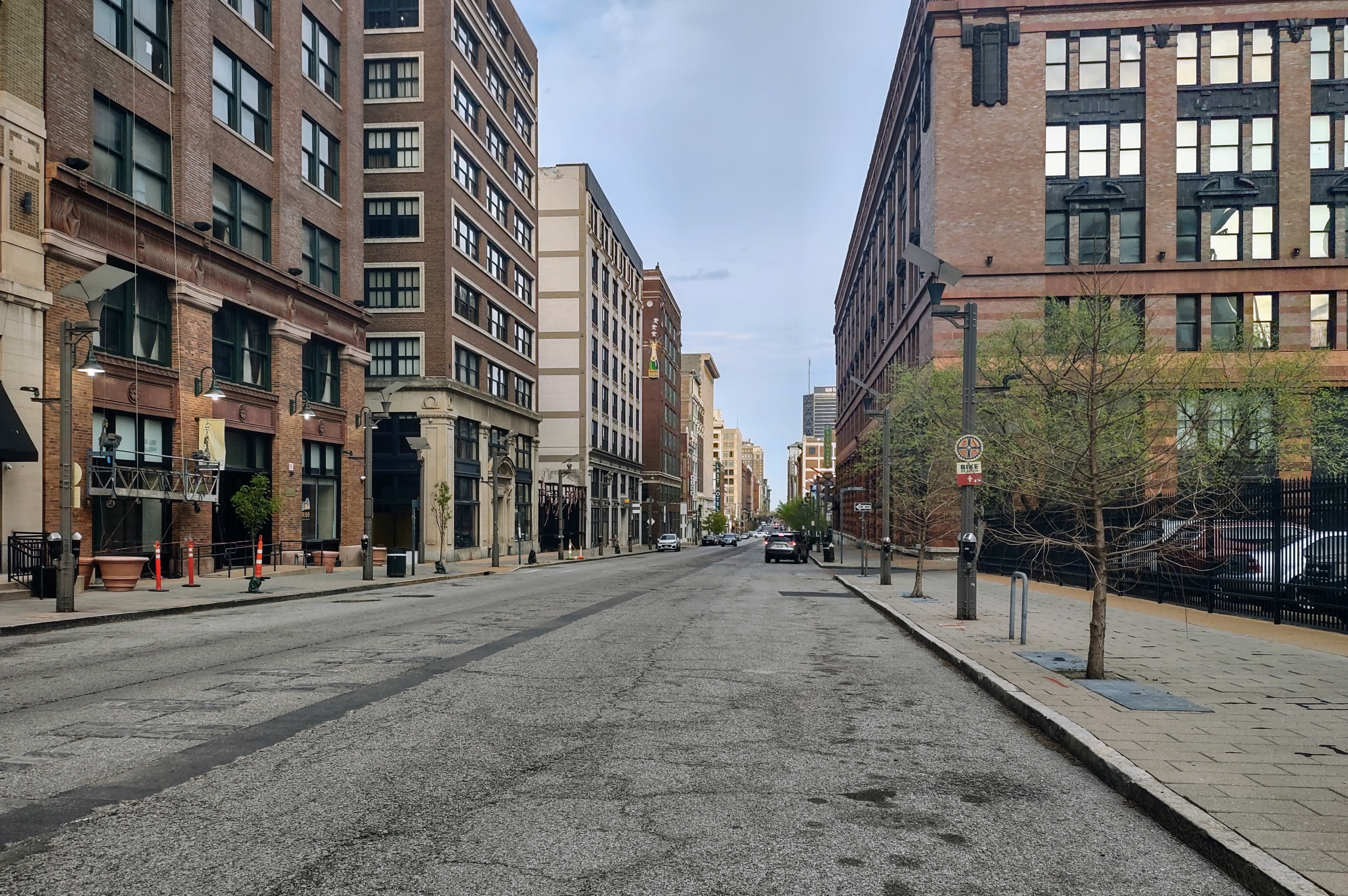
The recent temporary 10:00pm-5:00am downtown curfew by the St. Louis Metropolitan Police Department under Mayor Cara Spencer led to the detention of 23 people under the age of 18 and much public debate following implementation from March 20 through March 22. The existing downtown curfew for people under 18 years old is 11:59pm-5:00am. The curfew revisits earlier debates about the use of the city by youth after hours and also reveals a rather cynical view of downtown’s built environment. Implemented only downtown for the NCAA Men’s Basketball Tournament at Enterprise Center, despite a wave of nighttime disturbances more pronounced in other parts of the city, the curfew suggests that city leaders understand that the streets of downtown are an empty social canvas at night. (One exception: the popular late-night street vendors now facing shutdown from the city.)
Indeed, the city is just an emptier place altogether. The city has about 279,000 residents now, fallen from a peak of 856,000 in 1950. Yet the metropolitan population remains consistently around 2.8 million people. It is not surprising that the youth of the boring suburbs would want to come explore the hollowed core of the old city, especially since downtown becomes so dead at night that the streets seem completely up for grabs.
Decades of hollowing out downtown for automobile parking have led to a built environment dominated by surface parking lots and garages, underused parks, buildings fortified on their ground floors, overwide city streets, and temples of sporting events and conventions used only some days out of each year. Pockets of storefront activity are scattered. Downtown’s leadership has avoided cohesive experiential planning in favor of a spoils system of deal-making and consultant-padding. The fruits of these deals are more likely to be found in second homes and gourmet meals enjoyed in Ladue than in the quality of downtown as a social setting.
Of course, St. Louis found itself roiled by similar matters even when its population was larger and when downtown hosted many Fortune 500 corporate headquarters. In September 1991, when the city had 396,685 residents (per the 1990 Census), youth behavior on the streets became the subject of new curfew rules. As the murder rate had already hit 175 people – and would reach 260 people by the end of the year – Mayor Vincent Schoemehl and Police Chief Clarence Harmon announced measures to curb the rule of unruly youth.
A new curfew for persons under 17 years old would be set between 11:00pm and 5:00am Sunday through Thursday, with youths being allowed to stay out until midnight on Fridays and Saturdays. The existing citywide curfew for youth (midnight until 5:00am) was being enforced in a spotty manner, claimed Harmon. Harmon touted the department’s Street Corner Apprehension Team (SCAT), a “Broken Windows”-style apparatus designed to target gatherings of youth deemed likely to commit violent crimes, especially murder.
Schoemehl endorsed the new curfew and anti-crime measures, but added some possibilities that seem missing from the 2026 debate on youth curfews. First, the mayor proposed a crisis intervention hotline so that people could report suspicions of a youth likely to perpetrate a murder without going directly to the police. The idea still carried major civil liberties problems, as facilitating anonymous complaints against anyone of any age, making them more likely to be arrested, raises an obvious potential for abuse. Schoemehl added that he wanted the police to hire social workers at the three regional police districts and also hire social workers for high-risk neighborhoods.
That same year, the Laclede’s Landing Redevelopment Corporation, led by Thomas Purcell, pushed the Board of Aldermen to adopt an ordinance banning anyone under the age of 21 from the Landing after midnight. Then 3rd Ward Alderman Freeman Bosley, Sr. told a reporter, “I think that this bill is kind of racist.” Bosley saw that the law would mostly be used to move Black youth off the streets of the Landing, which was then a hot nightlife district (younger readers may be quite surprised). Young people could not get access to the alcohol-slinging bars and nightclubs, but may have wanted to be around the action and general festive atmosphere. This is sort of the reverse of downtown’s current issue, where the lack of action is making the streets seem like a playground. In 1991, young people wanted to draw near the excitement of activity.
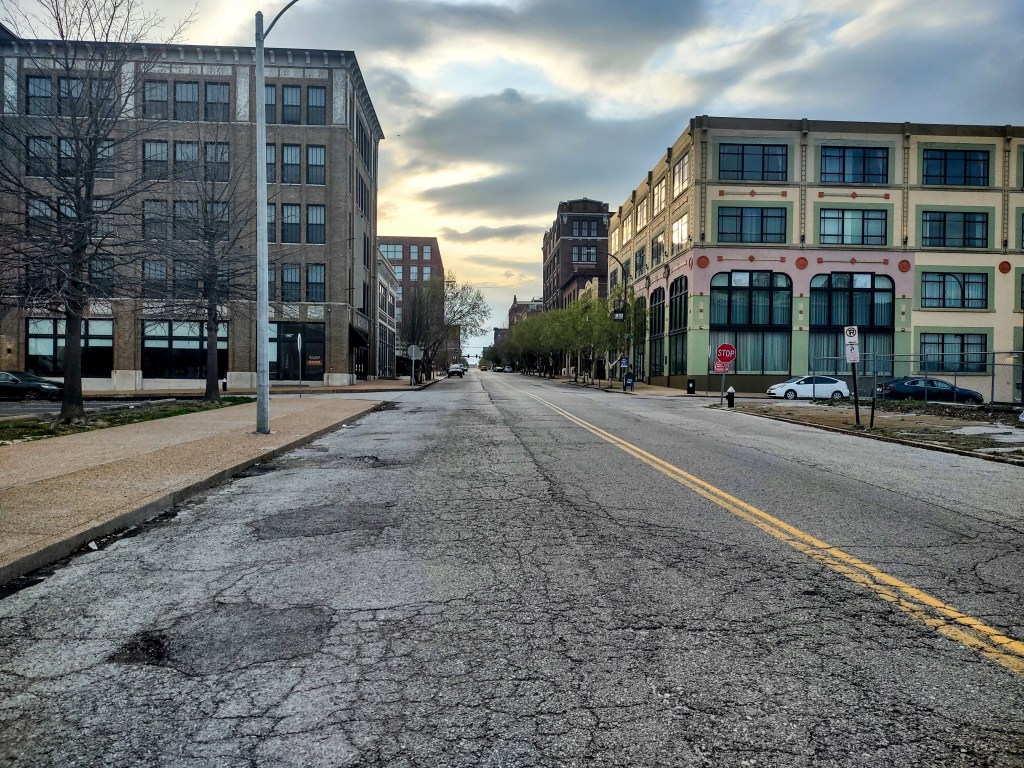
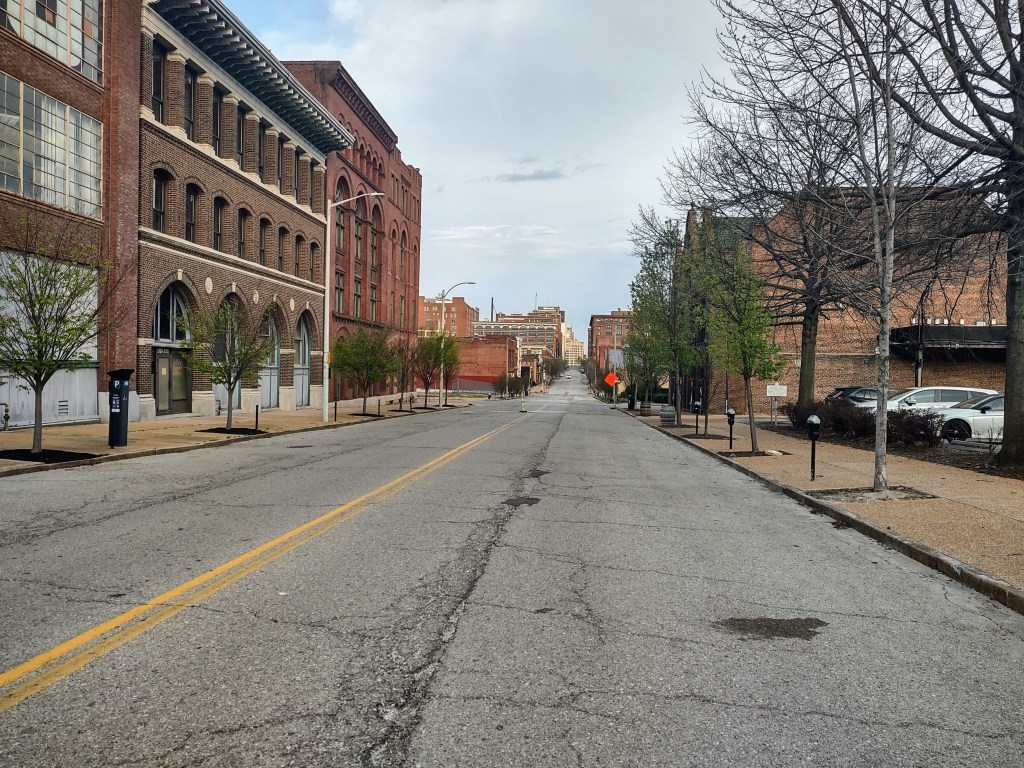
Views looking west and east from 21st and Locust, near City Park, on Tuesday evening. Photo by Glenn Burleigh
Harmon called the Landing curfew “modest, common sense,” and Schoemehl made it clear that he would support the bill. The Board of Aldermen split on the issue, but passed the bill in September 1991. The vote was 16-12 after it cleared the Public Safety Committee with 5-1 support. 21st Ward Alderman Willie Williams was the only Black alderman to support the bill, while white aldermen Steve Conway (D-8th) and Dan McGuire (D-28th) were the only white aldermen to oppose it. (Future mayor and then-alderman Francis Slay was absent.)
These curfew measures did not curb St. Louis’s soaring homicide numbers, which dropped from 260 in 1991 to 231 in 1992, only to rise to 267 in 1993 and 248 in 1994. The city’s homicides would not fall below 200 until 1996. When the city recorded 73 homicides in 2003, the national trend was toward a major drop in urban violence. Numbers ascended again, then dropped under Mayor Tishaura Jones. Thirty years later, the city’s rise and fall again mirrored national urban trends and did not demonstrate much impact of local policies.
Notably, Jones also turned to adjusting curfew laws downtown, similar to Spencer. In June 2021, Jones’ administration imposed an electric scooter curfew from 9:00pm-8:00am following allegations of teen scooter “swarming.” In September 2021, Jones began strict enforcement of the 11:59pm curfew time, including arrests and penalties incurred by the youths. Spencer has instead targeted parents for penalties. Jones’ strict enforcement incurred a rebuke signed by many activist groups whose leaders had supported her election, including Action St. Louis. Following a shooting at a downtown party in June 2023, Jones told reporters that “[d]owntown is not a 1:00am destination for a 15 year old…” Mayor Jones later imposed a 10:00pm curfew around City Hall to banish homeless campers in October 2023.
City leaders created a downtown perfect for the investment schemes of people uninterested in the quality of social life. Some of the animosity toward downtown’s streetscapes came when many of the users of downtown were Black residents of adjacent public housing complexes, most of whom were youth. This was especially true from the 1960s into the 1990s. Consequently, downtown was further fine-tuned for the speeding automobile, which degraded the environment as a place where pedestrians want to spend much time.
The lack of economic and social activity in downtown clearly indicates that the proverbial chickens are home to roost for those who destroyed downtown rather than let it become an integrated hub for all people. Curfews won’t save the district, or even impact crime statistics. A better next step than more curfews would be a gathering of everyone who uses downtown, including teenagers who come to play at night, and the crafting of a master plan that incorporates what its actual users – not its politically-connected overlords and their urban design and planning consultants – want. I would bet very firmly that the teenagers wish there were more to do downtown than come at night to drive donuts in empty streets, surrounded by fenced parking lots and empty overwrought plazas.


