
ICE in St. Louis: We Must Protect Our Neighbors
By Alicia Hernandez
Over a week ago, Renee Nicole Good, 37, was killed by ICE agents in Minneapolis. The officer involved has not been arrested, and the city of Minneapolis continues to face federal occupation and disruption.
Good’s death is the culmination of President Trump’s deportation agenda, which not only affects immigrant families, but whole cities. Children miss school, small businesses are forced to close, workplaces struggle to find staff, and restaurants have fewer customers. Good’s killing shows that legal observers and those who resist the Trump administration’s deportation agenda have reason to fear being murdered in the street by armed men in military gear, shot through the front windshield for the crime of noncompliance.
Immigration issues are often used to stir up fear, which captures voters’ attention and distracts us from bigger issues. The most vulnerable become political pawns for electoral gain, even though data continues to show immigrants don’t increase crime. The Trump administration’s mass deportation agenda focuses on fear, speed, and numbers, rather than safety, due process, and human life. This inevitably leads to more violence and disruption.
Renee Nicole Good was different from many who face state violence; she was a white U.S. citizen. Good was not the typical ICE target, and she lost her life because she chose not to stand by while her neighbors were attacked. Good supported her community and did not have to take a side. But she did. We often say solidarity is an action, and Renne Nicole Good showed solidarity by using her rights to document police activity and speaking up against ICE brutality.
In Midwestern cities, like our own, we are seeing the murderous consequences of an irrational agenda. Trump’s immigration crackdown is an attack on our communities. Homes are being raided, families are being separated, due process is ignored, and legal U.S. citizens are being detained alongside those who are labeled “illegal.”
Undocumented and even some immigrant workers lack many protections afforded to documented counterparts, which makes them easy to exploit and blame for economic problems. The label “illegal” is political, not moral. It was defined by The Immigration Act of 1924, and it exists to benefit those who make money from immigrant labor. Law enforcement and private prison companies are all part of this system, which is not broken; it is working as intended. The goal is to keep working families underpaid, threatened, and under control.
That is why activists and leaders in the Migrant & Immigrant Community Action (MICA) Project are talking to workers about leveraging their power to build safe workplaces. Workplace Preparedness Planning is a strategy to uphold the Fourth Amendment and reduce the risk of unconstitutional entry by federal agents.
MICA activists encourage workers to understand their rights in the event of an unexpected visit by law enforcement. Federal agents are intimidating. They carry military-style weapons while we carry whistles. It is important that regular people stay alert, brave, and use tools like the ICE Rapid Response Line (314-370-7080), and the S.A.L.U.T.E. method to collect key information. Size: How many agents are present? Activity: What are they doing? Location: Where are they? What uniforms are they wearing? What time is it, and what equipment or weapons are they carrying?
In the St. Louis region, most immigrant arrests and detentions are happening after contact with police. In Missouri, 89% of detentions start with a traffic stop. These tactics are disruptive to everyday life and put families in serious danger. Local police have become the arm of Trump’s deportation machine, but no police departments in St. Louis County are required to work with ICE under the 287(g) agreements.
What is 287(g)? It is a program allowing state and local agencies to act as immigration enforcement agents. Through agreements with ICE, which usually involve the county sheriff’s offices, select officers are given the power to enforce immigration laws. These agreements strengthen the Trump administration’s deportation agenda by deputizing local agencies to do ICE’s work. They often lead to increased racial profiling, civil rights violations, the isolation of immigrant communities, and more family separations. Since early 2025, 23 police or sheriff’s departments in our state have signed these agreements. Missouri had none until last year.
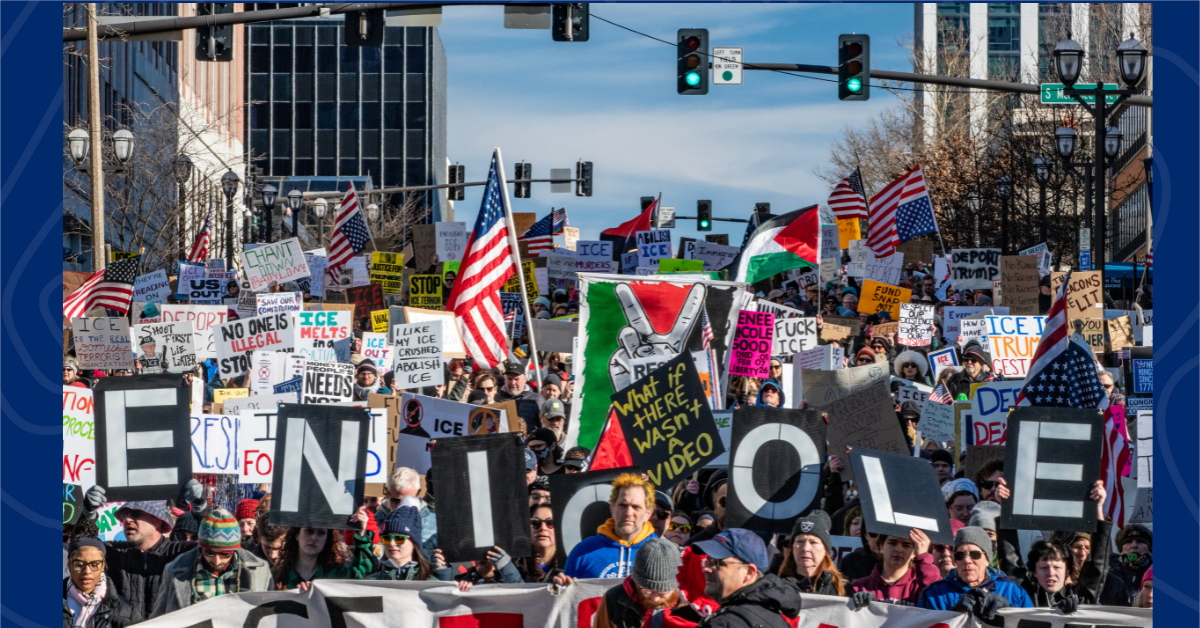
Legal efforts to stop these raids have mostly failed. How are workers and communities responding? We must focus on a vision beyond the slogan of “Abolish ICE,” starting locally. Local criminal justice reforms will help lower deportation rates. Fewer people in jail means fewer people for ICE to detain. Local actions will not stop every deportation, but we can and must take concrete steps to build real power and protect each other.
The legacy of Renee Nicole Good lives on through the work of rapid responders, activists, organizers, and community builders. Across the country, responders train to support each other and stand up to fear, carrying on a long tradition of organizing for freedom and civil rights. Renee Nicole Good did her part by warning neighbors about federal agent activity. Building a mass movement will mean millions of people will need to act as bravely as she did.
Activists do not need every answer before sharing a vision for a better world. We are not starting from scratch. Some strategies are already working. To transform inspiration into action, join a rapid-response training and canvass your neighborhood to talk to workplaces and neighbors about our rights. Then take it a step further and plan for community defense to protect yourself, your schools, and neighbors in case of a raid. We know what ICE has done, and we know how to fight back.
You’ve seen the fear ICE creates. You’ve also seen the power in organizing and coming together.

Alicia Hernandez is the Advocacy Director for the MICA Project in St. Louis. She is helping to coordinate the local community response to ICE activities in the region.


