
Demographic Change And The 2025 Mayoral Race: The Elephant In The Room

Pictures from candidates’ campaign websites
In recent years, the city’s demographics have shifted significantly, with a growing white plurality and a decline in the Black population. According to the 2020 census, whites slightly outnumbered Blacks. At that time, the city had 46.4% white residents and 45.7% Black residents. However, the most recent American Community Survey estimates show the white population at 45.9%, a small decline, while the Black population dropped to 40.5%. This represents a loss of about 12,00 white residents and 25,000 Black residents. Meanwhile, the city’s Asian and Latino populations have both grown as a percentage of the city’s population. This is somewhat of an illusion, as Asian population numbers have also slightly declined, just slower than the Black and white population. The only racial group to show an increase of over 1,000 residents was the Latino population. Overall, the city’s complexion is getting more diverse, but the continuing decline in Black population means that the city’s political arithmetic is changing in a way that doesn’t necessarily benefit non-white candidates.
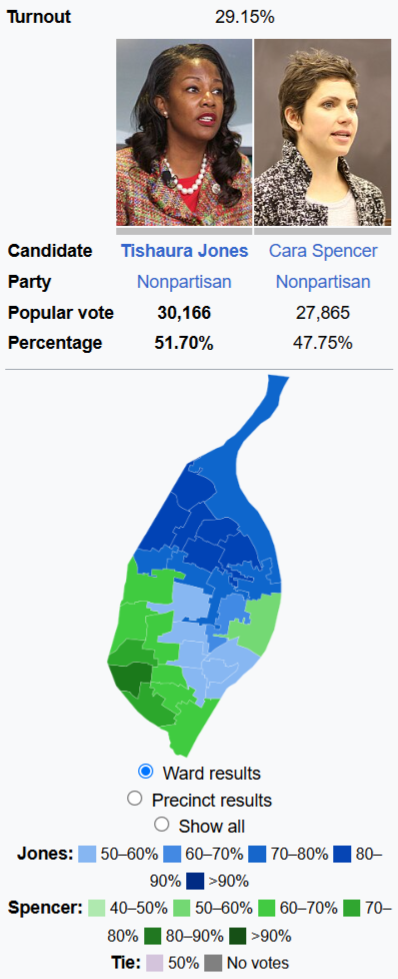
As the mayoral election approaches, these demographic changes are crucial to understanding the 2025 municipal election. In a city where racial polarization often influences voting trends, ignoring these shifts could lead to a significant misunderstanding of the city’s current electoral dynamics. This is not to say that voters only choose candidates that match their personal demography. Voters have shown a willingness to vote against racial trends—Mayor Jones’ success in past elections was partly due to strong support from white, college-educated voters in gentrifying neighborhoods like those surrounding Tower Grove Park. From Mayor Jones’ perspective, the large turnout from these neighborhoods has been an important counterweight to the continued strong turnout from the city’s southwestern neighborhoods. As vote totals to the north have declined, success with these voters has been key to Jones’ success.
At the same time, many people in these neighborhoods, who previously voted for Jones, are now considering casting their ballots for Spencer. Unfortunately for Recorder of Deeds Butler, his outsider campaign doesn’t yet seem to be gaining traction with these voters. Among some of these very liberal white voters, there is a sense of profound disappointment that the Jones administration hasn’t delivered on the “transformative” change they were told to expect. Developers still get pretty much any tax incentive they seek, and the city’s jail still seems to be an inhumane and violent mess. The things that have changed haven’t necessarily been for the better, either. The city’s aging street and underground infrastructure are showing the limits of deferred maintenance, leading to a visceral sense that things are breaking down.
Losing a portion of liberal, near-southside voters wouldn’t be fatal to Jones’ reelection effort, but combined with the decline in Black population, it narrows her path to victory. While not every Black voter who moved would have cast a ballot for mayor Jones, it’s hard to lose roughly 25,000 people from a core supporter demographic and not see a decrease in vote total. Essentially, the mayor faces a situation where she faces erosion among both of her core constituent groups: Black voters and very liberal transplants. Meanwhile, Spencer’s whiter base has shrunk by significantly less. Voters can be sure that the campaigns are keenly aware of these trends and how they will impact this spring’s race.

An unknown factor is the votes and funding that will come from the city’s growing Latino population. As the only demographic showing significant growth, trends among these voters will likely be increasingly key to victories at the citywide level. Will Spencer’s time as alderman of Cherokee’s business district translate into relationships and votes from the city’s growing Latino population? It could be a factor in a close race. Similarly, while the city hasn’t seen a boost in its overall Asian population, the mayor has received notable financial support from Indian-Americans. Indian-Americans are a growing portion of our region’s demographic makeup and also stand to play an increasingly important role in the city’s political future. It is also important to note that the number of St. Louisans who identify as multiracial have increased significantly, going from 3.1% of the city’s 2020 population to 7.7% as of the last available survey. It is unclear how much this represents new residents, as opposed to representing a growing comfort with choosing multiracial options on census forms.
All in all, the spring mayoral election will likely hinge on many of the same racial fault lines that have long dominated the city’s political discussion. If the saying “demography is destiny” holds true in the spring (and if post-#Ferguson cross-racial voting trends are fading), then Mayor Jones’ re-election effort faces significant headwinds from changing demographics.
UPDATE: The following disclosure was omitted at the time of initial publication. The article was also updated to note the increase in St. Louisans who identify as multiracial.
Disclosure: Author has worked for both Recorder of Deeds Michael Butler and Alderman Cara Spencer on past campaigns.


